

How to Prevent Theft in Salons & Spas: 24 Smart Ways to Protect Your Business

Introduction
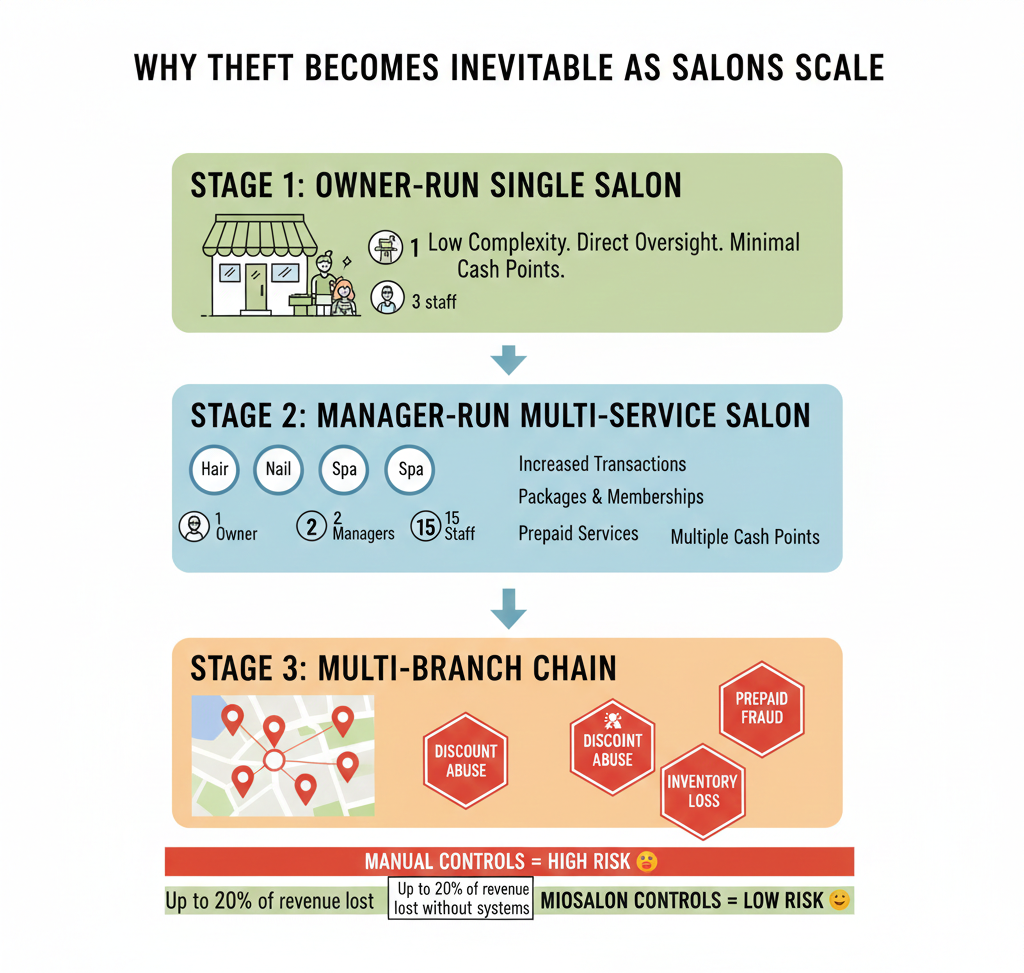
Across 15+ years of consulting for growing salons, spas, and aesthetic clinics, one pattern keeps repeating, revenue leaks begin not because owners are more ethical, but because the business shifts from direct control to delegated trust. Once you move into a manager-run setup or expand into multiple branches, you start depending on people, paper trails, and fragmented systems instead of structured controls.
If you’re trying to understand how to prevent theft in salons, start by accepting this uncomfortable reality: if your operations rely on cash transactions, manual billing, paper registers, or unrestricted access to discounts and data, theft isn’t a rare event; it’s a built-in operational loss.
The numbers back this up. Businesses lose roughly 20% of their revenue to workplace theft and fraud, and nearly 60% of inventory shrinkage in retail comes from employees. At the same time, the wellness and spa industry is booming. Global spa revenues have surpassed pre-pandemic levels and are projected to cross $150 billion by the end of the decade. Growth doesn’t just bring more customers, it also creates more opportunities for internal fraud.
When analyzing MioSalon client data across different markets, a clear pattern emerges: once a salon crosses a certain revenue threshold, “creative theft” starts appearing, discount abuse, cash skimming, silent service manipulation, and misuse of prepaid packages or memberships.
In commission-driven environments, especially in hair and nail salons, the risk increases further. Staff not only have access to transactions but also financial incentives to exploit system gaps if there are no controls in place. As your team grows, your service menu expands, and your branches multiply, manual tracking becomes ineffective. At that scale, preventing theft isn’t about trust; it’s about systems.
Table of Contents :
- Theft 1: Downloading Customer Details Before Resigning
- Theft 2: Editing Bills to Reduce Value After Cash Collection
- Theft 3: Cancelling Bills After Cash Collection
- Theft 4: Diverting High-Value Bridal and Home Appointments
- Theft 5: No-Bill or Paper-Only Billing (Cash Pocketing)
- Theft 6: Stealing Prepaid Value by Redeeming Other Customers’ Balances
- Theft 7: Stealing Package Credits by Redeeming from Other Customers’ Packages
- Theft 8: Abusing Membership Discounts via Fake or Edited Memberships
- Theft 9: Downloading Financial Data from Home and Using It for Planning Theft
- Theft 10: Creating Custom Packages at Unrealistic Prices and Deleting the Master
- Theft 11: Custom Prepaid with High Bonus, Low Sale Price, Sold to Friends
- Theft 12: Large Package Sold to Friend, Then Redeemed Against Regular Clients’ Visit
- Theft 13: Billing a Low-Value Service Instead of the High-Value Service Actually Taken
- Theft 14: Selling Products to Clients but Marking Them as Internal Consumption
- Theft 15: Redeeming Unused Gift Vouchers Against Other Customers
- Theft 16: Redeeming Reward Points Against Other Customers
- Theft 17: Deep Discounts on Cash Bills and Pocketing the Difference
- Theft 18: Under-Valuing Duration-Based Services (Recording Less Time Than Delivered)
- Theft 19: Turning Off Notifications, Then Editing or Cancelling Bills
- Theft 20: Printing Duplicate Copies of Existing Bills and Handing Them to Other Clients
- Theft 21: Adding Fake Expenses to Past (Already Audited) Dates
- Theft 22: Creating Backdated Bills to Look Genuine, Then Cancelling Them Later
- Theft 23: Viewing and Extracting Customer Phone Numbers for Future Poaching
- Theft 24: Online Appointment Spam to Block Staff Calendars
The structural problem: managers, trust, and scale
A single‑branch owner‑operated hair salon can survive with a basic POS and a lot of personal oversight. You see every client, collect every payment, and sense any irregularity quickly. But the moment you:
- Open a second or third location.
- Add specialized verticals (bridal, nail bars, tanning, skin clinic, massage, med‑spa).
- Hire a full‑time manager and a team of stylists, therapists, and front‑desk staff.
Your risk profile changes completely.
You cannot be everywhere. You cannot watch every bill, every edit, every cancellation, every prepaid redemption, and every “exception” discount. Even if you tried, human attention is not designed to detect patterns across thousands of line items per month.
At scale, theft hides in the gaps:
- Gaps between what the client thinks they paid and what is recorded.
- Gaps between prepaid, package, and membership liabilities and actual redemption.
- Gaps between reported consumption of products and what is actually left on the shelf.
- Gaps between who should access sensitive data and who actually does.
Traditional trust‑based management fails because it is reactive. Owners notice only when cash shortages become obvious, when a “star” employee suddenly opens a competing salon with suspiciously familiar clients, or when stock variance becomes too large to ignore. By then, months or even years of damage are already done.
Why technology, not policing, is the real answer
The instinctive reaction from many salon owners is to “tighten discipline”:
- Hire only “known” or “loyal” staff.
- Implement more manual checks.
- Hold frequent cash‑count meetings.
This approach feels comforting, but it doesn’t scale. Global employee theft data shows dishonest employees and internal fraud continue to rise despite such policies, with organizations reporting average shrink rates around 1.6% and rising. Manual controls are brittle, inconsistent, and easily bypassed by someone who understands how your processes work.
A better answer is systemic: you redesign your operations so that:
- Sensitive actions are technically impossible for the wrong people.
- Every exception is logged, highlighted, and optionally requires approval.
- Customers themselves become a guardrail through transparent digital communication.
- You have an always‑on audit trail instead of occasional spot‑checks.
This is where modern salon management software like MioSalon becomes non‑negotiable. It is not “just a billing tool” or “just appointment software.”
It is your embedded control system for:
Hair salon software: Controlling service billing, stylist performance, and commission‑linked fraud.
Nail salon software: Preventing no‑bill services, duplicate receipts, and stock shrinkage in fast‑turnover nail bars.
Bridal salon software: Securing high‑value home visits, group bookings, and event packages from offline diversions.
Massage software and spa software: Mapping therapist schedules, duration‑based billing, and product consumption.
Tanning salon software and skin clinic software: Tracking packages, high‑value medical‑grade treatments, and liability credits.
Barbershop software and beauty salon software: Simplifying daily operations while restricting edit, cancel, and discount abuse.
Aesthetic clinic software: Adding an extra layer of compliance, documentation, and financial traceability on quasi‑medical services.
A robust platform like MioSalon lets managers operate freely within clear boundaries, while owners retain invisible but absolute control: access permissions, OTP‑based approvals, device‑level restrictions, anomaly reports, and customer‑facing notifications that make silent fraud extremely hard to execute repeatedly.
According to a 2024 wellness sector overview, the spa and wellness market is on a steady growth path, with industry revenues recovering to above pre‑pandemic levels and projected to grow faster than 4% annually in the near term. This growth means more money flowing through your front desk. Without the right software‑based controls, a percentage of that money will quietly leak out through internal theft—whether you like it or not. globalwellnessinstitute
In the next sections, we’ll break down 24 specific “creative thefts” that I see repeatedly in salons and spas across markets, and how MioSalon is engineered to block or drastically limit each one. Treat each theft as a separate risk to be designed out of your system, not as a moral failure of individuals.
Theft 1: Downloading Customer Details Before Resigning
What is this Salon theft, and why is it dangerous?
In high‑performing salons and spas, senior stylists, therapists, or managers build strong, multi‑year relationships with clients. Over time, they become the “face” of your brand to those guests. When staff churn happens—and it will, especially in growing markets where skilled professionals open their own spaces—one of the most common abuses of access is silent customer data extraction.
Typical pattern:
- A senior stylist or manager decides to resign and start a competing salon or join a nearby competitor.
- In the months before leaving, they steadily build closer relationships with a subset of high‑value clients.
- Using their access to your salon software or CRM, they export or manually copy client names, phone numbers, email addresses, preferences, and visit histories.
- After resigning, they launch targeted outreach: personal WhatsApp messages, calls, or DMs that reference past services, preferences, and even past issues (“I know you love keratin every 4 months, I’ll give you the same at my new place for 20% less.”).
Because this theft targets your Client Lifetime Value (LTV) engine rather than today’s cash, it often goes unnoticed in financial reports. You simply see a slow drift in visits and pre‑booking ratios for certain staff segments or service categories over the next 3–6 months, and attribute it to “market conditions” or “seasonality.”
Real‑world illustration
In one multi‑branch beauty salon chain I worked with, a star senior stylist managed to export over 1,200 client contacts over a 4‑month period before he left. He had legitimate access to customer profiles in their legacy hair salon software, which had weak access controls and no masking of phone numbers.
After opening his own studio 2 km away, he:
- Sent personalized SMS and WhatsApp messages referencing specific services (“Your balayage is due next month; I can do it at my new salon with a loyalty price.”).
- Offered transfer of prepaid balances and packages with “bonus sessions.”
- Used customer visit frequency to prioritize outreach (top 20% of frequent, high‑spend guests first).
Within six months, the parent salon noticed:
- A 22% drop in visits for that stylist’s prior segment.
- Lower utilization for high‑margin services like color corrections and smoothing.
- Erosion of bridal trial conversions, as he had taken many bride‑to‑be contacts.
They initially blamed “competition” and “macro slowdown.” Only after moving to MioSalon and analyzing historical patterns did we connect the dots.
This pattern is not unique to hair. The same thing happens in:
- Nail studios (techs move and take gel and nail art clients with them).
- Bridal and makeup lounges (artists take brides and bridal party groups).
- Skin clinics and aesthetic clinics (therapists or doctors take injectable and laser clients).
- Spa and massage centers (therapists move to competitors or independent practice).
Anywhere client relationships are personal, data theft equals LTV theft.
Potential monthly loss estimate
Let’s quantify conservatively:
- Assume your salon has 2,000 active clients.
- One senior staff member builds deep relationships with 200 of them (10%).
- Average ticket per visit across segments (hair, nail, spa) is 3,000 INR, with an average of 1.2 visits per month.
- So each such client yields roughly 3,600 INR/month in revenue.
If 25% of those 200 clients (50 people) quietly follow the staff member to their new place after that staff leaves:
- Monthly revenue lost = 50 clients × 3,600 INR = 180,000 INR/month.
- Annually, that’s over 2.1 million INR in revenue at risk, for just one staff exit.
In more premium clinics or bridal salons, similar leakages easily exceed 300,000–500,000 INR per month, especially when higher‑priced aesthetic or bridal packages are involved.
Given that the global hair and nail salon industry in markets like the US alone generates tens of billions of dollars annually, even low‑single‑digit percentage leakages from client poaching translate into significant absolute losses for individual businesses. marketresearch
How MioSalon blocks or limits this theft
The answer is not “never give managers access to data.” A growing business needs managers and senior staff to:
- Analyze churn.
- Run targeted campaigns.
- Review membership and prepaid utilization.
- Manage yield on high‑demand slots.
The answer is granular access control and smart masking within your salon management software:
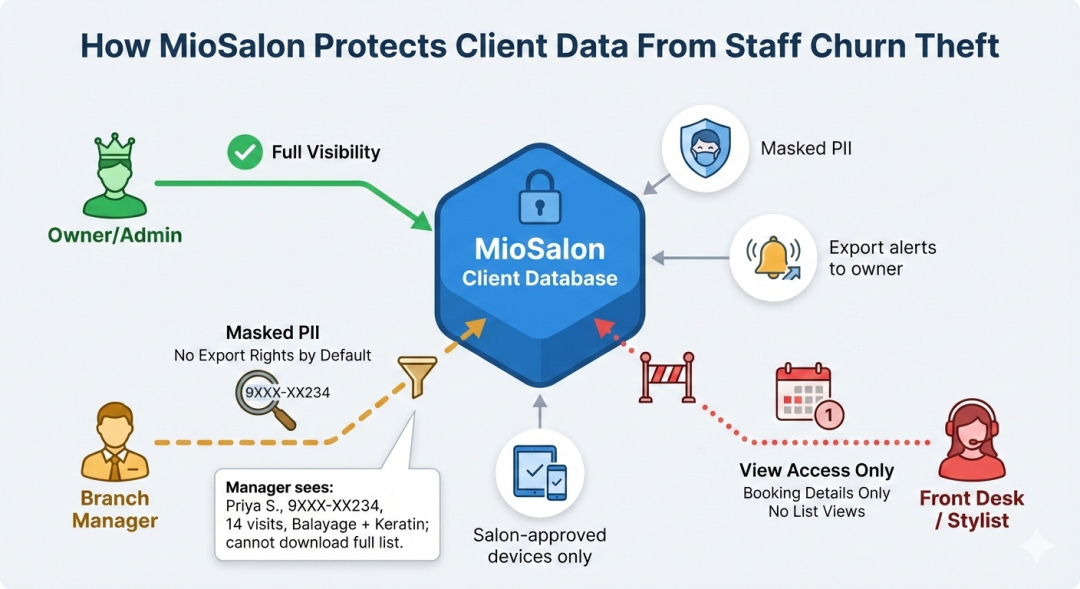
1. Role‑based access with masked contact details
- Managers can view customer names, service histories, bill values, visit frequencies, and segmentation tags.
- Phone numbers and email IDs are partially masked (e.g., 9XXX‑XX234) on all screens, exports, and reports.
- Only the owner (or a very small set of trusted admin roles) can see full contact details.
2. This lets managers perform all analytics and operational tasks (e.g., churn analysis, pre‑booking campaigns) without being able to copy usable raw contact data at scale.
3. Download and export permissions with alerts
MioSalon allows owners to decide who can export data at all.
When exports are allowed (for genuine reasons like migrating from another bridal salon software or generating a backup), every export triggers an immediate alert to the owner, with:
- Who exported.
- What segment or report was exported.
- When and from which device.
4. Owners can investigate any unusual export (e.g., “Why did the branch manager export all active VIP clients last night at 10:30 PM?”).
5. Device‑level restrictions
- Access to sensitive reports and exports can be limited to salon‑approved devices (reception system, office PC).
- Logging in from a personal laptop or home PC may be blocked or restricted to minimal access (e.g., only viewable dashboards, not detailed CSV downloads).
6. Customer‑initiated engagement instead of raw lists
- Rather than handing over raw data, MioSalon enables controlled marketing campaigns (SMS, WhatsApp, email) directly from the platform.
- Managers can filter segments (e.g., “clients not visited in 60 days,” “bridal trial completed but no booking”) and send campaigns without ever seeing or exporting full raw lists.
- This is particularly important for multi‑speciality businesses using MioSalon as bridal salon software, nail salon software, spa software, or aesthetic clinic software, where client sensitivity is higher.
Taken together, these controls do two things:
- Reduce the chance that staff can leave with a usable client database.
- Make any large‑scale data export highly visible, traceable, and therefore risky for the potential thief.
👉 Protect your client relationships before they leak—switch to MioSalon’s salon Booking software with granular access controls and real-time export alerts.
Theft 2: Editing Bills to Reduce Value After Cash Collection
How this theft works
This is one of the oldest fraud patterns in cash‑heavy salons and barbershops: the staff charges the client correctly, hands over a seemingly valid bill or digital message, and then quietly edits the bill in the system to reduce its value.
Typical flow:
1. Client takes service worth 2,000 INR.
2. Front desk or stylist:
- Creates a bill for 2,000 INR.
- Shows the screen or prints the invoice.
- Collects 2,000 INR in cash.
3. After the client leaves, the staff:
- Edits the bill and changes service values or discounts so that final recorded bill shows 1,200 INR.
- Sometimes they change service codes (e.g., record “basic haircut” instead of “keratin”).
4. Staff pockets the 800 INR difference.
In systems with weak control, they can do this across dozens of bills per month, especially where:
- Customers rarely ask for invoices.
- Digital invoices or notifications are not enabled.
- Owners do not regularly review edit logs or abnormal discount behavior.
This pattern is common across:
- Hair salons and barbershops using older barbershop software without proper editing restrictions.
- Nail salons with fast turnover and many small bills (where owners assume individual differences are “too small to matter”).
- Spas and massage centers where tourists or one‑time clients are less likely to complain.
- Tanning salons or skin clinics that offer duration‑based or package add‑ons.
Real‑world illustration
A mid‑size unisex salon I advised had a strong walk‑in base and high cash volumes. They were using a basic billing POS, not a specialized salon software, and allowed managers unrestricted “edit” rights to “help customers” (e.g., last‑minute discount requests, incorrect service selection).
One manager regularly:
- Generated the full bill at the correct amount.
- Collected cash.
- Waited a few hours or till end of day.
- Edited the bill, often converting premium services into basic ones or adding large “manual discounts” that brought bills closer to “popular price points” (e.g., 999, 1499).
- Pocketed the difference.
Over a 3‑month audit, we discovered:
- More than 70% of their high‑ticket bills (above 3,000 INR) had been edited within 12 hours of creation.
- Many edited bills showed high discounts only on cash payments, not on card or UPI payments.
- There was almost no written record of “management approvals” for these discounts.
By the time the owner suspected something was wrong—after noticing cash shortfalls and inconsistent discounting—significant revenue had already been lost.
Potential monthly loss estimate:
Assume a moderate‑volume salon:
- 40 bills per day.
- Average bill value: 1,800 INR.
- 60% of bills are paid in cash (24 per day).
If one dishonest staff member manipulates:
- 6 cash bills per day.
- Reduces each by an average of 300 INR post‑collection.
Then:
- Daily leakage: 6 × 300 = 1,800 INR.
- Monthly (30 days): 54,000 INR.
In a larger spa or skin clinic with higher ticket sizes, the per‑bill manipulation might be 800–1,500 INR, pushing monthly leakages beyond 100,000–150,000 INR.
Across the broader retail sector, such internal theft patterns contribute to tens of billions of dollars in lost inventory and revenue annually, with employee theft representing a significant portion of total shrink. For a salon or spa with tight margins, this is the difference between profit and loss.
How MioSalon prevents or controls bill‑editing theft
MioSalon’s design for salon management software reflects a core principle: editing or cancelling revenue should be rare, controlled, and auditable.
Key controls:
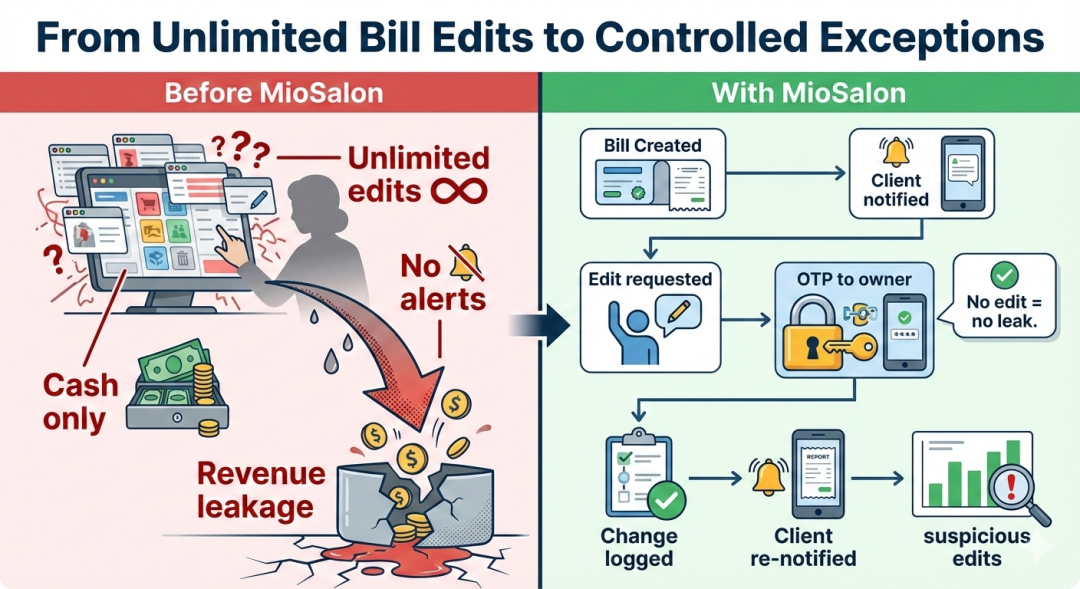
1. Disable bill edit by default
- Owners can completely disable bill edits for most roles (front desk, stylists).
- Only a designated role (e.g., branch manager or owner) may have access to edit, and even then, under supervision.
2. Moderated editing with OTP approval
- When edits are permitted, MioSalon allows you to require a One‑Time Password (OTP) for any bill change.
- OTP goes to the owner or a central authority, not to the manager performing the change.
- The manager must call or message the owner and justify the reason (“Customer complained about wrong service, need to correct,” “Service upgraded mid‑way,” etc.).
3. This single friction point drastically reduces casual fraud. Most “creative edits” disappear when staff know that every change requires a conversation with the owner.
4. Instant notifications to clients and owners
- MioSalon can send automatic digital invoices (SMS/WhatsApp/email) to clients immediately after billing.
- If a bill is later edited or cancelled, a new notification goes to the client and optionally to the owner.
Example:
Original invoice: “You paid 2,000 INR for Keratin Treatment.”
Post‑edit notification: “Your invoice has been updated: 1,200 INR for Hair Spa.”
6. Clients who see such mismatches are likely to question the front desk or escalate. This turns your clients into a live monitoring layer.
7. Abnormal activity reports and flags
MioSalon logs all bill edits, including:
- User who made the change.
- Original amount and new amount.
- Timestamp.
The system can highlight:
- Bills edited after a longer delay (e.g., more than 1 hour after payment).
- High‑value edits or repeated edits by the same user.
- Concentrations of edits on cash payments.
8. Owners can review these exceptions weekly, just as they review basic financials. This is especially powerful in multi‑branch setups using MioSalon as beauty salon software, barbershop software, or massage software, where patterns across branches can reveal systematic fraud.
9. Integration with discount policies
- MioSalon lets you define discount limits by role.
- Front desk may be allowed up to, say, 10%; managers up to 20%; anything higher either blocked or requires OTP.
- This prevents a common variant of this theft, where staff retroactively increase discounts after collecting full payment.
In practice, salons that implement these controls see a rapid drop in unexplained cash shortages and bill anomalies. Over 6–12 months, the impact on net profit is often larger than many marketing campaigns.
👉Stop silent bill tampering at the counter with MioSalon’s barbershop software designed for instant alerts and fraud-pattern detection.
Theft 3: Cancelling Bills After Cash Collection
How this theft works:
This theft is a close cousin of bill editing but often more aggressive: staff create a genuine bill, collect cash, share a printed or digital invoice, and then cancel the bill in the system entirely. On paper, your records show no revenue, and the staff keeps 100% of the cash.
Common flow:
1. Client receives services worth 2,500 INR.
2. Staff:
- Creates a bill for 2,500 INR in the salon software.
- Prints the bill or shows a digital copy; collects cash.
3. Post‑visit, staff cancels the bill:
- In systems with weak controls, this may just remove the bill from daily collections.
- No record appears in standard revenue reports unless canceled bills are specifically included.
4. Management review:
- Sees reduced revenue but no obvious “loss” because there is no formal bill.
- Daily cash may appear lower, but staff may manipulate closing cash counts or add fake expenses to “balance” (which you have another theft pattern for later).
This pattern is especially dangerous in:
- High‑volume barbershops and nail salons, where clients may not cross‑check digital vs system records.
- Spas and massage centers with tourists or first‑time visitors who are unlikely to return or complain.
- Multi‑branch chains where branch‑level oversight is weaker.
Real‑world illustration
A day spa that later migrated to MioSalon had been facing chronic cash shortfalls at one branch for months. The owner suspected theft but couldn’t pinpoint how it was happening.
Key background:
- They used a basic spa software system that allowed managers and receptionists to cancel bills with one click.
- Canceled bills did not appear in the owner’s daily revenue snapshot by default.
- Clients occasionally received printed receipts, but no digital notifications were in place.
When an external auditor reviewed raw database logs, they uncovered a pattern:
- Several staff created bills at full value during peak hours (evenings and weekends).
- Immediately after shift change or near closing time, those bills were canceled.
- There was no trail linking the cancellation to any “customer complaint” or “service failure.”
- Many canceled bills had no corresponding reissued invoices.
In effect, staff were pocketing entire bills, not just partial discounts. The monthly leakage at just this one branch was multiple lakhs.
Potential monthly loss estimate:
Take a moderate‑busy spa:
- 25 bills per day.
- Average bill value: 2,500 INR.
- 50% paid in cash (12–13 per day).
If dishonest staff:
- Cancel just 2 cash bills per day, each at 2,500 INR.
- Pocket the entire 5,000 INR.
Then:
- Daily leakage: 5,000 INR.
- Monthly (30 days): 150,000 INR.
In larger aesthetic clinics or high‑end spas, per‑bill values are higher, so even a single cancelled bill per day can equal 100,000 INR+ lost monthly.
Within broader retail, employee theft frequently manifests as cash or deposit theft, refund fraud, and manipulation of transaction records—this salon‑specific version is effectively “refund fraud without a visible refund.” Without software‑level controls, it is almost impossible to detect consistently.
How MioSalon stops or exposes cancel‑bill theft
MioSalon’s approach is to treat bill cancellation as an exceptional event, never routine. For all verticals—whether you use MioSalon as hair salon software, massage software, tanning salon software, or beauty salon software—the controls are similar.
1. Disable cancellation for most roles:
- Owners can configure that only specific senior roles (e.g., branch manager, supervisor) can cancel bills.
- Receptionists and stylists are blocked from direct cancellation, even if they can create bills.
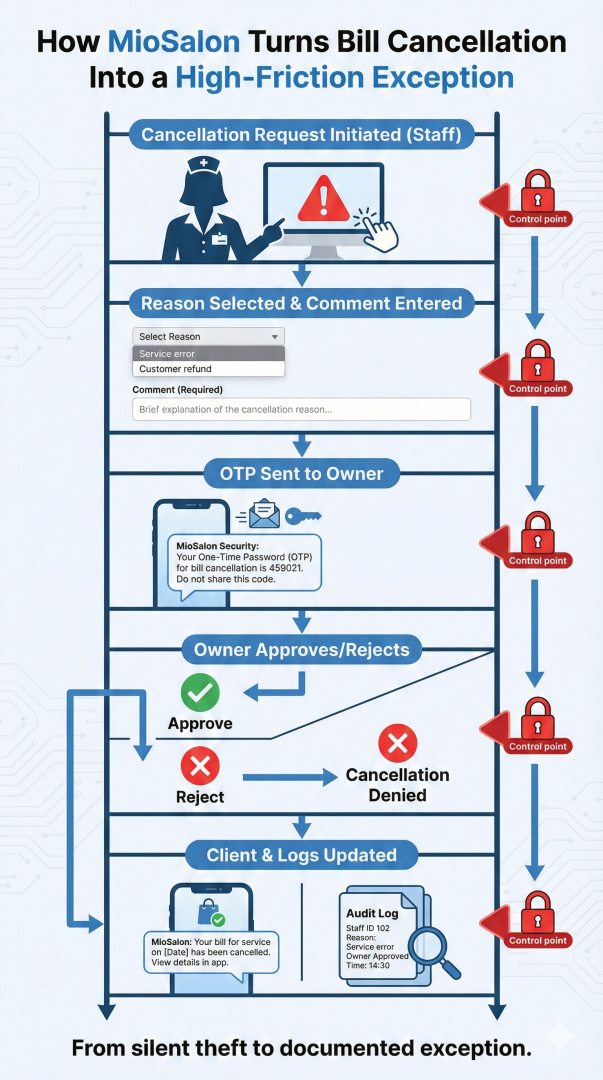
2. OTP‑gated cancellations:
- Just like edits, MioSalon can require OTP approval for cancellations.
- OTP is sent to the owner or central admin, not to the cancelling staff.
- Every cancellation requires a reason code (dropdown + free text), turning it into a documented event.
3. Mandatory digital invoices and change alerts:
- Immediately after billing, MioSalon sends the invoice to the client via SMS/WhatsApp/email.
- If a bill is cancelled, a second notification can be sent to the client: “Your invoice [#1234] has been cancelled. If you did not request this, contact us.”
4. This alone is a powerful deterrent. Staff know that secret cancellations might trigger client queries and owner follow‑up.
5. Owner‑visible canceled bill reports:
MioSalon keeps a complete log of canceled bills; they never “disappear.”
Owners can view:
- Total canceled bill count and value per branch and per staff.
- Time of cancellation (e.g., many cancellations just after closing is a red flag).
- Payment methods most commonly associated with cancellations (e.g., high concentration on cash).
This report should be part of weekly reviews across branches, especially for chains.
6. Linking cancellations to inventory and service records:
- In spas and clinics where services involve product usage (e.g., facials, hair treatments, aesthetic procedures), MioSalon allows product consumption to be linked to bills.
- If a bill is canceled, but product consumption and staff time remain recorded, the anomaly stands out.
- This is particularly important when you use MioSalon as skin clinic software, aesthetic clinic software, or spa software, where product cost per service is high.
7. Optional restrictions on same‑day vs backdated cancellations
- Many owners choose to allow only same‑day cancellations and require owner involvement for any backdated cancellation.
- MioSalon supports date‑based rules so staff cannot quietly cancel yesterday’s or last week’s bills to mask theft, which is another pattern you mentioned and we’ll detail later.
When all these controls are in place, the typical “create bill → collect cash → cancel bill” fraud becomes operationally difficult and risky. Most staff will not risk explicit, OTP‑logged, customer‑visible cancellations just to skim a few thousand rupees.
👉Prevent silent bill removals using MioSalon’s Massage Therapy Software that flags risky cancellations and keeps every rupee traceable.
Theft 4: Diverting High-Value Bridal and Home Appointments
How this theft works:
Bridal, group, and home‑visit appointments are among the highest‑value services in any salon, spa, or makeup studio. In many markets, a single bridal booking can equal the monthly revenue of several regular clients. That is exactly why dishonest staff target these bookings and divert them to their own personal freelance work.
A typical pattern looks like this. A bride or event organizer books a detailed package with your salon—engagement make‑up, Mehendi, wedding day, reception, plus add‑ons for bridesmaids or family. The manager or senior artist confirms details, blocks staff time, and sometimes even collects an advance or full payment. Closer to the event date, the staff member quietly cancels or “reschedules” the appointment in your system, often citing reasons like staff illness or double‑booking. They then take leave from work on the event day and service the same client privately at the client’s venue, using products taken from the salon and keeping the full payment off‑books.
Because bridal and event services are often planned months in advance, the financial impact is not just the lost booking. It is also the opportunity cost of blocked calendar slots, the negative word‑of‑mouth if the salon appears unreliable, and the practice of drawing product stock for “internal consumption” while actually using it to fulfil private jobs.
This pattern is common in businesses focused on bridal work, high‑end makeup, skin clinics offering wedding packages, and spas that provide full‑day pre‑wedding rituals. It also appears in nail bars doing large group bookings (for example, bridesmaid nail parties) and in bridal salon software context where detailed events sit in the calendar for weeks or months.
Real‑world illustration
In one MioSalon client—a popular bridal makeup and hair studio with three branches—senior artists were frequently sent to five‑star hotels and wedding venues for home appointments. The studio used a basic calendar app plus spreadsheets, not integrated salon management software, to manage these events.
Here is what happened in practice. A bride would book a full bridal package for 35,000 INR with hair, makeup, and draping included. The manager would block a senior artist for that date and time and occasionally note the booking in a paper diary. As the event date approached, the artist and manager would agree to cancel the appointment in the internal log “due to scheduling issues” or “artist unavailability” and call the bride directly, offering to service her privately at the same or slightly lower price. They would carry salon‑owned products—foundations, palettes, lashes, hairspray—to the venue, complete the work as “freelancers,” and keep all the money for themselves.
On the studio’s side, the booking vanished from the calendar or never appeared in any central report. The owner saw a fully booked team but inconsistent billing on weekends and wedding seasons. Only after migrating to MioSalon and enforcing centralized calendar management did they realize that event days with full staff utilization showed mysteriously low revenue.
Potential monthly loss estimate
Bridal and event theft looks small when you focus on single bookings, but it scales brutally. Consider a bridal‑focused salon:
- Average bridal package including trial: 30,000 INR.
- Average group or family event booking: 15,000–20,000 INR.
- Assume just two such high‑value appointments are diverted per month by a dishonest manager or artist.
With just those two appointments, you may lose between 60,000 and 80,000 INR in direct revenue. The opportunity cost is often higher. Bridal appointments crowd your calendar and prevent you from accepting other bookings in the same slots. If each high‑value day effectively blocks 8–10 hours of stylist or artist time, your lost revenue potential could easily cross 100,000 INR monthly.
Across a year, even a modest pattern of two diverted bridal or high‑value home visits per month adds up to 1.2 million INR or more in leakage. In larger metropolitan markets and premium studios, hourly rates and package prices are higher, pushing this into multi‑million‑rupee territory.
How MioSalon protects bridal and home‑visit revenue
MioSalon approaches this from three angles: centralized calendar control, clear revenue attribution, and product usage tracking. When used as bridal salon software, salon management software, or even as a specialized module within beauty salon software, the same principles apply.
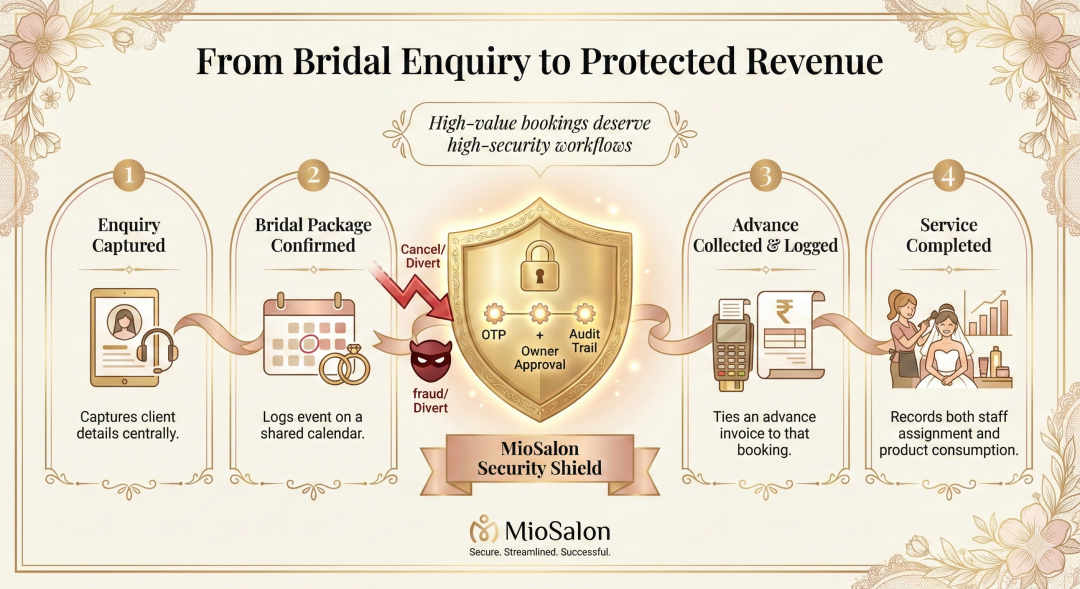
First, all bridal and home‑visit appointments must live in the central MioSalon calendar, not in personal notebooks or external apps. Every event is tied to a specific staff member, time slot, and location (in‑salon or home service). When a manager or artist tries to cancel or move such appointments, MioSalon records the change with user ID, timestamp, and reason. Owners can choose to require OTP approvals for cancellations within a certain window—for example, anything within seven days of the event cannot be cancelled without owner approval.
Second, MioSalon links these high‑value bookings directly to billing and advance payments. If a bridal booking is created, the system expects either an advance invoice or a full invoice to follow. If a booking is cancelled, but there is evidence of product usage, staff time, or client communication that does not match the cancellation reason, the anomaly is visible. Owners can receive daily or weekly summary reports: number of bridal or home appointments booked, honoured, rescheduled, and cancelled, along with associated revenues.
Third, MioSalon’s product inventory and internal consumption features are particularly important where artists use high‑end makeup or skin products for events. You can define product kits associated with bridal or group services. When a home visit is carried out, the product consumption is logged at the staff level or salon level. If an event suddenly disappears from the calendar but product usage and leave records suggests an off‑site service happened, you know where to investigate. This is especially relevant when MioSalon is used as skin clinic software, tanning salon software, or aesthetic clinic software where single‑use consumables and high‑value products must be tightly controlled.
By shifting all bridal and home‑visit operations into a transparent, OTP‑guarded workflow, MioSalon makes it extremely difficult for managers or artists to “privatize” bookings. Even if one attempt slips through, pattern reports across months will highlight abnormal cancellations around weekends or festive seasons.
👉Secure every wedding booking with MioSalon’s bridal salon software built for centralized calendars and OTP-protected cancellations.
Theft 5: No-Bill or Paper-Only Billing (Cash Pocketing)
How this theft works
No‑bill theft is one of the simplest and most widespread scams in salons, nail bars, barbershops, and spas. It thrives wherever owners accept manual billing, paper receipts, or informal “cash box” practices. In this pattern, staff simply perform services, take cash from clients, and never generate a bill in your salon software or POS. Because no transaction is created, there is nothing to audit later.
The typical scenario unfolds in busy hours or with clients who appear disinterested in documentation. A client walks in for a haircut, manicure, or quick facial. The service is delivered, the staff mentions a price, collects cash, and either gives no receipt or hands over a handwritten slip that is never entered into the system. When end‑of‑day cash and reports are reconciled, these transactions do not exist in your billing data. The shortfall often gets masked by manual adjustments: small expenses recorded without receipts, rounding differences, or simply miscounted cash.
No‑bill theft is not limited to small tickets. In many cases, dishonest staff wait for clients taking multiple services, upsold treatments, or add‑on retail products. Those are billed verbally rather than through software, creating a bigger pool to skim from.
Real‑world illustration
Consider a busy nail and beauty bar in a mall. During weekends, footfall surges and the front desk is under pressure. The salon relies on a mix of manual registers and partial nail salon software usage, where staff are “encouraged” but not forced to create a bill for every client.
One technician learns that management rarely cross‑checks chair utilization against billed services. She begins by skipping bills for small services: quick polish changes and file‑and‑polish add‑ons. When she notices no one notices, she escalates. On days when her chair is fully booked, she simply does not generate bills for some clients, especially walk‑ins paying in cash. She charges them full price and keeps all or part of the cash. If questioned by colleagues, she casually writes services into a notebook claiming she will “enter them later.” Many never get entered at all.
The owner, looking at monthly reports, sees reasonably healthy revenue but also hears staff complaining that they are “too busy.” They assume this is a capacity problem, not a leak. Only after introducing compulsory digital billing through MioSalon did they notice a jump in recorded revenue without any actual increase in footfall, revealing how much business had been happening off‑system.
Potential monthly loss estimate
Even conservative assumptions show how dangerous this is. Imagine a mid‑tier salon:
- 30 clients per day on average.
- Average bill value across services: 1,500 INR.
- In a loosely controlled environment, staff skip billing for just 3 clients per day, mostly cash payers.
In that case, daily revenue leakage is 4,500 INR. Over a 30‑day month, that becomes 135,000 INR of completely invisible loss. In high‑volume barbershops doing 70–80 haircuts a day or in bustling nail bars with many low‑ticket services, even a smaller per‑ticket amount adds up quickly.
When you compare this to typical salon EBITDA margins—which often sit in the range of 10–20% in competitive markets—even a 5–10% loss from no‑bill operations can erase most or all of your profits. And because there is no digital trace, owners often misinterpret weak profitability as “pricing pressure” instead of theft.
How MioSalon makes “no bill” nearly impossible
The solution is not just telling staff “always create a bill.” It is to make the absence of a bill visible, uncomfortable, and risky for anyone trying to cheat. MioSalon does this through a combination of compulsory workflows, client‑facing guarantees, and usage‑based monitoring.
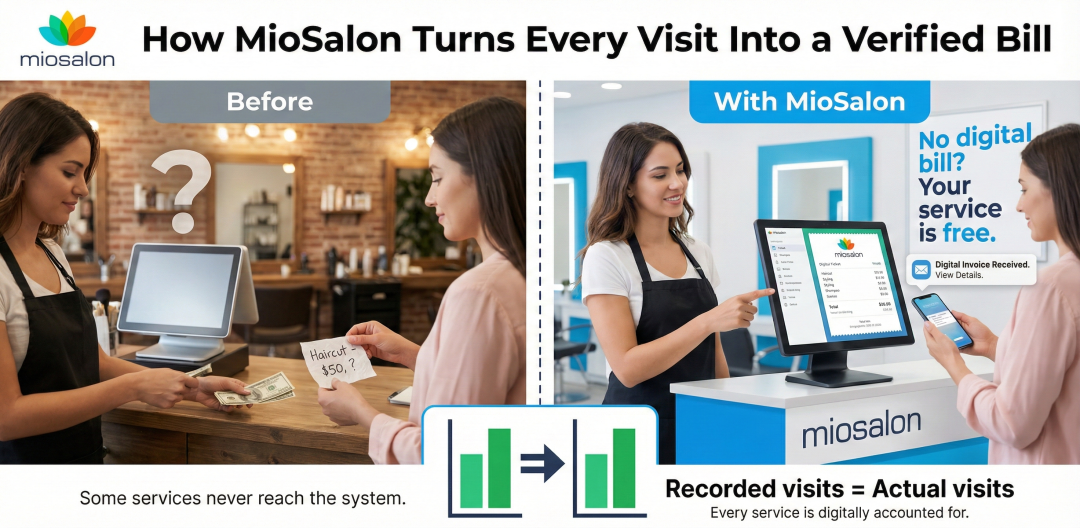
At the operational level, MioSalon encourages a “no service without ticket” culture. Every appointment, walk‑in, or chair service should be created as a ticket in the salon management software, linked to a client profile or at least a quick guest record. Staff select services from a standardized list, and the system automatically calculates totals, taxes, and applicable discounts. When the visit is complete, the bill is closed, and a digital invoice is sent to the client via SMS or WhatsApp.
To reinforce this behavior with clients, many MioSalon users adopt a visible promise at the front desk and mirrors: “No bill, your service is free” or “If you do not receive a digital bill, your service is on us.” The attached note clarifies that all genuine services are billed through the system and customers should receive a message within a few minutes of payment. This flips client expectations; they now ask for their digital invoice as a right, turning each client into a control point.
MioSalon’s reports also allow owners to correlate utilization and billing. For example, in a spa or massage software context, you can see total number of appointments per therapist, total hours booked, and total revenue recorded. If a therapist consistently shows high utilization but comparatively low revenue, you can investigate. In barbershop software or nail salon software scenarios, you can compare chair occupancy (from appointments or queue management) against bills closed per staff and time slot.
Finally, MioSalon can send automated “Thank you for visiting” messages with a link to the digital invoice and feedback form. If a client reports having visited but not receiving a bill, or if the feedback volume exceeds the number of bills recorded, that branch gets flagged for review. Over time, this multi‑layered approach makes “off‑book” services extremely hard to run repeatedly without detection.
👉Stop paper-only transactions with MioSalon’s salon software that sends instant invoices and flags missing revenue.
Theft 6: Stealing Prepaid Value by Redeeming Other Customers’ Balances
How this theft works
Prepaid programs are powerful revenue tools. A client pays a lump sum—say 10,000 INR—and receives 12,000 or 13,000 INR worth of services to be used over several months. This upfront sale improves cash flow, raises pre‑booking ratios, and increases Client Lifetime Value. But because a significant portion of clients never fully exhaust their prepaid balances, dishonest staff see a tempting opportunity: redeeming unused credits on behalf of other paying customers and pocketing the cash.
The scam goes like this. Staff identify clients who have prepaid balances but have not visited for a long time or have historically low utilization. Then, when a different customer walks in and pays cash for services, the staff secretly bills the visit against the dormant or low‑tracking prepaid account instead of accurately recording a cash transaction. In the software, it looks like a legitimate prepaid redemption. In reality, the prepaid client never came, and the present client’s cash never reaches the system.
This pattern exploits two facts: many owners do not closely monitor individual prepaid account movements, and many clients are casual about checking their balances, especially if they received a bonus at the time of purchase and perceive the package as “good value” even if underused.
Real‑world illustration
Imagine a unisex salon using prepaid credits to retain high‑spend hair and skin clients. The program might offer “Pay 10,000 INR, get 13,000 INR valid for 12 months.” Over time, management notices what is common in such schemes: a segment of clients leaves part of their balance unused. This is normal breakage.
A front‑desk executive with access to the prepaid balance report notices a group of 30 clients with significant remaining credits who have not visited for six months. She recognizes that many of them are NRIs or have shifted cities. She then begins the scam. When a regular walk‑in client comes for a cut and color worth 3,000 INR and pays in cash, she creates a bill linked to one of those dormant prepaid accounts and redeems 3,000 INR from that balance. She hands over a printed bill or simple receipt to the paying client but never records a cash payment. On paper, the salon’s liability to that prepaid client decreases, and reported revenue appears normal because it is a prepaid redemption.
Over time, by repeating this across dozens of visits, she converts unused prepaid balances into personal cash. The owner only sees a healthy prepaid utilization report and may even think, “Great, more of our prepaid is finally being used.”
Potential monthly loss estimate
Prepaid theft can rapidly become one of the largest invisible leaks in a salon’s P&L. Let us model a conservative case:
- Total active prepaid liability in the system: 1,000,000 INR.
- Breakage expectation (clients not fully redeeming): 20% (200,000 INR).
- A dishonest staff member targets only a portion: say 50,000 INR per month in dormant or low‑usage accounts.
If she diverts 50,000 INR worth of prepaid each month to cover real cash‑paying clients:
- Reported revenue may not change dramatically since redemptions are still revenue recognition.
- Actual cash in hand, however, is short by 50,000 INR every month.
- Over a year, that is 600,000 INR of cash that never reaches the business.
In premium skin clinic software or aesthetic clinic software environments where prepaid packages are larger—20,000–50,000 INR each—the monthly leakage can easily cross 100,000 INR when not controlled.
How MioSalon protects prepaid balances using OTP and controls:
The core defense here is to ensure that prepaid value cannot be redeemed without live confirmation from the rightful owner, and to make it hard for staff to fish through vulnerable accounts.
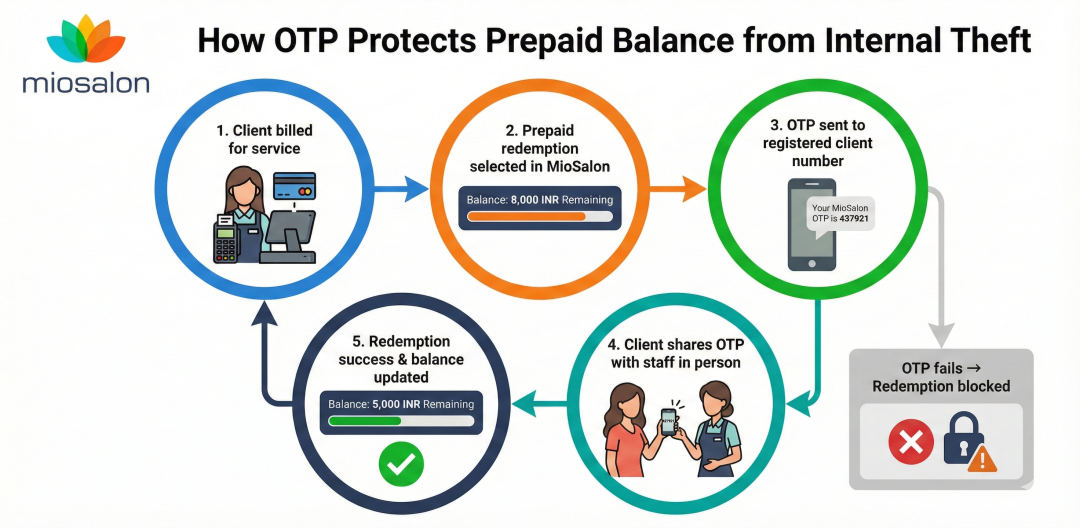
MioSalon addresses this first by treating prepaid balances as highly sensitive assets. Every prepaid account is tied to a verified phone number and name. When staff attempt to redeem prepaid credits at the point of billing, MioSalon can be configured to send a One‑Time Password (OTP) directly to the client’s phone. The staff must enter this OTP to complete the redemption. If the actual prepaid holder is not present, or if the staff try to use an old or wrong phone number, the process fails. This single step blocks the common pattern of silently redeeming dormant accounts.
Second, the system can mask or limit access to full prepaid balance lists. Front desk staff may see that a client has a sufficient balance when they load the client profile, but they do not need to browse through all prepaid accounts searching for inactive ones. Only managers or owners, operating under strict permissions, can view and export comprehensive prepaid reports. This minimizes the chance of targeted abuse.
Third, MioSalon’s reporting makes prepaid movements transparent at the macro and micro level. Owners can see, per month, how much prepaid was sold and how much was redeemed, broken down by branch, staff, and client segment. Unusual spikes in redemptions on days with high cash traffic, or disproportionate redemptions tied to specific staff, can trigger deeper investigation. In spa software or massage software contexts where prepaid is popular (e.g., packages of 10 massages), these reports are crucial.
Finally, customer communication closes the loop. Every time prepaid is redeemed, MioSalon can send a message to the customer summarizing the service used and remaining balance. Clients then have a live running ledger. If a redemption occurs without their knowledge, they can flag it immediately. Over time, this interaction builds trust in your prepaid program and allows you to scale it confidently without fearing that increased liability automatically increases theft risk.
👉Protect prepaid revenue at the source with MioSalon’s Best Aesthetic Clinic Software that enforces OTP-based redemptions and real-time balance alerts.
Theft 7: Stealing Package Credits by Redeeming from Other Customers’ Packages
How this theft works:
Package programs are close cousins of prepaid plans but structured around service counts rather than currency. A client might buy a “12 haircuts for the price of 8” package, or a “10 sessions of massage” pack. These programs are extremely common in hair salons, spas, tanning centers, and skin clinics because they improve retention and pre‑booking ratios. The vulnerability is similar to prepaid: some clients never fully redeem all sessions, creating a pool of unused credits that can be misused.
The theft mechanism is straightforward. Staff look for packages with unused services and low recent activity. When a regular customer pays cash for the same service, the staff bills it under the dormant package holder’s account and deducts one session from that package, keeping the client’s cash. From the salon’s perspective, it looks like a legitimate redemption of a previously sold package. From the client’s perspective, nothing seems wrong because the person whose package is being drained is often absent and may not track session counts closely.
This is particularly prevalent in hair salon software and spa software environments where packages are structured around frequently repeated services like haircuts, facials, massages, or tanning sessions.
Real‑world illustration:
Consider a men’s grooming and spa chain offering “VIP Haircut Packages”: pay for 8 haircuts and get 4 free, valid for 12 months. Many clients buy these packages with enthusiasm but later switch jobs, move cities, or simply reduce visit frequency. A front‑desk executive with full package visibility notices packages with 3–6 unused haircuts left, last used over six months ago.
When a walk‑in client pays 600 INR cash for a haircut, the executive quietly tags the bill to one of those packages and redeems a haircut credit. The cash payment never enters the system; the package holder’s remaining count drops, and the package liability decreases. The executive repeats this across dozens of cash‑paying visits per month, focusing on high‑liability, low‑activity accounts.
The salon notices only that some old packages are finally being redeemed and that package breakage (unused balance that expires) is slightly lower than expected. They do not realize that much of that “redemption” is effectively staff‑driven theft.
Potential monthly loss estimate:
Let us model a typical case:
- A salon has sold packages worth 500,000 INR across haircuts and spa treatments.
- Around 30% of package service credits remain unused close to expiry.
- A staff member targets just a fraction, redeeming the equivalent of 25,000–40,000 INR worth of sessions per month against paying cash customers.
In such a setup:
- The salon still sees service activity and package redemption in reports.
- The cash that should have been recorded for those walk‑ins is instead taken personally by the staff.
- Over a year, this amounts to 300,000–480,000 INR of pure cash leakage, hidden behind what appears to be “healthy package utilization.”
In higher‑ticket environments—such as tanning salon software setups with multi‑session UV or spray‑tan packages, or skin clinic software environments with packages for laser or peels—per‑session values are much higher, so the same manipulation can be worth lakhs per quarter.
How MioSalon safeguards package redemptions
MioSalon uses the same rigorous philosophy for packages as for prepaid: only the rightful owner of the package should be able to authorize its use, and every redemption must be transparent to that client.
First, when packages are created in MioSalon, each package is linked to a specific client profile with verified contact information. Package session counts and usage histories are visible to that client both on invoices and, where configured, via automated messages. Each time a session is redeemed, MioSalon can send an update showing which service was used, on what date, at which branch, and how many sessions remain.
Second, MioSalon supports OTP‑based validation for package redemptions, just like with prepaid. When staff attempt to redeem a session, the system can issue an OTP to the client’s registered phone. The code must be entered to complete the redemption. This mechanism is especially protective for infrequent services, where the client is more likely to notice anomalies if they receive an unexpected notification.
Third, access rights and reporting combine to deter misuse. Staff do not need broad visibility into all package holders and their remaining sessions; they only need to see the package information of the client currently being billed. Strategic roles (owner, branch head) can see a full list, but they are also the ones receiving high‑level anomaly reports: packages with unusually fast redemption rates, many redemptions tied to one staff member, or redemptions clustered in time windows with high cash traffic.
When MioSalon is used as massage software or spa software, therapists’ performance and utilization reports can be cross‑checked with package redemption activity. If a therapist’s chair is fully booked but package redemptions under their name are disproportionately high compared to recorded cash revenue, it signals a pattern worth examining.
By combining OTP authorization, client notifications, and role‑based visibility, MioSalon dramatically reduces the space in which staff can arbitrage unused package credits for personal gain.
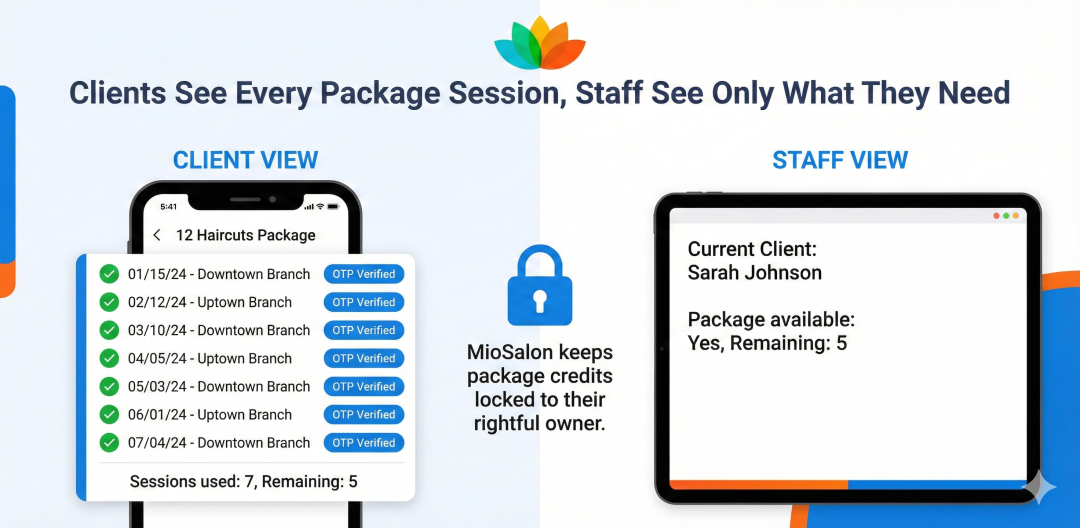
👉Stop silent package draining using MioSalon’s spa software that alerts clients and flags abnormal redemptions.
Theft 8: Abusing Membership Discounts via Fake or Edited Memberships
How this theft works:
Membership programs are increasingly popular, especially in beauty salon software, barbershop software, and spa software settings. Members might pay an annual fee to unlock recurring discounts (for example, 20% off all services), priority booking, or complimentary add‑ons. Memberships improve loyalty and increase the average number of visits per year. However, poorly controlled membership systems invite a sophisticated form of discount theft.
One common pattern is the “ghost membership.” A staff member creates a fake membership account, sometimes using their own number or a dummy phone number. When non‑member clients come in and pay cash, the staff effectively “assigns” those visits to the fake membership and bills them at a discounted price in the system, while collecting full price from the customer. Alternatively, they may alter a genuine member’s contact details temporarily, use the membership benefits for another paying client, and then revert the details.
In both cases, the salon’s revenue reports show many transactions at discounted member rates, while real cash inflows should have been higher. The staff keeps the difference between full client payment and system‑recorded discounted amounts.
Real‑world illustration:
A multi‑service beauty salon launched a membership plan: pay 5,000 INR annually and enjoy 20% off all services plus 10% off retail. Management used basic membership tracking, relying on front‑desk staff to enroll clients and tag visits as “member” or “non‑member.” The salon software in use allowed phone numbers and notification settings to be edited without approval.
One receptionist set up a membership account under a random number and labeled it as “Test Member.” When cash‑paying non‑member customers came in for large bills—say 4,000 INR for hair color and spa—she charged the client full price and then, in the system, attached the bill to the “Test Member” profile, applying a 20% membership discount. The salon’s report showed 3,200 INR as billed revenue and a 20% discount granted to a “member,” while the receptionist pocketed the 800 INR difference.
Another variant occurred with real members. For a high‑spend member who did not pay attention to bill breakdowns, staff temporarily edited the membership profile to use that member’s benefits for another client’s visit. After redeeming benefits or points, they changed the number back. Since the genuine member never cross‑checked points or discounts thoroughly, the theft went unnoticed.
Potential monthly loss estimate :
Membership discount abuse can quietly cut into margins because it lowers revenue on transactions that should be billed at full price, while the difference goes straight into staff pockets. Consider the following conservative setup:
- 300 non‑member clients visited in a month.
- Average bill per non‑member: 1,800 INR.
- Dishonest staff misuse membership discounts on just 30 of those visits (10%), focusing on larger bills.
If the member discount is 20%, and staff apply it in the system while collecting full price in cash:
- Average discount per targeted bill: 360 INR.
- Total stolen margin per month: 30 × 360 = 10,800 INR.
In reality, once staff discover that this tactic is not monitored, they tend to scale it. At 100 misused bills per month with higher average tickets (typical in skin clinics or spas), monthly leakage could exceed 50,000–100,000 INR. Over a year, this can reach 600,000–1,200,000 INR of lost margin, all while your membership program appears to be “performing” because discount usage is high.
How MioSalon closes membership fraud loops
MioSalon treats membership data—especially client identifiers like phone numbers and notification settings—as high‑sensitivity fields. When used as salon management software across branches, or specifically as beauty salon software and spa software, three types of controls work together to curb this theft.
First, phone number edits are permission‑based and logged. Only specific roles can change a member’s contact information, and every change is recorded with time, user, and old versus new value. Owners can even choose to require OTP verification when certain critical fields are altered, sending a confirmation message to the original number. This makes it risky for staff to temporarily hijack a member account for a single bill.
Second, notification controls are centralized. Staff cannot arbitrarily turn off SMS or email notifications for select clients to hide what they are doing. MioSalon grants the owner the ability to lock notification settings, ensuring that every member transaction—discount application, points accrual, or benefit redemption—triggers a message to the registered client. If a non‑member visit gets billed under a member’s account, the real member will receive a strange bill notification and can flag the discrepancy.
Third, MioSalon’s membership analytics help detect abnormal patterns. You can review membership reports showing revenue and service counts per member. If a single “member” appears to generate an unusually high volume of discounted revenue or has a discount‑to‑visits ratio that looks abnormal, it becomes a red flag. This is especially powerful in multi‑branch setups where a fake membership may be heavily used at one branch only. Owners can filter for “Top 10 members by discount value used this month” and manually review those profiles.
Finally, loyalty and membership behaviors in MioSalon are tightly integrated with reward points and prepaid systems. Clients regularly see their benefits summarized on invoices and messages: membership discounts applied, reward points earned, remaining points, and so forth. This constant, small‑touch communication builds an external audit layer where clients themselves help catch anomalies if their membership is misused.
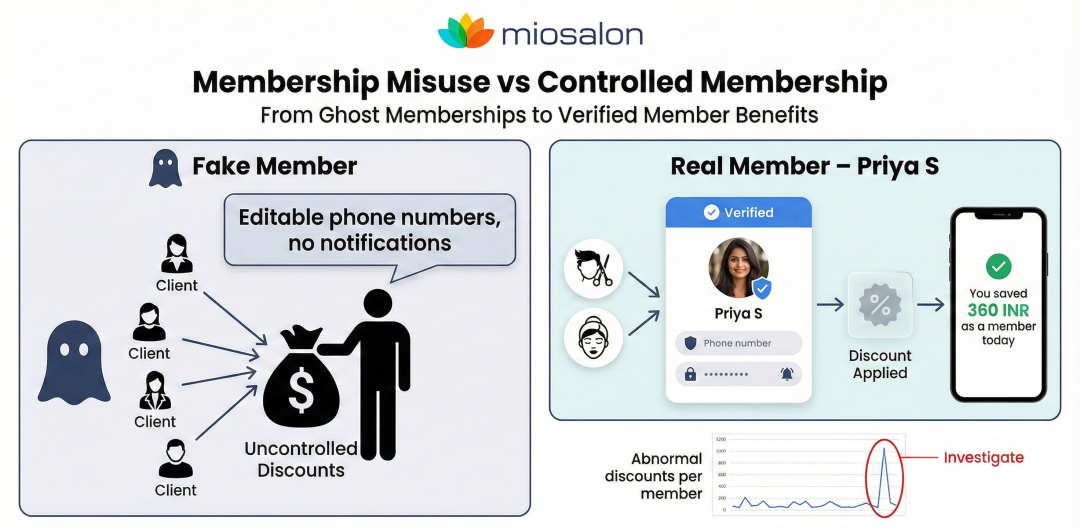
👉Protect full-price revenue using MioSalon’s beauty salon software that enforces client alerts and tracks abnormal membership use.
Theft 9: Downloading Financial Data from Home and Using It for Planning Theft
How this theft works:
When managers can log in from any device and freely download sensitive financial reports, they gain a powerful blueprint for fraud. They see exactly where your vulnerabilities are: dormant prepaid and package balances, high‑value but low‑engagement clients, and services or products with weak tracking. The theft itself may still happen in‑store, but the planning and target selection are done quietly at home.
Typical behavior includes:
- Logging in after hours from personal laptops or phones.
- Exporting detailed revenue, package, prepaid, and membership reports.
- Analysing which accounts have large unused balances and low activity.
- Mapping which services or branches have weak OTP or notification practices.
- Selling high‑value customer lists to competitors or using them to promote a future competing salon.
In effect, your salon management software becomes an intelligence source for attackers if you do not restrict access properly.
Real‑world illustration:
A chain of three salons used cloud‑based software where every manager had full login rights from any location. One branch manager routinely exported month‑end reports at home, including:
- Full prepaid and package liability lists with client names and balances.
- Top‑spend customer lists with contact details.
- Staff performance and commission reports.
He then designed a multi‑layered fraud strategy. Inside the salon, he selectively redeemed dormant credits against cash‑paying clients, just as in the prepaid and package thefts described earlier. Outside the salon, he built a personal WhatsApp list of high‑spend clients to target once he opened his own outlet.
Because exports were not logged or restricted by device, the owner saw only “normal report usage.” The pattern surfaced only after several high‑value clients followed the manager to his new space and after inexplicable prepaid and package shrinkages.
Potential monthly loss estimate:
The direct loss from this specific behavior may seem intangible at first because the real theft happens via other mechanisms (prepaid, package, membership, etc.). However, the planning enabled by off‑site data access amplifies each of those thefts.
Consider a salon with:
- 1,500 active clients.
- Prepaid and package liabilities totaling 1,200,000 INR.
- Top 150 clients contributing 50% of revenue.
If a manager uses exported data to:
Steal 50,000–75,000 INR per month through targeted credit redemptions, and Poach 30–40 of the highest LTV clients when they leave,
then in addition to the monthly fraud, the business may lose 150,000–250,000 INR in monthly revenue once those top clients churn. In mature markets, hair and nail salon revenue can reach tens of billions of dollars annually, so even a small shift in high‑value client behavior materially affects individual outlets.
How MioSalon locks down financial data access
MioSalon treats off‑site access and downloads as powerful privileges that must be explicitly controlled, especially for multi‑branch setups using it as salon software, spa software, nail salon software, or aesthetic clinic software.
Key controls:
Device‑level whitelisting
Owners can restrict logins with elevated permissions to approved salon devices only. A manager might view basic dashboards from home, but detailed exports and raw CSV downloads are available only on whitelisted systems inside the salon.
Granular export permissions and alerts
Export rights can be limited to owner or head‑office roles. When exports are allowed for managers, every download is logged with user, timestamp, report type, and IP/device fingerprint. Owners can receive instant alerts for sensitive exports, such as “Full prepaid liability list downloaded.”
Owner‑mediated exports
In stricter setups, MioSalon can route export results to the owner’s email. The manager requests an export, but the file goes to the owner, who then decides whether to share or not. This simple friction forces a conscious decision each time sensitive data leaves the system.
Anomaly reporting on login patterns
Regular reports can summarize off‑hours logins, failed attempts, and unusual report access. For example, a branch manager repeatedly logging in at 1 a.m. from a new device indicates risk.
Together, these features mean managers can still operate efficiently—running day‑to‑day reports and dashboards—while owners retain control of the “keys to the vault.” For high‑risk verticals like skin clinic software or bridal salon software, where data sensitivity and ticket sizes are higher, these restrictions are essential.
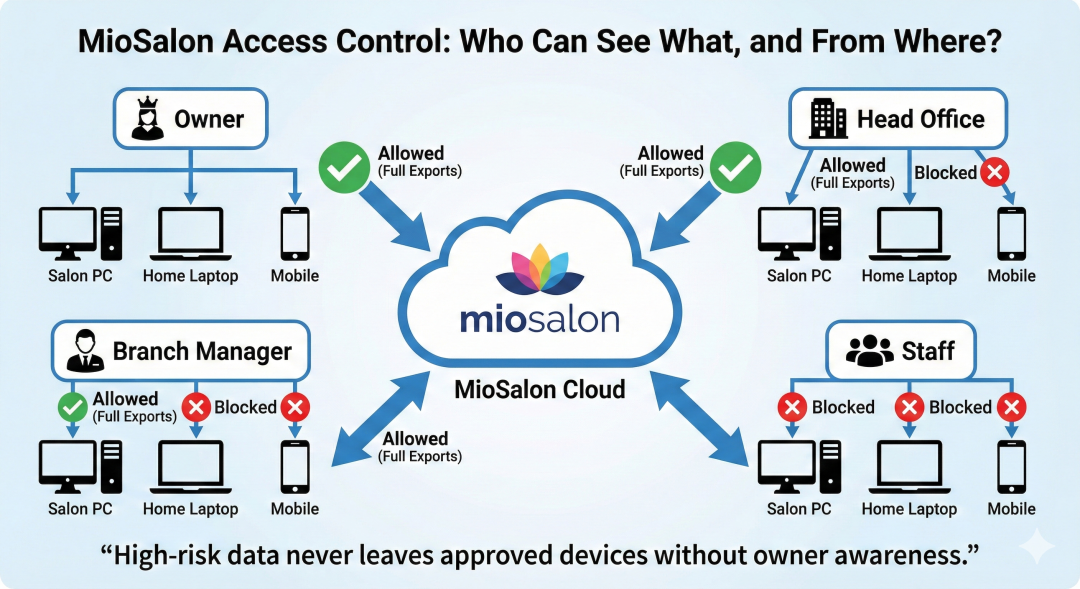
👉Protect high-value client data using MioSalon’s software for salons that flags after-hours logins and restricts sensitive report exports.
Theft 10: Creating Custom Packages at Unrealistic Prices and Deleting the Master
How this theft works:
When managers can freely create custom packages with arbitrary contents and prices, they can design deals that look legitimate in reports but actually transfer value away from the salon. The trick is to create a high‑value package, sell it at a deeply discounted price to a friend or themselves, and then delete or hide the package definition so the owner cannot easily see it existed.
Common workflow:
- Manager creates a package containing services worth 2,000 INR but sets the package sale price in the system as 500 INR.
- They charge a real client 1,500 INR in cash, pocket 1,000 INR, and record the sale as 500 INR in the system.
- After selling, they delete or deactivate the package master record.
- In the future, when the client redeems package services, staff honor it because the credits are attached to that client, while the owner has no easy reference to what the original pricing should have been.
This pattern is especially damaging in spas, salons, and clinics where packages mix multiple high‑cost services (e.g., chemical treatments, advanced facials, or laser sessions) and where owners delegate pricing decisions locally.
Real‑world illustration:
A high‑footfall unisex salon introduced custom “seasonal packages” on top of its standard offerings. Managers had full permission in their legacy salon management software to:
- Add new packages at any time.
- Define included services and pricing.
- Delete packages that were “no longer active.”
One manager created a “Winter Glow Combo” package containing services worth about 2,500 INR. In the system, they set the selling price as 500 INR but verbally sold it at 1,500 INR to selected clients, usually friends or clients ready to pay cash. After the sale, they deleted the package definition, leaving only the client‑level credits. When those clients later redeemed their services, the salon bore full service cost and time, unaware that the package had been under‑priced in the system.
In aggregate, over three months, dozens of such custom packages were sold below cost, eroding margins and hiding a steady leak of cash that never reached the business.
Potential monthly loss estimate:
Model a single branch:
- Ten manipulated packages sold per month.
- True value of services per package: 2,000 INR.
- System sale price recorded: 500 INR.
- Actual cash collected from clients: 1,500 INR (of which 1,000 INR is stolen).
Then:
- Direct monthly cash theft: 10 × 1,000 = 10,000 INR.
- Additional future cost: the salon must later deliver 2,000 INR worth of services per package, having only recorded 500 INR as revenue per sale, hurting margins by another 1,500 INR per package. Across ten packages, that is 15,000 INR of negative margin.
Total financial damage per month (cash theft + future service loss) is therefore about 25,000 INR. Scale this across multi‑branch networks or high‑ticket packages (for example, aesthetic or bridal series), and the number can easily exceed 100,000 INR per month.
How MioSalon controls custom package creation and auditing
MioSalon’s package design and permissions structure prevent managers from quietly creating and erasing value without visibility, whether you use it as hair salon software, spa software, tanning salon software, or aesthetic clinic software.
Key safeguards:
Centralized package catalog:
Package creation and base pricing are usually restricted to owner or head‑office roles. Branch managers can apply discounts within predefined limits but cannot arbitrarily define new package structures without approval.
Role‑based creation rights with audit trails:
If you choose to give managers limited package creation rights (for agility), MioSalon logs:
- Who created the package.
- Included services, total value, and selling price.
- When it was created and first used.
Any deletion or deactivation of a package also gets logged, and the system can prevent deletion if any active client credits still exist.
Weekly or monthly “New & Custom Package” reports:
Owners can run a report listing all packages created or modified in a period, along with:
- Number of times each package was sold.
- Total revenue generated.
- Total services redeemed and outstanding value.
- Packages with unusually low prices relative to contained service value stand out instantly.
Discount boundaries and approval flows:
You can set boundaries such as “No package can be priced below 70% of total service value” or “Any package with more than three service types requires owner approval.” These rules reduce the space for abuse.
With these controls, using MioSalon as salon software shifts package management from an informal, manager‑driven activity to a governed process, while still allowing enough flexibility for genuine promotions.
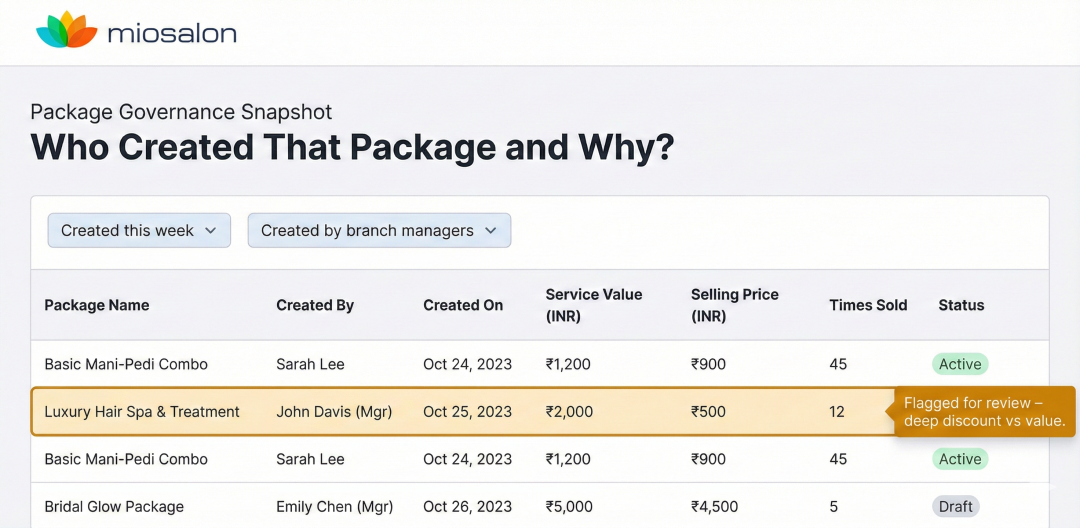
👉 Protect margins using MioSalon’s tanning salon software built for approval-based package creation and deletion tracking.
Theft 11: Custom Prepaid with High Bonus, Low Sale Price, Sold to Friends
How this theft works:
This is the prepaid version of the custom package scam. Instead of building a discounted package around service counts, staff create a prepaid plan with:
- An unusually high bonus credit.
- A very low recorded sale price.
- A much higher actual cash collection.
They then sell this to themselves or friends, pocketing the difference and leaving the salon on the hook for future services at loss.
The basic steps:
- Manager defines a custom prepaid offer: pay 500 INR, get 2,000 INR in credit.
- They verbally sell it as a “special deal” for 1,500 INR to a friend, keeping 1,000 INR.
- After the sale, they delete or hide the prepaid master offer, so reports only show client‑level credit.
- The client uses credit for high‑value services until it is exhausted; the salon delivers full value but has under‑recorded revenue.
Real‑world illustration:
A skin and hair clinic used prepaid wallets heavily, especially for laser and treatment packages. Head office occasionally ran promotions like “Pay 10,000 INR, get 12,500 INR credit.” Managers had access to create custom prepaid offers for “local campaigns.”
One manager exploited this by setting up an offer “Pay 500 INR, get 2,000 INR wallet balance.” He quietly sold this to close contacts for 1,500 INR each. In the software, each sale appeared as a 500 INR top‑up with 1,500 INR bonus. The extra 1,000 INR per sale never reached the business.
Because usage patterns for prepaid wallets varied widely across clients and promotions, the anomaly didn’t stand out initially. Only after head office compared top‑up transactions against allowed promotional templates and looked at per‑transaction bonus ratios did they notice a set of extremely generous, unauthorized prepaid deals—all created by the same manager.
Potential monthly loss estimate:
Assume:
- Ten such custom prepaid sales per month.
- System‑recorded sale value per prepaid: 500 INR.
- Actual cash collected per prepaid: 1,500 INR.
- Bonus credit recorded: 1,500 INR (so client gets 2,000 INR in wallet).
Per sale:
Immediate cash theft: 1,000 INR (collected vs recorded).
Future margin loss: delivering 2,000 INR worth of services for 500 INR recorded revenue (1,500 INR margin erosion).
Across ten sales:
- Cash theft: 10,000 INR.
- Future margin loss: 15,000 INR.
Total financial effect: 25,000 INR per month, similar in magnitude to the package scam, but potentially higher in clinics where per‑service prices are larger.
In global gift and prepaid systems, it is widely documented that 10–19% of gift card balances go unused, representing billions in unredeemed value. Dishonest staff exploit this same behavioral pattern in salons by assuming some part of aggressive prepaid offers will never be fully consumed—making it feel “safe” to create overly generous, unauthorized deals. party.
How MioSalon governs prepaid program creation and usage
Using MioSalon as salon management software, skin clinic software, or nail salon software, owners gain a structured framework for prepaid offers, greatly reducing scope for manager‑level manipulation.
Core protections:
Central prepaid templates and rule‑based offers
Prepaid products are created centrally with clearly defined:
- Minimum purchase amount.
- Maximum bonus percentage.
- Validity period and usage rules.
Branch users pick from these templates rather than inventing their own bonus structures on the fly.
Permission‑based creation and strict logging
Where you allow local prepaid creation (for example, a regional Diwali campaign), only specified roles may do this, and every new template is logged with creator, bonus %, and approved by a higher role. Deletion is prevented while any active balances exist.
Prepaid analytics by template and branch
MioSalon reports show:
- Prepaid sold and redeemed per template.
- Average bonus percentage per branch.
- Outliers where recorded bonus greatly exceeds standard patterns.
A custom template with 300% effective bonus stands out immediately.
Client notifications on top‑up and usage
Every wallet top‑up triggers a message stating paid amount, bonus credit, and total new balance. If a manager promises a client “secret” prepaid deals off the books, the mismatch between what the client expects and what they see in their message will surface quickly.
Together, these features make it very hard to run a shadow prepaid program. Even if one offer slips through, it becomes visible in periodic “Prepaid Templates & Usage” reviews.
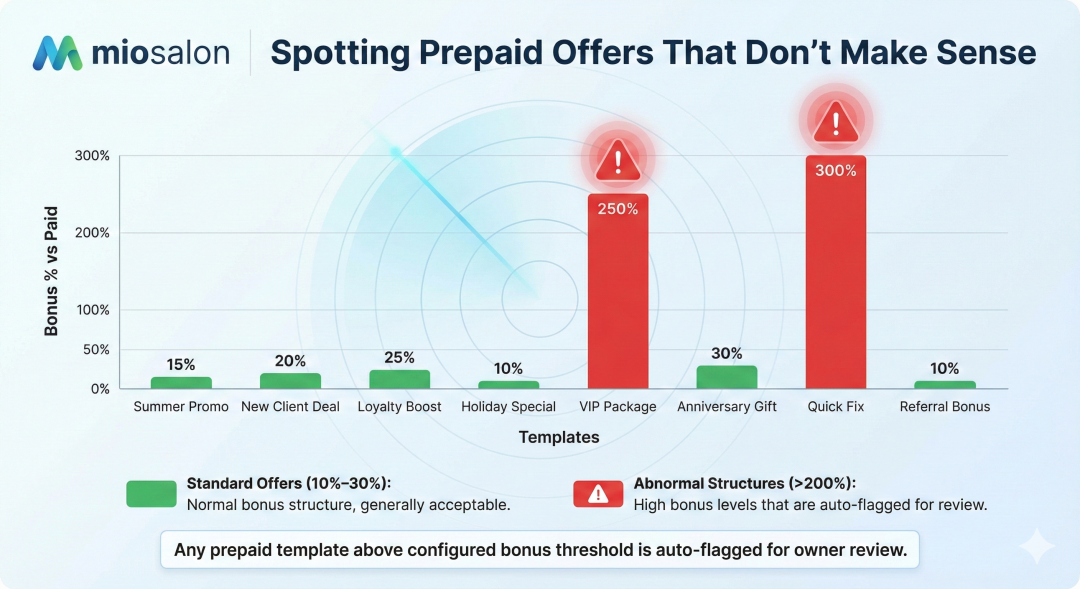
👉Block fake prepaid deals with MioSalon’s salon management software that locks bonus rules and audits every wallet top-up.
Theft 12: Large Package Sold to Friend, Then Redeemed Against Regular Clients’ Visit
How this theft works
This is a hybrid scam that combines under‑priced packages with cross‑account redemptions. A manager creates a package with a large number of service credits at a very low system price, sells it cheaply (or effectively to themselves or a friend), and then uses those credits to “pay” for services taken by regular clients who actually pay cash.
The steps:
- Manager creates a high‑credit package—say, 20 facials worth 1,000 INR each, total value 20,000 INR.
- They sell it in the system for a nominal 100 INR to a friend or a fake account, often with a phone number they control.
- Regular clients come in and pay 1,000 INR cash for each facial.
- The manager or staff bill those visits against the fake package, redeeming one credit each time, and pocket the full cash.
- Even with OTP‑based protection, if OTP goes to the fake number owned by the manager, they can confirm redemptions themselves.
The salon will eventually see a package heavily redeemed, but revenue numbers appear “normal” because each redeemed service corresponds to an actual visit; the missing piece is the cash, which never hits the system.
Real‑world illustration:
A spa offering facial packages migrated to MioSalon to gain better reporting. During the initial data review, we noticed one package code with:
- Very low recorded sale price per package (near free).
- Extremely high number of included services (15–20 facials).
- Redemption activity tied predominantly to one or two staff members.
- OTP logs where all codes were sent to the same obscure phone number.
Investigating further, the owner discovered that the branch manager had created an ultra‑cheap “staff trial” package, sold it to a friend, and then repeatedly used its credits to cover paying clients’ facials. The manager would accept cash from those clients, redeem a session from the package, and keep the money.
Potential monthly loss estimate:
Consider:
- A single large package with 20 sessions of a 1,000 INR facial (service value 20,000 INR).
- Package sold in system for 100 INR to a fake account.
- Each redeemed session covers a real client’s cash visit.
If the manager runs one such package to full redemption each month:
- Direct cash theft: roughly 20,000 INR (minus the nominal 100 INR recorded).
- Additional margin distortion: the business believes it honored a loyalty or staff‑only deal but has no matching strategic reason.
If multiple such packages or higher‑value services (for example, advanced skin treatments at 3,000–5,000 INR per session) are abused similarly, monthly leakage can quickly exceed 50,000–100,000 INR.
How MioSalon detects and limits cross‑account package theft
MioSalon’s layered controls for packages—creation rights, OTP, phone‑number governance, and analytics—work together to neutralize this scam when used across hair salon software, spa software, and skin clinic software contexts.
Key defences:
Restricted package creation and pricing:
As with Theft 10, managers generally cannot define both very high credit counts and negligible prices without oversight. Any package where total service value exceeds a certain multiple of sale price (for example, more than 1.5× or 2×) can be auto‑flagged.
Phone number verification and locking:
Fake accounts often rely on staff using their own numbers or disposable numbers. MioSalon requires unique, verified phone numbers per client. Owners can disable phone‑number edits for staff, preventing easy reassignment of a package’s OTP destination.
OTP plus behavioral analytics
Even if OTP is enabled and staff briefly manage to route codes to themselves, MioSalon can highlight:
- Packages with unusually high redemption frequency.
- Many redemptions approved by OTPs always going to the same number.
- Packages where redemptions occur without corresponding client feedback or recognizable names.
Owners can audit those specific client records and numbers.
Client‑facing transparency
If the fake package is ever tied to a real client, they’ll receive detailed usage messages. But in the design MioSalon encourages, genuinely high‑value packages are marketed openly, not hidden as “secret” staff deals. Any client hearing about such a package from staff but not seeing it in official materials may raise questions.
By making it technically hard to create huge, under‑priced packages and by tracking redemption behavior at a granular level, MioSalon sharply limits the room for this attack.
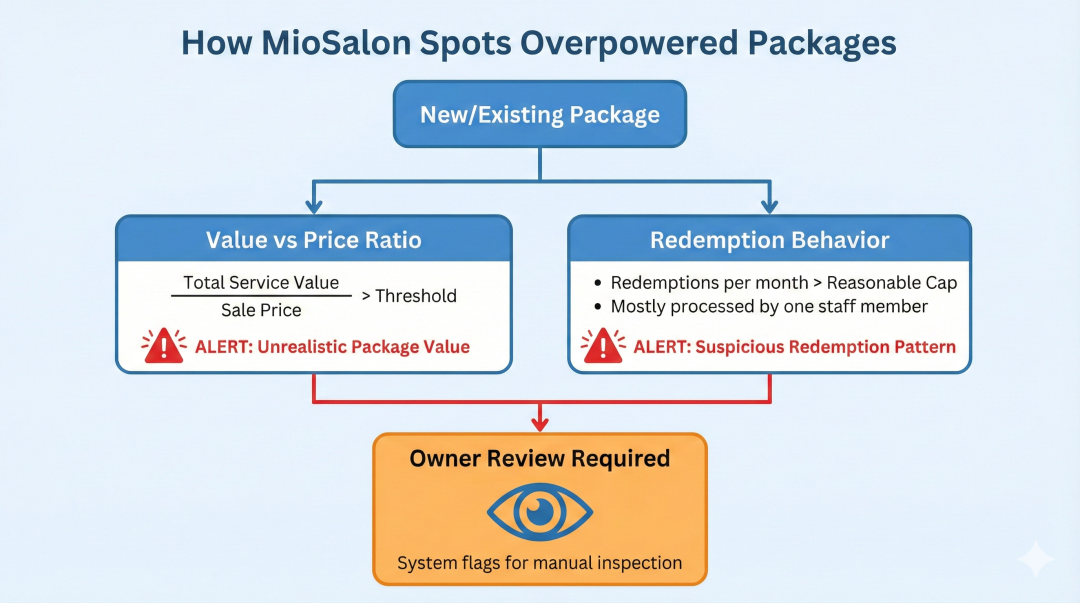
👉Stop fake packages being used on paying clients with MioSalon’s hair salon software that flags underpriced bundles and suspicious redemptions.
Theft 13: Billing a Low-Value Service Instead of the High-Value Service Actually Taken
How this theft works
This theft is simple but pervasive: staff charge the client for a high‑value service but record a lower‑value service in the system. The difference between actual charge and recorded value becomes their personal gain, especially when payments are in cash and clients do not receive or review detailed invoices.
The pattern:
- Client receives a 1,000 INR hair spa, facial, or add‑on treatment.
- Staff verbally quote and collect 1,000 INR.
- In the salon software, staff record a basic 500 INR service instead.
- The system shows 500 INR revenue; staff keep the extra 500 INR.
Even when printed invoices exist, some staff issue a genuine bill then later edit or cancel and re‑create at a lower value, as discussed previously.
Real‑world illustration
A busy men’s salon offered several haircut tiers and add‑on services like head massage or express facials. Many clients were regulars who trusted their stylists and rarely asked for detailed bills. The front desk and stylists realized they could:
- Charge 700 INR for a premium haircut and head massage.
- Record only a 400 INR basic cut in the barbershop software.
- Keep 300 INR.
On periodic promotional days, they aggressively pushed upsells like premium care or color, then under‑reported the associated services. The owner noticed strong chair utilization and service mix verbally but comparatively low average ticket values in reports. Because no digital invoices reached customers and edits were not audited, the discrepancy was hard to prove.
Potential monthly loss estimate:
For a single branch:
- 40 clients per day.
- 15 of them take high‑value services or upsells.
- Staff under‑record 5 of those per day, reducing system value by an average of 400 INR each.
Daily leakage: 5 × 400 = 2,000 INR. Over 30 days, that’s 60,000 INR lost per month. In premium salons, spas, and clinics—where add‑ons can be 1,000–3,000 INR each—under‑recording even a fraction of them can push the monthly loss well beyond 100,000 INR.
Given that salon and spa profit margins are already under pressure in many markets despite rising industry revenues, this type of leakage can neutralize the gains from any marketing effort.
How MioSalon makes service under‑billing visible and risky
MioSalon tackles this in two main ways: enforcing transparent client‑facing billing and providing owners with analytics that correlate service patterns and revenue.
Operational measures:
Mandatory digital invoices with full line‑items
MioSalon sends each client a digital invoice via SMS/WhatsApp/email that clearly lists services, quantities, durations (where applicable), discounts, and total amount charged. Clients see what the system thinks they paid for. If they were told they took a “premium spa + add‑on,” but the invoice only shows “basic haircut,” they can question it on the spot or later.
Edit and cancel controls
As covered in Thefts 2 and 3, any post‑billing edits or cancellations can be locked down, OTP‑gated, and notified to both owner and client. This prevents staff from issuing a correct invoice initially, collecting payment, then secretly downgrading the services on record.
Analytical safeguards:
Service mix and average ticket reporting:
Owners can see the distribution of services and average ticket by staff, time slot, and branch. For example:
- A stylist who frequently talks about selling color or keratin but whose recorded service mix shows mostly basic cuts is suspicious.
- Spa therapists with high booking hours but consistently low average invoice values need review.
Duration‑based services with strict mapping:
For spas or massage software scenarios, duration is often linked to price (30 vs 60 vs 90 minutes). MioSalon can map each duration to a clear SKU; staff cannot simply type arbitrary descriptions. If a therapist consistently records 30‑minute sessions when calendars show 60‑minute blocks, the system highlights it.
Customer feedback as an extra layer:
Post‑visit feedback forms can include a quick question: “Did your invoice correctly reflect the services performed?” Repeated discrepancies against certain staff members prompt investigation.
By making the billed service transparent to the customer and tying service mix tightly to system SKUs, MioSalon leaves far less room for staff to sell one thing, record another, and keep the difference.
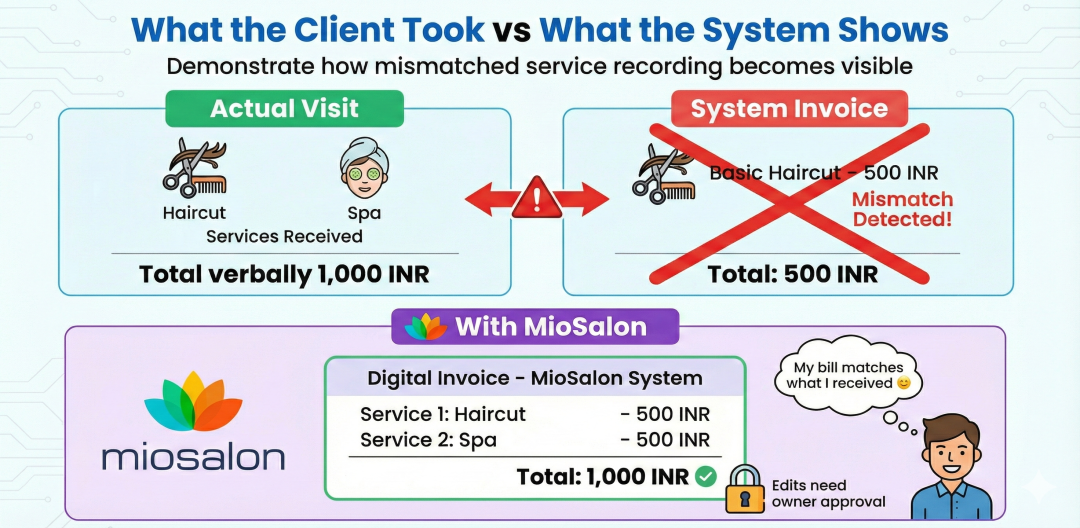
👉 Stop service downgrades with MioSalon’s Salon Appointment Software that sends instant digital invoices and locks post-billing edits.
Theft 14: Selling Products to Clients but Marking Them as Internal Consumption
How this theft works
Retail products—shampoos, masks, serums, oils, styling products—are a crucial profit center for salons and spas. At the same time, many of these products are also used for in‑service consumption. When inventory is not tightly managed, staff can exploit this dual use by:
- Selling products to clients off‑bill (cash only).
- Recording those items in the system as “internal consumption” rather than retail sales.
- Pocketing the cash while the product quantity is reduced in internal stock, not retail.
Since overall inventory levels fall and some level of internal consumption is expected, owners may overlook the discrepancy unless they closely track consumption norms per service.
Real‑world illustration
A spa combined services like facials and hair spas with a strong retail shelf. They stocked professional‑grade masks, serums, and oils. Inventory reports tracked total stock and a single “internal use” category, but not detailed per‑service consumption.
Staff in one branch began selling high‑margin retail masks at full price (for example, 1,200 INR each) to regular clients, taking cash and giving the products without generating retail bills. In the salon software, they then recorded those units as “internal consumption,” claiming they were used for facials. Because the owner expected some product usage per service and because the spa had moderate stock turnover, the theft went undetected.
Only after switching to MioSalon and enabling service‑linked product consumption did they see that internal usage of certain products far exceeded the number of qualifying services performed.
Potential monthly loss estimate
Assume:
- A popular mask costs the salon 400 INR and retails at 1,200 INR.
- Staff divert ten units per month via this scam.
Then:
- Lost revenue per month: 10 × 1,200 = 12,000 INR.
- Product cost incurred: 10 × 400 = 4,000 INR.
- Total profit impact: about 16,000 INR per month (lost profit plus unmapped cost).
For a wider range of products—shampoos, serums, oils—diverted in small quantities, monthly leakage can easily reach 30,000–50,000 INR in a mid‑sized salon. In larger chains, aggregated across branches, this becomes a high‑six‑figure annual issue.
Inventory‑related pilferage and retail shrinkage are well‑documented challenges in retail and beauty, and internal fraud often plays a major role. Without precise mapping between service volumes and product usage, this category of theft is almost impossible to spot early.
How MioSalon brings product consumption and billing together
MioSalon’s inventory engine is designed to support both salon software and spa software use cases where the same products appear in treatments and on retail shelves. The central idea is that every consumed unit should have a clear reason: retail sale or mapped internal use.
Key capabilities:
Retail vs internal stock classification
Products can be tagged as “Retail Only,” “Service Only,” or “Dual Use.” For dual‑use items, MioSalon tracks:
- Quantities sold as retail, tied to invoices.
- Quantities consumed internally, tied to services.
Automated and manual product consumption per service
For many services, owners can define expected product usage (for example, 30 ml of mask per facial). Every time that service is billed, MioSalon automatically deducts the corresponding quantity from internal stock. Staff cannot arbitrarily assign large internal consumption without matching services.
Internal consumption reconciliation reports
Owners can run reports showing internal product usage by:
- Service type.
- Staff member.
- Branch and time period.
If ten units of a retail mask are recorded as internal consumption in a month, but only five facials that require that mask were performed, the discrepancy stands out.
Physical stock audits tied to system data
Periodic stock counts can be compared to system levels. Significant negative variances in dual‑use products trigger an investigation into whether they were truly used for services or sold off‑bill.
These features make it much harder for staff to hide product sales under internal consumption. When MioSalon is used as nail salon software, tanning salon software, or aesthetic clinic software, similar principles apply: gels, tanning solutions, or single‑use consumables must map cleanly to services or retail.
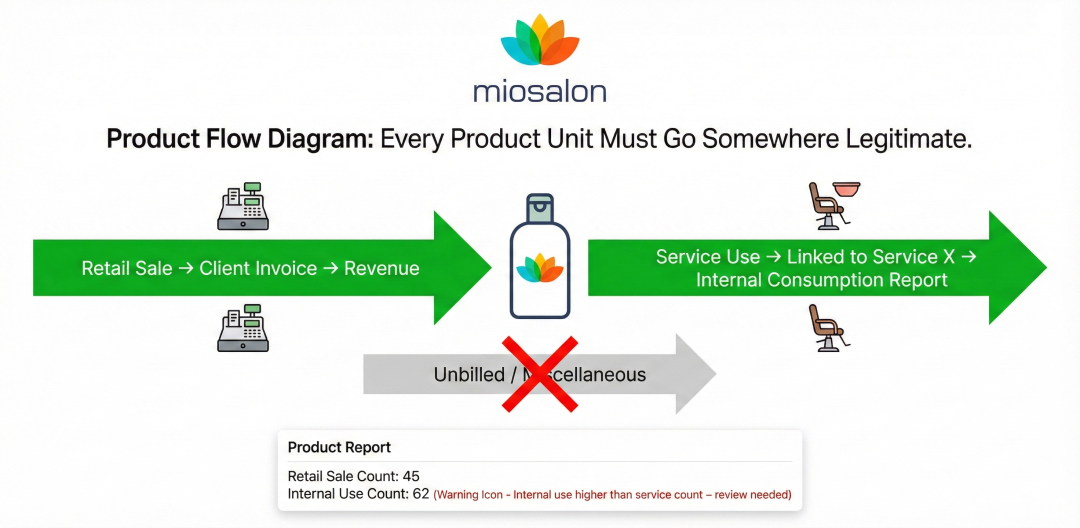
👉Cut retail shrinkage using MioSalon’s Beauty Parlour software that auto-maps product consumption to each treatment.
Theft 15: Redeeming Unused Gift Vouchers Against Other Customers
How this theft works
Gift vouchers and gift cards are a powerful cash‑flow tool, especially around festivals and peak seasons. Clients or corporates pay upfront, and recipients redeem services later. Globally, however, a significant share of gift card value is never used: estimates suggest up to 20% of balances go unspent, representing tens of billions of dollars annually. Dishonest staff know this and treat unused salon vouchers as a private “fund.”
The scam works like this:
- Staff access the list of issued vouchers and see which codes remain unused or nearly expired.
- When a regular client comes in and pays by cash, staff:
- To the system, it looks like a legitimate voucher redemption.
- In reality, the voucher recipient never visited; the staff member simply used their unused gift value to cover another person’s cash visit and kept the cash.
Generate a bill for that client.
After taking cash, change the payment method from “Cash” to “Gift Voucher.”
Enter one of the unused voucher codes and mark it as redeemed.
Because unredeemed vouchers are common in most industries, owners may not immediately notice slightly lower breakage. Staff rely on this assumption to hide the fraud.
Real‑world illustration:
A premium spa sold physical gift vouchers heavily during December. Historically, only 70–80% of those vouchers were redeemed, which aligned with general gift card behavior. The spa used basic voucher tracking via spreadsheets and a POS. Access to voucher codes was open to reception staff.
One receptionist began monitoring the unused voucher list and found many high‑value vouchers (3,000–5,000 INR) that were months old. On busy weekends, when cash clients came for couples’ massages or spa days, she:
- Charged them full price in cash.
- Issued a proper invoice initially.
- Later edited the bill in the system, replacing the payment mode with “Voucher” and entering one of the old codes.
- Marked the voucher as redeemed.
To the owner, voucher redemption looked strong. The cash shortfall was masked by small manual adjustments and the assumption that “clients forget small voucher balances.” Only when they moved to MioSalon and centrally digitized the voucher system did the pattern of redemptions linked to a single staff member become clear.
Potential monthly loss estimate
Gift voucher theft can scale quickly:
- Suppose the salon has 100,000 INR worth of outstanding gift vouchers at any point.
- Historically, 15–20% go unused (normal breakage).
- A dishonest staff member decides to “harvest” 20,000 INR a month from that pool.
If they divert 20,000 INR of unused voucher value every month by mapping it onto cash‑paying clients:
- The salon loses 20,000 INR in cash inflow that should have been recorded.
- Reports still show voucher redemptions, so nothing looks obviously wrong.
- Over 12 months, losses total 240,000 INR, not counting potential liability issues if original voucher holders attempt late redemption.
How MioSalon secures gift vouchers and redemptions
MioSalon handles vouchers as a first‑class, audit‑ready feature, crucial for salon software, spa software, and nail salon software users who rely on them for promotions.
Controls include:
Voucher code masking and permission control
Staff may validate a voucher presented by a client, but they do not see full lists of codes or full code strings by default. Access to the “voucher register” is restricted to owner or head‑office roles. This removes the pool of easy targets that staff can cherry‑pick.
One‑way mapping between voucher and client visit
When a voucher is sold, MioSalon records:
- Voucher code.
- Value and expiry.
- Purchaser and (optionally) intended recipient contact.
During redemption, the system expects that voucher to be presented (code, QR, or link) at the time of payment. Changing an existing cash transaction to “voucher” after the fact can be blocked or OTP‑gated.
Client notifications on voucher issue and redemption
MioSalon can send an SMS or email to the voucher purchaser (and recipient if known) at issue and redemption:
- “Voucher XXXX‑1234 worth 3,000 INR has been issued.”
- “Voucher XXXX‑1234 redeemed for 2,800 INR at Branch X on [date].”
If a voucher is used without the buyer’s knowledge, they can immediately raise a dispute.
Voucher analytics and breakage monitoring
Owners can track:
- Total vouchers sold vs redeemed.
- Breakage rate by period.
- Redemptions by staff and branch.
Unusual clusters of redemptions by one staff member or a sudden drop in breakage can signal fraud. This aligns with broader loyalty and voucher analytics practices where breakage rates are monitored for anomalies. leat
Together, these measures transform vouchers from a blind spot into a tightly controlled revenue tool.
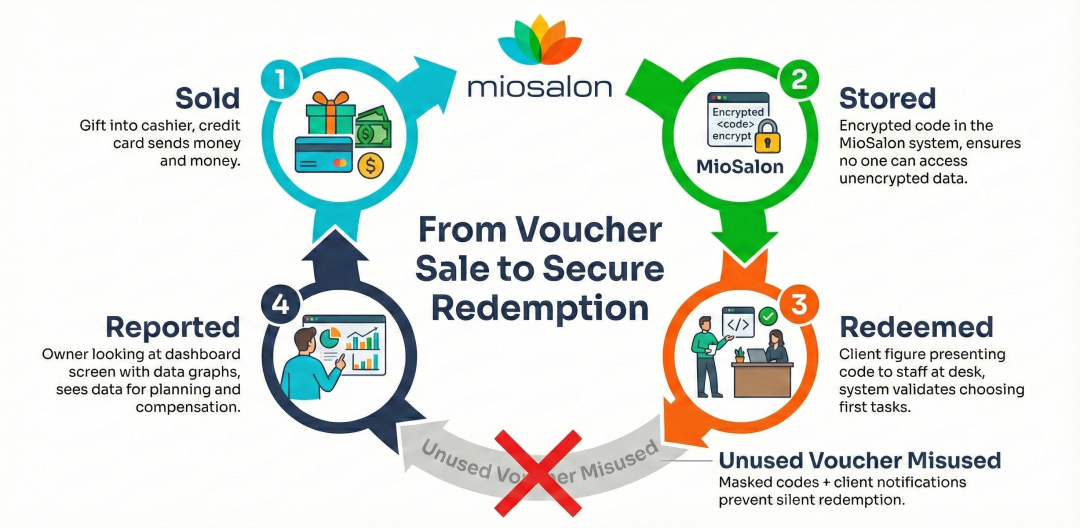
👉Stop gift card misuse using MioSalon’s software for beauty salon with OTP-secured payments and staff-level tracking.
Theft 16: Redeeming Reward Points Against Other Customers
How this theft works
Loyalty or reward points programs are now standard in salons, spas, and aesthetic clinics. Every visit or purchase earns points; accumulated points can be redeemed for discounts or services. As in other industries, a share of points typically goes unredeemed—breakage for retail programs often sits between 20% and 30%. That unredeemed pool tempts staff to “borrow” points from disengaged or inattentive clients and apply them to other paying customers.
The pattern:
- Staff identify high‑spending clients who rarely check or use their points.
- When another client pays cash, staff:
Temporarily change the phone number or identifier on the high‑spender’s profile to match the paying client.
Redeem the high‑spender’s reward points on that bill.
Switch the phone number back.
The system shows points redeemed, reducing loyalty liability; the staff keep the cash equivalent of those points.
Because loyalty programs are meant to reduce churn and raise LTV, high breakage and odd redemption behaviors directly undermine their value.
Real‑world illustration
A chain of premium salons used a points‑based loyalty program: 1 point per 100 INR spent, with 1 point equal to 1 INR at redemption. Clients regularly received points but few actively tracked balances. Front‑desk staff had full rights to edit client phone numbers.
One receptionist focused on top 10% spenders who did not care about small discounts. When a different client came in and insisted on a “better deal,” she:
- Logged into the high‑spender’s account.
- Swapped the phone number with the cash‑paying client’s number temporarily.
- Applied points to reduce the bill in the system.
- Collected full cash from the client.
- Switched the phone numbers back, leaving the high‑spender with lower points and no idea what had happened.
Over time, she siphoned thousands of rupees in equivalent value by re‑routing points.
Potential monthly loss estimate
Assume:
- Total outstanding loyalty points represent 100,000 INR in discount value.
- Normal breakage expectation: 20–30%.
- A staff member diverts 10,000–15,000 INR per month in points from inattentive clients to cash‑paying ones.
Then:
- Effective revenue leakage: 10,000–15,000 INR per month, as the salon gives discounts not to build loyalty but merely to mask staff theft.
- Over 12 months, 120,000–180,000 INR of loyalty value is burned without strategic benefit.
More importantly, if loyal clients eventually discover that their hard‑earned points vanished, trust and retention suffer—negatively impacting Client Lifetime Value beyond the raw numbers.
How MioSalon prevents loyalty point hijacking
MioSalon’s loyalty and points module is built to work across beauty salon software, barbershop software, spa software, and aesthetic clinic software, applying strict identity and communication controls.
Key protections:
Phone number edit permissions and logs:
Editing a client’s primary identifier (phone/email) is restricted to certain roles and always logged. Owners can:
- View a history of number changes.
- Receive alerts when high‑value clients’ numbers are altered.
- Block repeated toggling of the same profile within short intervals.
Automatic point balance display on every invoice:
Every invoice—printed or digital—shows:
- Points earned in this visit.
- Total accumulated points.
- Whether the client is eligible to redeem.
If points are redeemed without the client’s knowledge, they see lower totals or “0 points” unexpectedly, prompting questions.
Client notifications for point accrual and redemption
MioSalon can send real‑time messages:
- “You earned 80 points today; your total is 520.”
- “You redeemed 300 points on invoice #1234.”
If a client did not visit but receives a redemption message, the fraud is exposed quickly.
Loyalty analytics and breakage monitoring
Owners can track:
- Points issued vs redeemed over time.
- Breakage trends (points that expire unused).
- Redemptions by staff, branch, and customer tier.
Unusual spikes in redemptions processed by a particular staff member, or repeated redemptions against a small set of top clients who rarely visit, get flagged. This parallels best practices in other loyalty‑heavy industries where breakage and redemption are closely monitored.
With these measures, loyalty programs in MioSalon function as intended: to increase pre‑booking ratios, reduce churn, and drive LTV, not to enrich staff at the expense of both salon and customer.
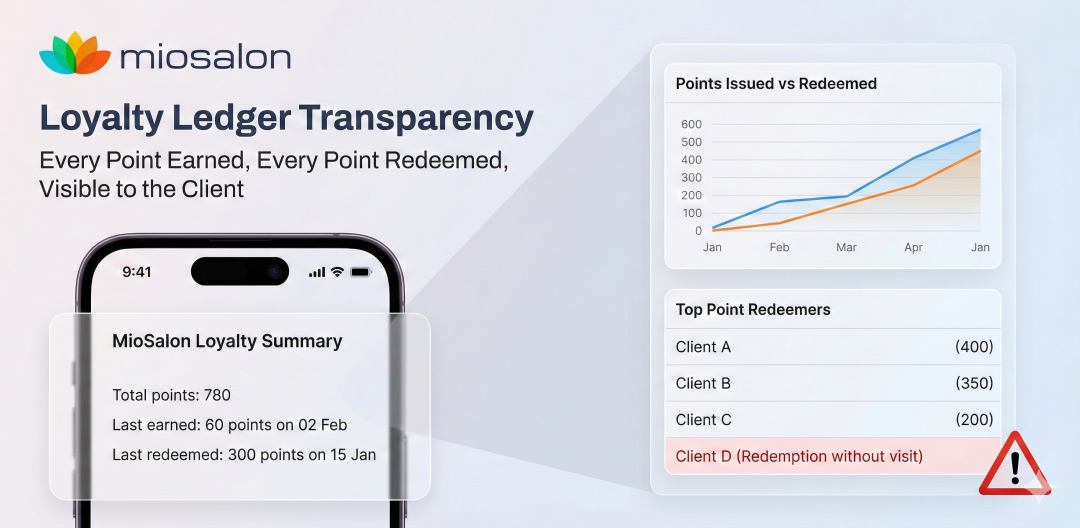
👉 Protect loyalty points and discounts with MioSalon’s hairdressing salon software that locks, edits and alerts owners in real time.
Theft 17: Deep Discounts on Cash Bills and Pocketing the Difference
How this theft works
Many salons empower staff to offer discretionary discounts to close sales, respond to complaints, or compete with nearby outlets. While flexible pricing can be a strategic tool, it also opens the door to abuse: staff can grant large “discounts” in the system after collecting full cash from the customer, keeping the difference.
The process usually looks like:
- Client is quoted a price of 2,000 INR.
- They pay 2,000 INR in cash.
- Staff record a bill for 2,000 INR but then:
Apply a 40–50% discount in the system, bringing recorded value down to 1,000–1,200 INR.
Or cancel and reissue the bill at a lower amount.
- Staff keep the 800–1,000 INR gap.
This is particularly common in:
- Barbershops and hair salons with “variable pricing” for stylists.
- Nail bars offering many small upsells and negotiable bundles.
- Spas during off‑peak hours, where staff claim they “had to discount” to get walk‑ins.
Real‑world illustration
A high‑traffic unisex salon allowed front‑desk staff to offer up to 30% discount without explicit approval, thinking it would help retain price‑sensitive clients. They relied on trust and occasional branch visits to monitor abuse.
One receptionist adopted the following pattern:
- On busy days, charge clients list price and say nothing about discounts.
- Later, edit bills or apply large “manual discounts” in the salon software.
- When questioned informally by colleagues, claim that clients had complained or negotiated.
Over a quarter, discount reports showed certain staff consistently giving higher discounts, but overall revenue still looked decent because volume was up. Only when the owner dug into cash vs digital payments did they notice that high discounts were mostly paired with cash, not card or UPI.
Potential monthly loss estimate
Assume:
- 35 bills per day.
- Average bill value: 1,800 INR.
- 60% paid in cash (21 per day).
- On 5 cash bills per day, staff retroactively apply an extra 30% discount after collecting full payment.
Then:
- Extra discount per manipulated bill: about 540 INR.
- Daily leakage: 5 × 540 ≈ 2,700 INR.
- Monthly (30 days): roughly 81,000 INR lost.
In higher‑ticket segments like skin clinic software or aesthetic clinic software contexts—where single services can cost 5,000–15,000 INR—the same tactic executed on fewer bills can cause even larger monthly losses.
How MioSalon constrains discount abuse
MioSalon provides structured discount governance, which is critical across hair salon software, barbershop software, spa software, and others.
Controls include:
Role‑based discount limits
Owners can define:
- Maximum discount % per role (for example, 10% for front desk, 20% for branch manager).
- Specific services where no manual discounts are allowed (for example, already heavily discounted packages or medical‑grade treatments).
Approval workflows and OTP for high discounts
For discounts above a threshold (say 15–20%), MioSalon can:
- Enforce an OTP approval sent to the owner or senior admin.
- Require a reason code (e.g., “service recovery,” “VIP exception”).
Real‑time notifications to clients
Clients receive digital invoices showing the price and discount applied. If they see a large “discount” they never got in cash or were not told about, it raises suspicion. Conversely, if they paid less but the bill shows full price, they are reassured the system is recording correctly.
Discount analytics dashboard
Owners see:
- Discount % by staff, service, and branch.
- Top 10 highest discounted bills per period.
- Patterns: for example, heavy discounts only on cash payments, or consistent end‑of‑day discount spikes.
These analytics align with generic advice to monitor discounts and pilferage statistics closely in salons.
By turning discounts from a casual manual action into a governed process, MioSalon keeps genuine flexibility while shutting down “deep discount for cash and pocket the rest” schemes.
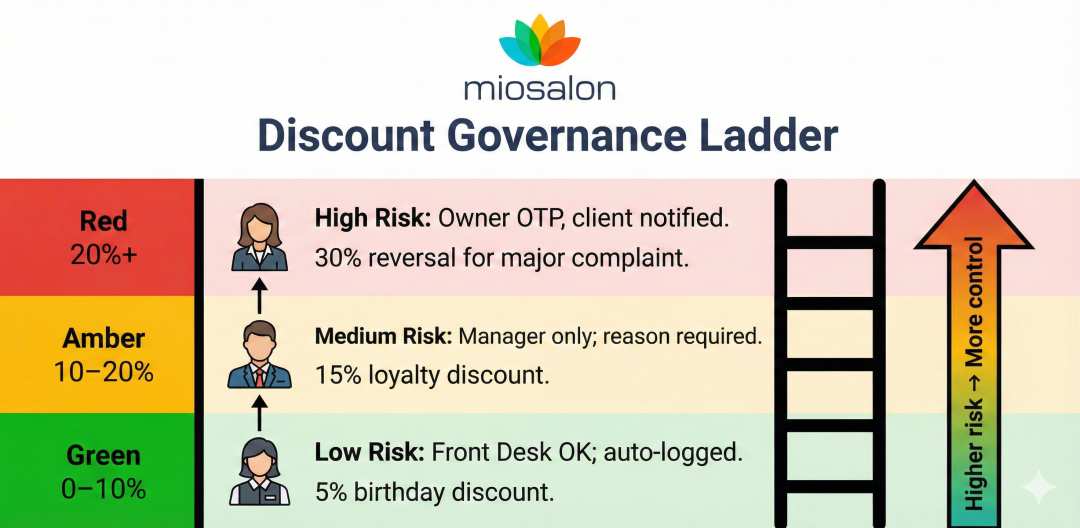
👉 Lock discount limits and stop cash leakage using MioSalon’s Salon Business Management Software with approval rules and live alerts.
Theft 18: Under-Valuing Duration-Based Services (Recording Less Time Than Delivered)
How this theft works
Many services—especially in spas, massage centers, tanning studios, and some hair treatments—are priced by duration. A 30‑minute massage costs less than a 60‑minute one; a “quick facial” is cheaper than an extended treatment. When staff can choose any duration entry, they can deliver the longer service but record the shorter one, taking the price difference in cash.
The pattern:
- Client receives a 90‑minute massage but is told verbally to pay 2,500 INR.
- In the massage software, staff record a 60‑minute session priced at 1,800 INR.
- The staff member keeps the 700 INR difference (or some part of it).
- If invoices are not sent or clients do not inspect them, the mismatch goes unnoticed.
This scam often joins with previous ones—no digital invoice, bill edits, and discount abuse.
Real‑world illustration:
A day spa with several treatment rooms offered 30‑, 60‑, and 90‑minute versions of massages and body scrubs. They used a basic booking tool plus separate billing, without strict mapping between appointment duration and billed duration.
Therapists began:
- Taking clients for 60‑minute sessions but billing 30‑minute ones.
- Suggesting “extended time” in the room, then under‑recording in the system.
- Accepting cash for the full amount and recording only part in the software.
The owner sensed something was wrong because therapists claimed to be fully booked while total revenue per hour remained surprisingly low. Without time‑linked billing, it was hard to prove.
Potential monthly loss estimate
Consider:
- 20 duration‑based services per day (massages, spa rituals).
- Average intended duration: 60 minutes.
- Average price difference between 60‑ and 30‑minute versions: 800 INR.
- Staff under‑record 4 sessions per day (billing 30 min instead of 60).
Then:
- Daily leakage: 4 × 800 = 3,200 INR.
- Monthly (30 days): 96,000 INR.
In high‑end spas or clinics where 90‑minute or specialized treatments carry much higher prices, the same scam on fewer services can still cost tens of thousands monthly.
How MioSalon aligns appointments, duration, and billing
MioSalon’s design for spa software, massage software, and tanning salon software tightly couples booking duration with service SKUs, making duration fraud far more difficult.
Key features:
Duration‑locked service codes
Each service variant (30-, 60-, 90‑minute) is set up as a distinct SKU with fixed duration and price. When an appointment is booked for 60 minutes, the associated SKU is the 60‑minute version; staff cannot casually downgrade to a 30‑minute SKU without editing the appointment, which is logged.
Calendar and invoice reconciliation
Owners can see:
- For each appointment: booked duration vs billed duration.
- For each therapist: total booked hours vs billed revenue.
System flags where billed duration is consistently lower than booked duration for a given staff member.
Detailed digital invoices
Clients receive invoices stating duration and service type (for example, “Relaxation Massage – 60 minutes”). If they paid for or experienced a 60‑minute treatment but the bill shows 30 minutes, they can question the discrepancy.
Edit controls and notifications
Any post‑visit change to service duration or amount can be OTP‑gated and notified as described earlier. This makes it riskier for staff to adjust durations quietly after clients leave.
By binding time and billing together, MioSalon improves both revenue integrity and capacity planning. Owners know they are paid appropriately for every booked minute of therapist time.
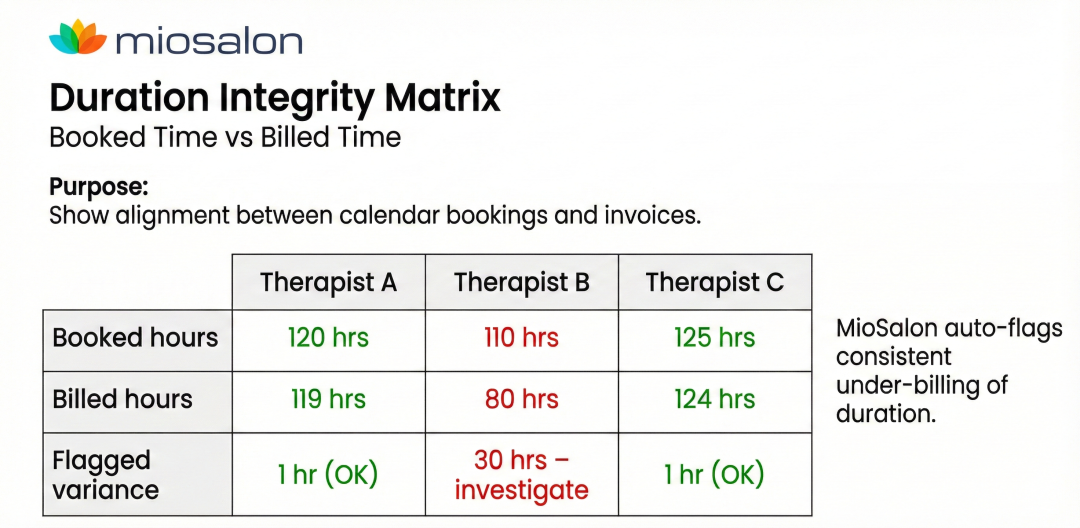
👉 Protect every booked minute with MioSalon’s software for beauty parlour that matches appointments to billed time.
Theft 19: Turning Off Notifications, Then Editing or Cancelling Bills
How this theft works
All of the previous edit, cancel, and mis‑billing scams become much easier if staff can quietly turn off customer notifications. If SMS or email alerts about invoices, edits, and cancellations are disabled at the user level, staff can:
- Collect cash at full value.
- Edit the bill to reduce or cancel its value.
- Avoid detection because the client never receives a corrected or cancellation message.
In other words, they remove the external “watchdog” layer—your clients—by flipping a settings switch, and then proceed with internal manipulation.
Real‑world illustration
A salon chain that recently implemented digital invoices noticed a drop in fraud at branches where notifications were always on. At a particular branch, however, odd patterns continued: cash shortages, missing bills, and unusually high levels of edited or cancelled invoices.
Upon investigation, they found:
- Staff had access to notification settings in the salon management software.
- A few users routinely disabled SMS notifications “to avoid spamming customers.”
- After turning notifications off, they:
Cancelled or edited bills for cash‑paying clients.
Reduced recorded values.
- Since clients no longer received messages, there were no complaints about changed or missing invoices.
The branch’s fraud was more persistent precisely because the notification system—a key protective layer—had been undermined.
Potential monthly loss estimate :
This theft is an enabler of others rather than a standalone numeric pattern, but we can still estimate impact by considering how many manipulated transactions become invisible when notifications are off.
If:
- 20 bills per day are edited or cancelled in a branch.
- Average leakage per manipulated bill (from previous patterns) is 300–800 INR.
- Staff disable notifications for those bills.
Then plausible daily leakage ranges between 6,000 and 16,000 INR. Over 30 days, that becomes 180,000–480,000 INR that clients could have helped flag—if only they had been notified.
How MioSalon locks notification settings and exposes misuse
MioSalon recognizes customer notifications as a core security feature, not just a marketing add‑on. When used as salon software, beauty salon software, or spa software, owners can harden this layer.
Key protections:
Centralized control of notification settings
Only owner or head‑office roles can:
- Enable or disable SMS/WhatsApp/email notifications by event type (new invoice, edit, cancellation, appointment).
- Change sender IDs or templates.
Front‑desk and branch staff cannot simply turn off notifications for all or selected clients.
Per‑client notification lock
While clients can opt out of marketing messages, transactional notifications (bills, OTPs, appointment confirmations) can be kept compulsory. MioSalon separates these categories, preventing staff from disabling transactional alerts under the guise of “reducing spam.”
Audit log for setting changes
Any attempt to change notification configurations is logged with user, time, and old vs new values. Owners can review a “Notification Changes” report as part of their monthly oversight routine.
Cross‑checking notifications against edits and cancellations
MioSalon can surface:
- Number of edited/cancelled bills.
- Number of corresponding client notifications sent.
If a branch has high edit/cancellation activity but unusually low notification counts, you know that someone has tampered with settings or is trying to avoid scrutiny.
By treating notifications as a security perimeter, MioSalon ensures that clients remain informed co‑auditors of their own bills, drastically reducing the risk of silent fraud.
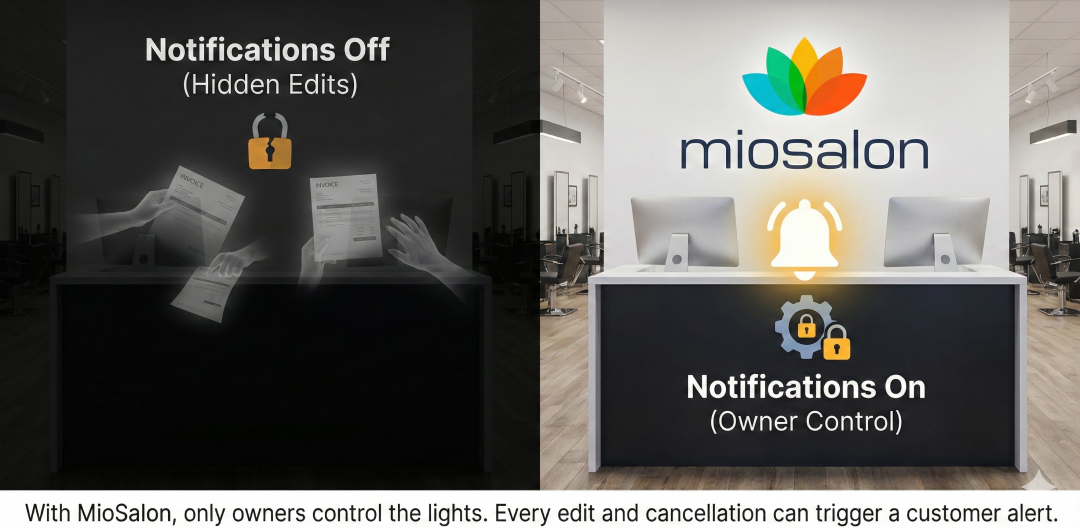
👉 Expose hidden bill changes through MioSalon’s best medical spa software that cross-checks edits with sent alerts.
Theft 20: Printing Duplicate Copies of Existing Bills and Handing Them to Other Clients
How this theft works
In print‑heavy environments, one of the simplest frauds is reusing an existing genuine bill as a receipt for another client. Instead of creating a new invoice, staff:
- Print a duplicate copy of an earlier bill for similar or identical services.
- Hand that print to a new client as if it is their own receipt.
- Collect cash and never record the new visit in the salon software.
Because the paper invoice looks legitimate—correct logo, tax information, and realistic line‑items—most clients never suspect anything. The salon’s records show only the original transaction, not the new one.
This pattern is especially risky in:
- Barbershops and hair salons doing many identical haircuts daily.
- Nail salons with repetitive service combinations.
- Spas where many clients do basic, similar packages.
Real‑world illustration
A popular barbershop used printed invoices but did not track how many times a bill could be reprinted. Staff realized that a haircut bill from the morning could be reprinted in the afternoon for another client receiving the same service.
The typical flow became:
- Client A gets a 400 INR haircut at 10:00 a.m. A genuine bill #250 is created and printed.
- Client B gets a 400 INR haircut at 3:00 p.m. Staff print a “duplicate” of bill #250, give it to Client B, collect 400 INR in cash, but do not create a fresh bill.
- End‑of‑day system reports only one billed haircut (#250), but two haircuts were actually done, with 400 INR of cash never recorded.
Over weeks, multiple staff used this method whenever the service matched an earlier transaction.
Potential monthly loss estimate
For a moderate‑volume outlet:
- 50 haircuts or similar repeatable services per day.
- Fraudster reuses 3 duplicate bills per day for cash clients.
- Ticket size per service: 400 INR.
Daily leakage: 3 × 400 = 1,200 INR. Monthly (30 days): 36,000 INR. In multi‑chair setups with higher service values or more complex add‑ons, numbers can be even higher.
Since the system never sees the second transaction, owners relying only on software reports will underestimate both volume and revenue.
How MioSalon stops duplicate‑bill misuse
MioSalon treats each invoice as a unique, traceable object, and it gives owners tight control over reprints. Across barbershop software, hair salon software, and beauty salon software use cases, core controls include:
Limit on duplicate prints per invoice:
Owners can set a maximum number of allowed reprints (for example, 1 or 2). After that, any further attempt:
- Is blocked altogether, or
- Requires higher‑level permission or OTP.
This prevents staff from repeatedly using the same bill as a generic receipt.
“Reprint” watermark and timestamp
Duplicate copies can automatically carry a “Duplicate / Reprint” watermark and a timestamp, making it obvious to both client and owner that this is not the original. If a client receives a “duplicate” for their very first visit, they might question it.
Digital invoices as default
Even when print is used, MioSalon can send digital invoices to the client’s phone. If a client gets a printed bill but no digital invoice, it becomes suspicious. This helps phase out reliance on paper alone.
Invoice‑to‑customer binding
Each invoice is tightly linked to a specific client profile or phone number. If the same invoice number is reused with a different client, owner‑level reports and random audits can quickly reveal anomalies (for example, conflicting feedback or mismatched contact history).
These measures mean that reusing existing invoices becomes technically difficult and easily traceable, making it an unattractive fraud route for staff.
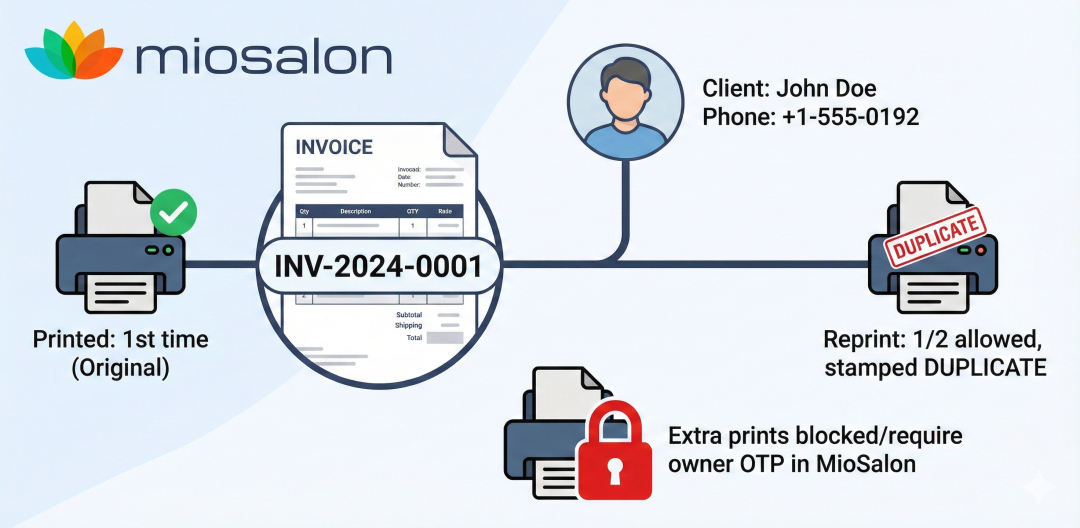
👉Make every receipt traceable through MioSalon’s Barbershop Booking System with watermarking and audit logs.
Theft 21: Adding Fake Expenses to Past (Already Audited) Dates
How this theft works:
Expense manipulation is a classic fraud vector across many industries. In salons, staff who handle cash and petty expenses can hide theft by:
- Stealing cash from the till.
- Creating fake or inflated expenses on dates that have already been reviewed and “closed” by the owner.
- Ensuring that new expenses back‑dated into previously audited periods make the current day’s cash appear to balance.
Because owners often review expenses by week or month and do not revisit old periods, back‑dated entries slip under the radar.
Typical pattern:
- Owner audits Week 1 and accepts expense total as final.
- In Week 3, a staff member steals 5,000 INR from cash.
- To hide the difference, they enter a 5,000 INR “product purchase” or “miscellaneous” expense dated in Week 1.
- Current cash now matches reported revenue minus same‑day expenses; theft is hidden inside a previously “closed” period.
Real‑world illustration
A multi‑chair salon allowed branch managers to add expenses directly into the system with full back‑dating rights. Owners reviewed expenses weekly and rarely re‑opened old weeks.
A manager routinely:
- Took small amounts of cash (2,000–5,000 INR) per week.
- Logged fake utility or supply expenses dated in weeks that had already passed their review.
- Printed occasional fake receipts or used old supplier bills with changed dates.
Over a year, cumulative theft exceeded 300,000 INR. Because the owner only compared total monthly expenses to rough expectations and not to vendor invoices per period, the fraud survived for many cycles.
Potential monthly loss estimate
Consider:
Weekly petty cash budget: 10,000–15,000 INR.
Staff divert 5,000 INR every week and back‑date a fake expense into an already‑audited period.
Then:
- Monthly loss: about 20,000 INR.
- Annual loss: 240,000 INR.
In high‑volume salons or spas with more complex expenses (laundry, consumables, rent adjustments), the same tactic can hide even larger sums.
How MioSalon controls back‑dated expense entries
MioSalon’s cash and expense management features are built with internal control principles in mind—something many salon owners overlook when they focus only on billing and appointments.
Key safeguards:
Date‑range locks for cash entries:
Owners can “close” a day, week, or month. Once closed:
- No new expenses can be added for those dates without opening the period.
- Any reopening action is logged with user and reason.
This mimics accounting‑style period closing, making it risky to back‑date expenses.
Permission‑based back‑dating
If some back‑dating is necessary (for example, late supplier invoices), only owner‑level or head‑office roles can:
- Add entries to past dates.
- Edit older expense records.
Branch staff are restricted to same‑day or limited backward windows.
Expense categorization and document attachment
Each expense entry can be categorized and, where feasible, have an attachment (photo of bill or invoice). Random audits become easier: owners can pick a sample of expenses and verify receipts.
Reconciliation views
MioSalon offers views that summarize:
- Cash collected per day.
- Expenses entered per day.
- Cash to be deposited.
Sudden spikes in past‑date expenses or mismatched patterns become visible across branches.
By treating expenses with the same rigor as revenue, MioSalon significantly reduces the ability of staff to “fix” today’s cash shortfalls by doctoring old days.
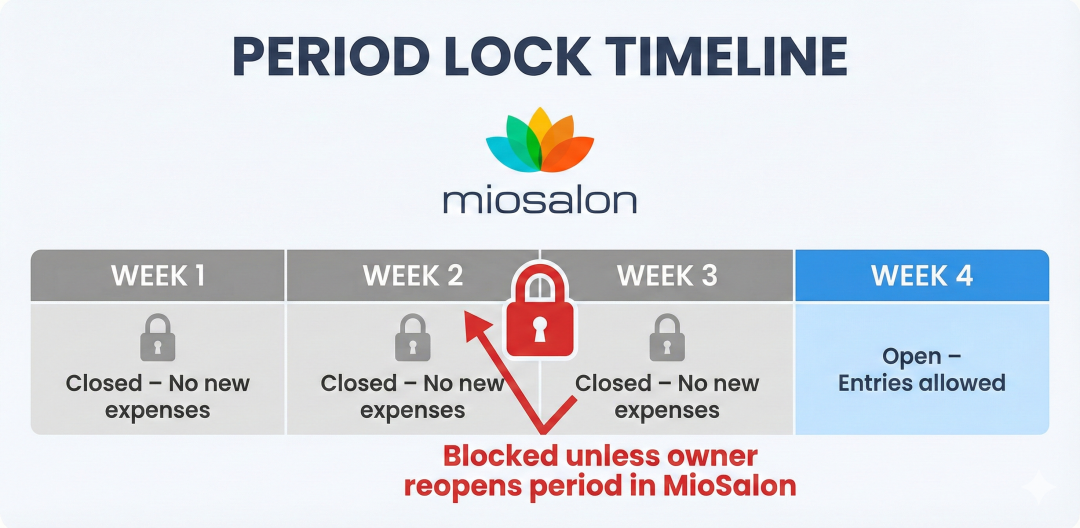
👉Lock past dates and stop fake expenses using MioSalon’s Salon Data Security with audit-ready cash controls.
Theft 22: Creating Backdated Bills to Look Genuine, Then Cancelling Them Later
How this theft works
This is a more advanced variant of bill manipulation. Staff exploit backdating to make an invoice look legitimate to the client (correct service, amount, and even a digital notification), but they:
- Create the bill for a past date that has already been or soon will be audited.
- After the client leaves and the past date is “out of scope” for daily reviews, they cancel that backdated bill.
- Since owners usually review only current‑day cancellations, the backdated cancellation goes unnoticed.
Essentially, they create a ghost bill in the past and then erase it quietly, while keeping the client’s current‑day cash.
Real‑world illustration:
A spa using an older system allowed staff to choose any bill date when creating invoices. Staff began:
- On today’s date (say 20th), entering bills dated 10th or 12th.
- Clients still received digital or printed invoices with correct service and price, usually not paying attention to the date.
- After end‑of‑day, staff cancelled those backdated bills.
The owner checked the current day’s (20th) reports and saw no cancellations. When reviewing Week 2 earlier, the dated bills were not yet present. Unless they re‑ran reports for all earlier weeks with cancellation filters, the fraud stayed hidden.
Potential monthly loss estimate
Assume:
- 2 backdated‑then‑cancelled bills per day.
- Average bill value: 2,000 INR.
- All paid in cash.
Daily leakage: 4,000 INR. Monthly (30 days): 120,000 INR. In high‑ticket clinics, a single such bill per day could produce comparable or higher leakage.
How MioSalon tracks and exposes backdated billing and cancellations
MioSalon’s philosophy is that time manipulation is a red‑flag action. Whether used as salon software, spa software, or aesthetic clinic software, the system offers:
Control over bill date editing
By default, bill date is the current date and cannot be changed by front‑desk users. Backdating:
- Can be completely disabled, or
- Allowed only for specific roles with OTP and reason logging.
Comprehensive cancellation history across dates
MioSalon doesn’t limit cancellation reports to “today.” Owners can:
- View all cancellations for any date range.
- Filter by creation date vs cancellation date.
A bill created on 10th but cancelled on 20th is clearly visible and suspicious.
Owner alerts for late cancellations
You can set rules such as: “Alert me for any bill cancelled more than 24 hours after creation.” These alerts help catch precisely this type of delayed, backdated fraud.
Cross‑checking appointments and bills
If appointments are logged properly, MioSalon can highlight:
- Visits with appointments but no final bill.
- Bills whose service date and bill date differ by an unusual amount.
This is particularly powerful in appointment‑heavy setups like bridal salon software, massage software, or skin clinic software.
By eliminating easy backdating and shining light on late cancellations, MioSalon makes it very difficult to erase revenue stealthily.
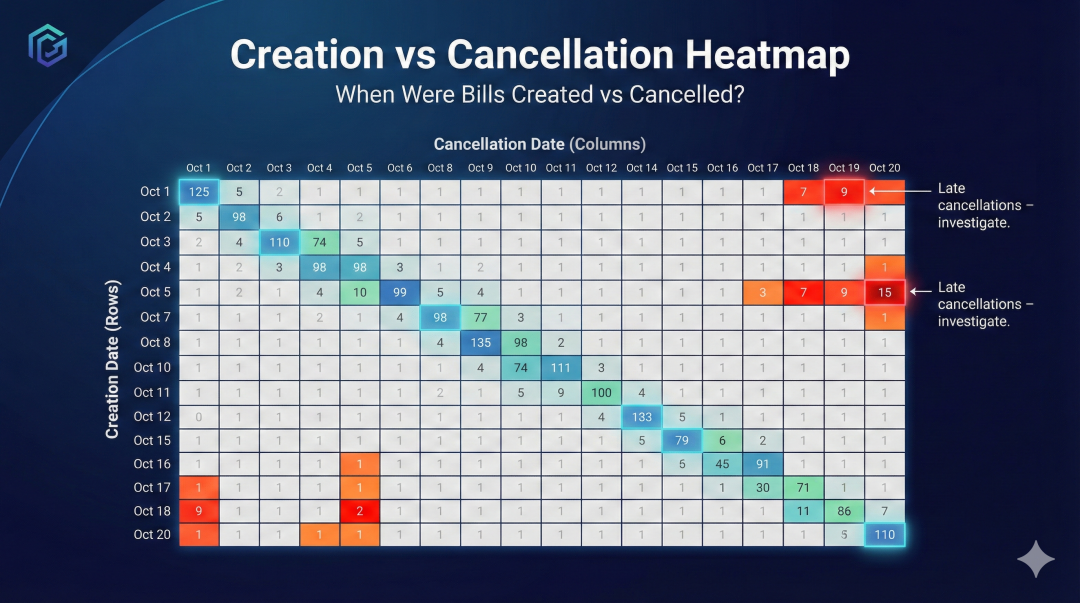
👉Catch late edits fast using MioSalon’s Spa Pilferage Control with backdate controls and owner alerts.
Theft 23: Viewing and Extracting Customer Phone Numbers for Future Poaching
How this theft works:
Customer phone numbers and emails are not just contact details; they are your recurring revenue engine. If staff can freely see, copy, or export them, they can:
- Build their own customer list before resigning.
- Sell client data to competitors or aggregators.
- Personally solicit high‑value clients once they move to a new salon or freelance.
This is related to Theft 1 (downloading client data), but it happens at the micro level: staff taking photos of screens, writing numbers in notebooks, or gradually building a database.
Real‑world illustration:
In many salons, it is common to see reception or stylists reading out client phone numbers aloud or writing them on paper forms. A stylist might maintain a personal diary of “top clients” with:
- Names and numbers.
- Service preferences.
- Appointment patterns.
Over time, when they leave to open their own studio, they simply start messaging these clients directly: “I’ve moved to a new space, same quality, better prices.” Because they know the client’s preferences and history, conversion rates are high.
If your salon software shows full phone numbers in every report and screen, this silent leakage is almost impossible to stop without design changes.
Potential monthly loss estimate
Quantifying this precisely is hard, but we can approximate impact of losing a slice of your top clients:
- Say you have 500 high‑value clients.
- Average monthly spend per such client: 3,000 INR.
- If a leaving stylist/managers successfully poaches 40 of them (8%), monthly revenue loss is 40 × 3,000 = 120,000 INR.
- Annualized, that is 1.44 million INR of revenue shifted to a competitor.
As industry benchmarks show, top clients often contribute a disproportionate share of revenue and profit. Losing even a small fraction can materially hurt LTV and branch performance.
How MioSalon masks sensitive contact data while preserving operations
MioSalon’s access‑control model is built to allow staff to do their jobs—booking, rebooking, analyzing customer behavior—without exposing raw contact data unnecessarily.
Core features:
Phone number masking at role level:
For most staff roles, MioSalon:
- Displays phone numbers partially masked (for example, 9XXX‑XX234).
- Allows calling or messaging through integrated buttons without revealing full numbers.
- Shows full numbers only to a small set of trusted roles (owner, head office).
Report‑level masking and export control:
Even in downloads and reports:
- Contact details can be masked or removed entirely.
- Only owner‑level roles can export full lists with IDs and contacts.
This makes casual copying of thousands of numbers infeasible.
Operational flexibility without exposure
Staff can still:
- Filter clients for campaigns.
- Analyze visit frequencies, spend, and churn.
- Segment by membership, prepaid, or package behavior.
But they work with anonymized IDs or masked numbers, not raw PII, aligning with modern data‑protection best practices.
By default, MioSalon assumes that your client list is a strategic asset that must be shielded—even from well‑meaning staff—to preserve long‑term LTV.
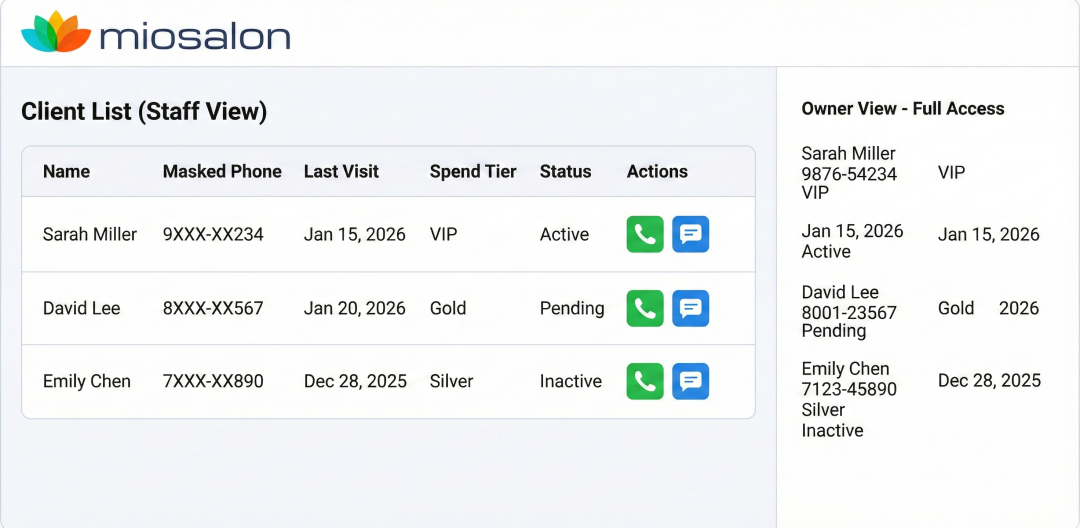
👉 Protect your client list with MioSalon’s salon CRM software that masks phone numbers and controls exports.
Theft 24: Online Appointment Spam to Block Staff Calendars
How this “theft” works:
Not all threats are internal. Competitors or malicious actors can attack your business by flooding your online booking system with fake appointments. The goal is to:
- Block your staff schedules with no‑show appointments.
- Make real clients see “no availability” and go elsewhere.
- Waste staff time and lower utilization.
In more extreme cases, spammers might use scripts or bots to create large volumes of bogus bookings. In digital scheduling systems outside beauty, requiring email or phone verification has been shown to cut spam by over 90%. The same logic applies to salon software.
Real‑world illustration:
A high‑end salon opened online booking widely: any visitor could pick a stylist and time, enter any name and phone number, and book without upfront payment or verification. Within weeks:
- Popular weekend slots with star stylists showed fully booked.
- Actual footfall during those hours turned out to be poor, with many no‑shows.
- Some “clients” never picked up calls on the numbers used to book.
Owners suspected competitors or pranksters were flooding their calendars. Meanwhile, genuine clients checking the online booking page often saw “no slots available” and gave up or went to other salons that showed availability.
Potential monthly loss estimate
If spam bookings fill just:
- 3 premium slots per day (for example, Saturdays and Sundays with top stylists).
- Average bill per premium slot: 3,000 INR.
- Utilization drops because real clients cannot book those times.
Potential lost revenue: 3 × 3,000 × 8 weekend days ≈ 72,000 INR per month, not counting weekday spam. In skin clinics or bridal studios where single appointments can be worth much more, stakes are even higher.
How MioSalon secures online booking against spam
MioSalon embeds anti‑spam and validation features into its online booking module, whether used as salon software, spa software, bridal salon software, or nail salon software.
Controls include:
OTP‑validated bookings:
Before confirming an appointment, MioSalon can:
- Send an OTP to the entered phone number.
- Confirm booking only if OTP is correctly entered.
Fake numbers or bot submissions fail this step, mirroring how email/phone verification dramatically reduces fake bookings in other systems.
Mandatory partial or full prepayment:
Owners can configure:
- Minimum booking fee (for example, 10–30% of estimated service value).
- Full prepayment for high‑demand categories (bridal trials, long spa rituals).
- Requiring payment strongly discourages spam and no‑shows.
Booking rules and limits:
MioSalon can enforce:
- Booking limits per phone number or per day.
- Lead‑time rules (for example, no same‑minute bookings).
- Cancellation and rescheduling policies.
These rules reduce both abuse and genuine errors.
Monitoring of no‑show rates and source channels:
The system reports:
- No‑show rates by source (online vs manual).
- No‑show rates by client profile.
- Any pattern of repeated no‑shows from particular numbers or IPs can be blocked.
In combination, these features protect your most valuable asset—your bookable time—so that yoursalon management software genuinely drives occupancy instead of exposing you to schedule sabotage.
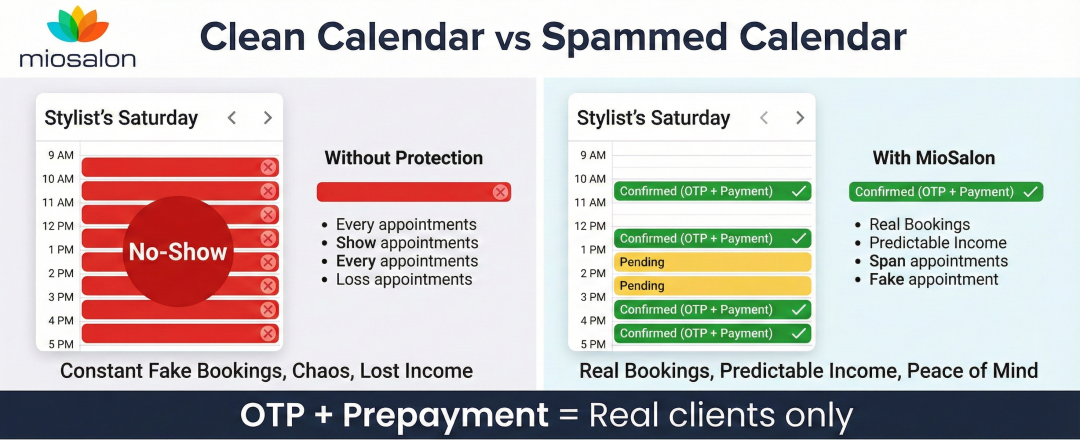
👉Stop fake reservations through MioSalon’s spa appointment software with no-show tracking and booking limits.
Closing: From Creative Theft to Systemic Protection with MioSalon
In my 15+ years consulting for salons, spas, and aesthetic clinics, and reviewing datasets from hundreds of MioSalon customers, one insight repeats: theft is rarely a single big event. It is a thousand small cuts—discount tweaks, silent cancellations, misuse of credits, data leaks—that, together, can erode 10–20% of your real profit if left unchecked.
The core problem is structural:
- As you grow, you must trust managers and staff.
- Trust without systems invites creativity in the worst ways.
- Manual controls cannot keep up with the complexity of modern multi‑branch operations.
That is why technology—specifically, an all‑in‑one salon management software such as MioSalon—becomes your operating system for both growth and protection. Whether you run:
- A chain of hair salons or barbershops needs tight hair salon software and barbershop software controls.
- A multi‑service spa with massage, facials, and rituals needs robust spa software and massage software.
- A specialist bridal, nail, tanning, or aesthetic practice requiring tailored bridal salon software, nail salon software, tanning salon software, skin clinic software, or aesthetic clinic software.
The same logic applies: you design theft out of your workflows instead of chasing it after the fact.
When fully implemented, MioSalon helps you:
- Increase revenue capture by ensuring every visit, every minute, and every product is properly billed.
- Protect recurring revenue streams ( prepaid, packages, memberships, loyalty) with OTP, masking, and client‑visible ledgers.
- Shield client data so that your LTV engine is not stolen every time a star stylist resigns.
- Turn customers into a living audit system through real‑time digital invoices and notifications.
- Equip owners and multi‑branch executives with anomaly dashboards and period controls so small leaks are caught early.
Industry data shows the global salon and spa sector is growing steadily in both revenue and complexity. In that environment, the businesses that thrive are not the ones with the fanciest interiors, but the ones with disciplined, software‑backed operations. MioSalon’s own guidance on internal controls for salons emphasizes that structured systems—inventory tracking, audit trails, access controls—are the most reliable deterrent to employee fraud.
If you are serious about:
- Lifting your Client Lifetime Value by 20–30%.
- Stabilizing cash flow.
- Scaling from one outlet to many without losing control.
Then the next step is straightforward:
- Implement MioSalon across all branches as your unified salon software platform.
- Configure the permission, OTP, and notification rules described in these 24 theft scenarios.
- Run a focused 90‑day review cycle to measure reduced leakages and improved profitability.
Schedule a MioSalon demo to see these controls in action on your own data, or start a free trial and experience how quickly systemic protection pays for itself through recovered revenue and peace of mind.