


How to Set Up a Salon Staff Commission System That Boosts Profits (2026)

Introduction
A salon’s success depends on two things: happy clients and motivated staff.
While great service brings customers back, a smart commission structure keeps stylists driven, consistent, and loyal to your brand.
According to industry data, over 85–92% of a salon’s revenue comes directly from services performed by staff, making your team the biggest driver of income and profitability.
Most salons struggle to create a commission system that is fair, profitable, motivating, and scalable. Some pay too much, hurting margins; some pay too little, causing staff churn, and some track everything manually and end up with disputes every month.
This guide will help you build a system that balances your profitability, your staff’s motivation, and your salon’s long-term growth.
Table of Contents
- Why a Strong Commission Structure Matters?
- What are the Types of Commission Models Used in Salons?
- How to Build the Right Commission Structure for Your Salon?
- What Are the Biggest Mistakes Salons Make With Commission Payouts?
- How MioSalon Simplifies and Strengthens Your Salon Commission System?
- The Biggest Mistakes Salons Make With Commission Structures
- Conclusion
- FAQs
Why a Strong Commission Structure Matters?
A well-designed salon commission model is a performance system. Here’s what the right commission structure achieves:
- Encourages stylists to upsell and improve their skills
- Increases average bill value
- Boosts retail sales
- Reduces staff turnover
- Gives you predictable profits
- Aligns staff goals with business goals
Simply put, your commission system shapes your salon culture. If you get this right, everything else becomes easier.
What are the Types of Commission Models Used in Salons?
1. Percentage-Based Commission
This is the most common model. Stylists earn a fixed percentage of the revenue they generate.
Example:
A stylist gets 30% commission on all services they perform.
If they do services worth ₹10,000, they earn ₹3,000.
Pros: Easy to calculate, motivates performance.
Cons: If the percentage is too high, it reduces salon profit.
2. Tiered (Slab-Based) Commission
Commission increases as stylists achieve higher targets.
Example:
- Up to ₹50,000 sales → 25%
- ₹50,001–₹80,000 → 30%
- ₹80,001+ → 35%
Pros: Encourages stylists to hit higher sales.
Cons: Can be confusing without clear rules.
3. Commission on Services vs. Retail Products
Some salons split commissions into two categories:
a) Service Commission
Percentage or tiered commission on services like facials, haircuts, coloring, etc.
b) Retail Commission
Separate, often higher commission (10–20%) on product sales.
Pros: Boosts retail revenue, encourages cross-selling.
Cons: Requires proper tracking.
4. Team-Based Commission
Commission is shared across the team instead of individuals. Everyone earns based on overall salon performance.
Example:
If the salon hits ₹10 lakhs/month, each team member gets a percentage based on their role/level.
Pros: Encourages teamwork, reduces client hoarding.
Cons: High performers may feel under-rewarded.
How to Build the Right Commission Structure for Your Salon?
Every salon is different, and your commission plan should reflect your pricing, operating costs, staff levels, and business goals. Below is a detailed, practical framework to design a system that works in real life.
1. Understand Your Costs and Margins
Before you decide on any percentage, you must understand what each service actually costs you. This ensures your commission plan motivates staff without killing your profit margin.
Break down your key expenses:
- Service/product consumption
- Utilities
- Rent and infrastructure
- Staff salaries
- Training expenses
- Marketing and promotions
- Taxes
- Average bill value and service demand
2. Identify Staff Categories
Not every staff member should follow the same commission model. Your structure should reflect skill level, contribution, and responsibilities.
Common categories include:
- Junior Stylists – still learning, need structured growth incentives
- Senior Stylists – high expertise, trusted with premium services
- Beauty Therapists – service-specific incentives
- Nail Technicians – high-frequency service rewards
- Receptionists – retail & rebooking-based incentives
This differentiation makes your commission structure fair, relevant, and performance-based.
3. Set Clear Rules
Setting clear rules is essential for preventing confusion, conflict, or unnecessary negotiations. Your commission structure should clearly define the percentage each role earns, the conditions under which commissions apply, and whether staff must meet specific targets to qualify.
It must also outline how incentives differ between services and retail sales, how commissions are handled when discounts or complimentary services are given, and which categories are eligible for incentives. A transparent and well-documented ruleset ensures fairness and keeps your team motivated and aligned.
4. Build Performance-Based Tiers
Tiered commission slabs are one of the simplest ways to boost performance.
For example:
| Monthly Revenue | Commission |
| ₹40,000 | 15% |
| ₹70,000 | 20% |
| ₹1,00,000 | 25% |
Why this works:
- Staff see a clear earning path
- Additional effort = higher income
- Encourages rebooking and upselling
- Avoids complacency
Instead of offering a fixed percentage, make it earnable.
5. Add Smart Incentives
Commissions alone won’t build a high-performance culture. Micro-incentives help develop habits that grow your business.
Consider adding rewards for:
- 5-star customer reviews
- Retail sales
- Rebooking clients
- Add-on services
- Package/upgraded service conversions
- High attendance or punctuality
These create consistent, long-term behaviours that benefit both your staff and your revenue.
6. Track Everything Accurately
This is where most salons fall apart.
Common problems include:
- Miscalculations in spreadsheets
- Disputes with staff
- Missing data
- Incorrect discounts
- End-of-month chaos
- No tracking of retail vs service performance
- No clarity on who sold what
And this is where automation becomes essential. Instead of spending hours fixing mistakes, your software should handle them for you. That’s where MioSalon transforms everything.
What Are the Biggest Mistakes Salons Make With Commission Payouts?
- Not Defining Clear Commission Rules – Many salons fail to explain the “how,” “when,” and “why” behind commissions. This leads to misunderstandings, arguments, and trust issues.
- Offering Unrealistically High Percentages – In trying to attract or retain staff, some salons offer very high commissions (40%–60%). This reduces the salon’s profit so much that expenses become unmanageable.
- Not Tracking Individual Performance Properly – Many salons calculate commissions manually or skip tracking KPIs altogether.
- Paying Commission on Discounted or Complimentary Services – Some salons mistakenly offer commission even when services are heavily discounted or given for free.
- No Separation Between Service and Retail Commission – Salons often use a single percentage for everything, ignoring the fact that retail needs higher motivation.
- Not Updating Commission Models Year After Year – Salons often stick to an old commission structure even when business costs rise or customer behavior shifts.
How MioSalon Simplifies and Strengthens Your Salon Commission System?
Tracking commissions manually is stressful, time-consuming, and error-prone.
MioSalon automates the entire workflow, ensuring fairness, accuracy, and transparency for both you and your staff.
1. Intelligent Commission Profiles That Adapt to Your Salon
Every salon has different staff levels, service categories, and compensation styles.
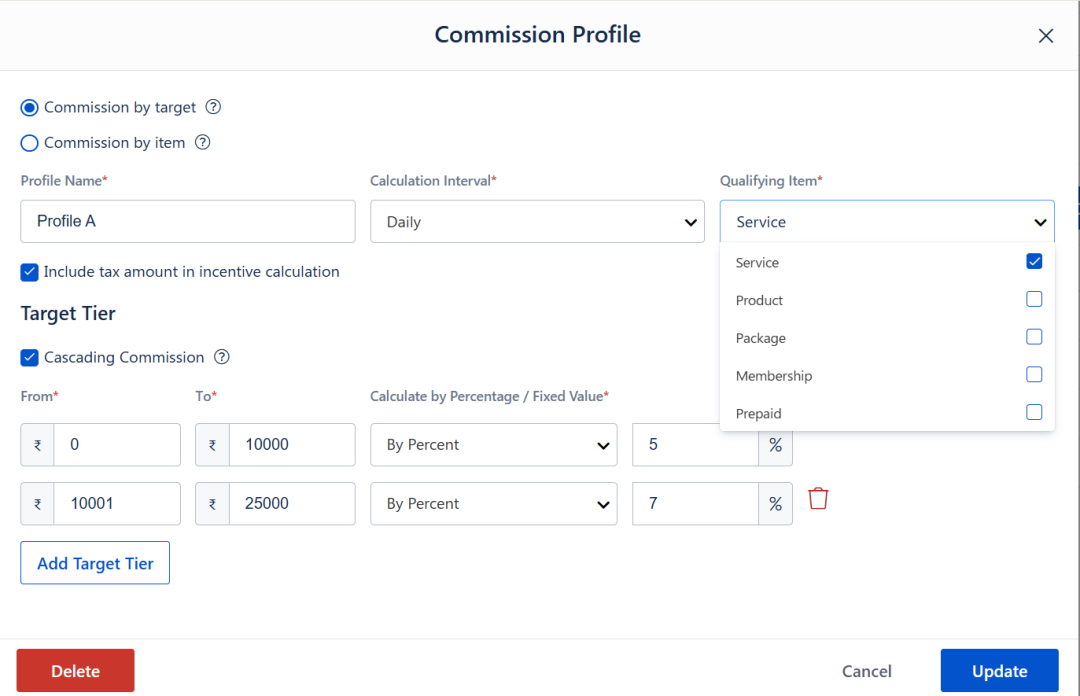
MioSalon gives you the flexibility to create a custom commission profile that fits your business perfectly.
You can:
- You can set custom calculation intervals, such as daily, weekly, or monthly, so staff incentives align perfectly with your business cycle.
- You can select specific qualifying items like services, products, packages, memberships, or prepaid credits, ensuring each staff member earns commission only on what is relevant to their role.
- You can decide whether to include or exclude tax from commission calculations, helping you maintain clean and transparent payroll practices.
- You can choose whether commissions should be calculated by percentage (such as 5% or 7%) or as a fixed value per item sold, allowing different strategies for services and retail items.
2. Commission Tracking on Every Invoice
Most salons wait until the end of the month to calculate commissions. That is exactly where errors creep in. With MioSalon, commissions are calculated in real time:
- When the service is billed
- When the product is sold
- When a discount is applied
- When multiple staff contribute to a service
This eliminates end-of-month chaos, manual recalculations and back-and-forth arguments.
3. Automated Split Commissions for Multi-Staff Services
In many salons, a single service is performed by multiple people. For example, one stylist does the cut, another handles the colour, and an assistant helps with washing.
Without software, splitting commissions leads to misunderstandings, errors, favouritism and your time is wasted.
MioSalon automates all of this.
You can set:
- Percentage-based splits
- Role-based splits
- Custom split rules for each service category
You can enable cascading commission, which splits staff earnings across slabs and applies percentages accordingly, ensuring fair and accurate incentives even when targets are crossed.
4. Target & Tier Configuration to Increase Staff Productivity
Your commission system becomes more powerful when combined with targets.
MioSalon allows you to define monthly targets, tier slabs, and performance milestones.
For example:
- Tier 1 → ₹40K → 15%
- Tier 2 → ₹70K → 20%
- Tier 3 → ₹1L → 25%
MioSalon automatically tracks progress and updates the slab as staff reach higher levels. This transforms your team from “doing the minimum” to actively chasing goals.
The best part? The staff can track their own progress via their profile, reducing dependency on managers.
5. Transparent Staff Reports
Transparency builds trust. MioSalon provides detailed commission and performance reports that include:
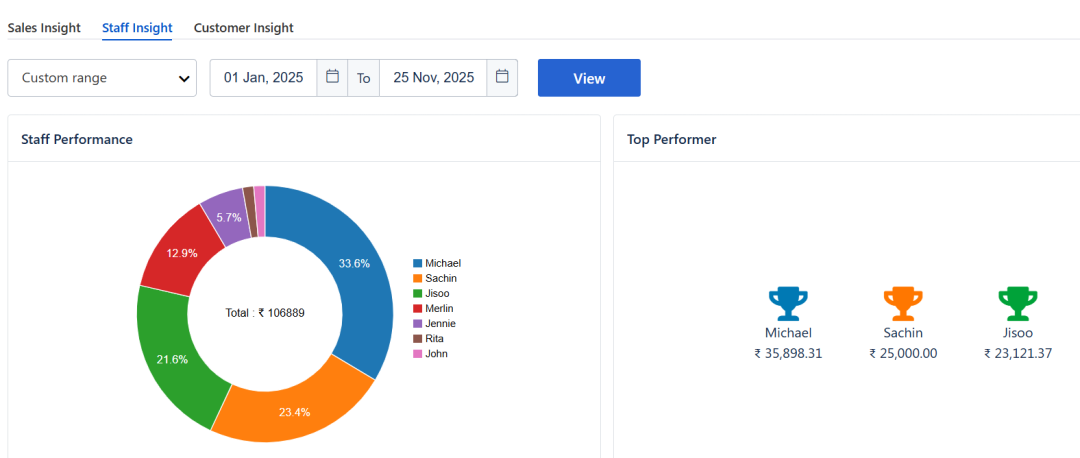
- Service-wise earnings
- Retail commissions
- Add-on service performance
- Commission deductions during discounts
- Target progress
- Monthly summaries
- Comparison with previous months
Both the salon owner and the stylist can see exactly how commissions were calculated. This eliminates confusion, builds accountability, and boosts staff satisfaction.
6. Retail Commission
Retail is one of the easiest sources of additional revenue, yet most salons fail to track it properly.
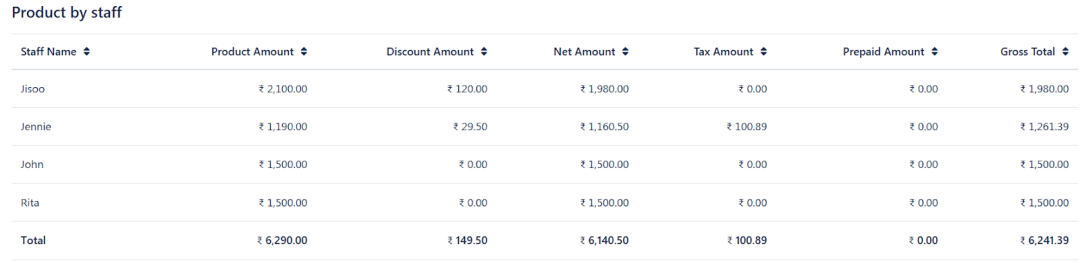
With MioSalon, retail commissions are:
- Tracked separately
- Visible in staff reports
- Linked to targets
This motivates staff to recommend the right products while giving you a reliable, predictable retail inventory revenue stream.
7. A Complete End-to-End Commission System
When you combine all these features, MioSalon becomes a complete commission ecosystem:
- Rule creation
- Real-time tracking
- Target monitoring
- Retail automation
- Split commission
- Transparency
- Error-free payouts
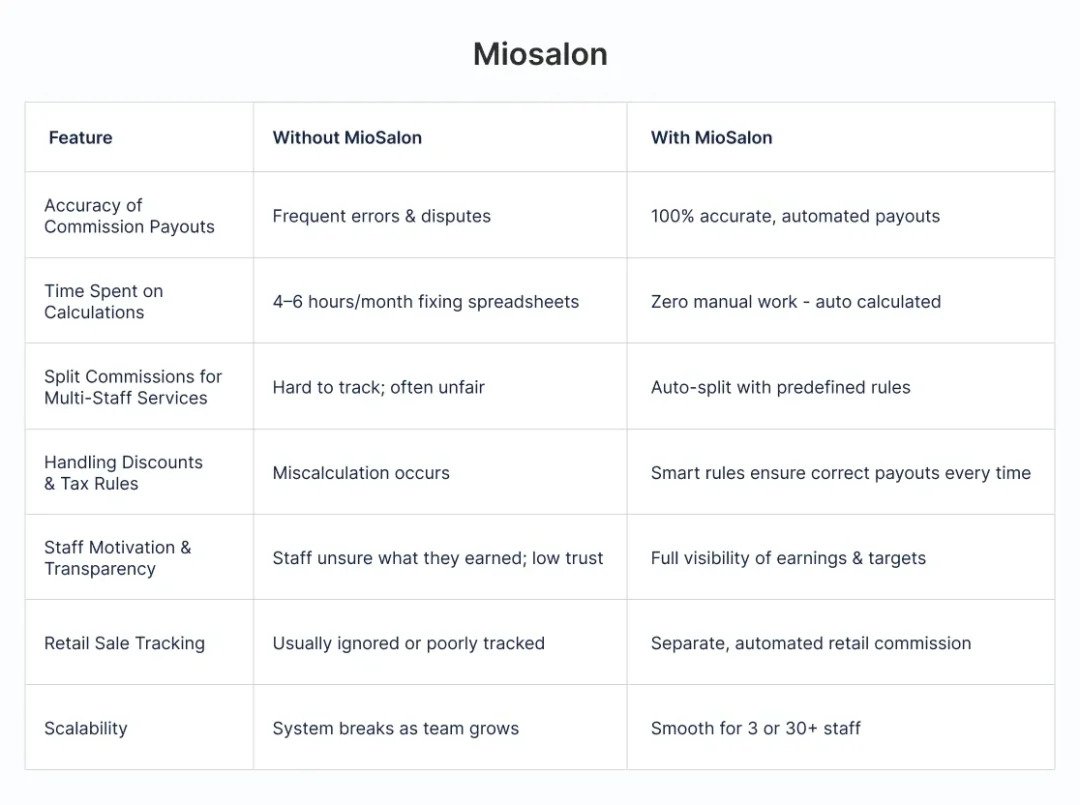
Instead of spending hours fixing mistakes or handling staff disputes, your commissions become accurate, automated, and stress-free.
The Biggest Mistakes Salons Make With Commission Structures
Many salons unknowingly sabotage their own profitability. Before you design your system, avoid these common mistakes:
- Changing commission percentages too often
- Not checking profit margins before offering commissions
- Manual tracking through spreadsheets
- Not separating retail vs service commissions
- Lack of transparency with staff
- No targets or growth incentives
- One-size-fits-all plans
- No rules for discounts or promotions
A good commission model is clear and consistent.
Conclusion
A strong commission structure is the foundation of a motivated team, a consistent client experience, and a financially healthy salon. When your staff knows exactly how they earn and how transparency is maintained, your business operates with trust and efficiency. But designing and managing this system manually is exhausting.
With MioSalon, turn a complicated monthly task into a smooth, reliable, and motivating workflow. Instead of spending hours correcting spreadsheets, you can focus on training your team, improving services, and growing your salon.
If you’re ready to build a commission structure that truly supports your business, try MioSalon today – Book a Free Demo to get started.
How to Get Started?
1. Book a Free Demo – See MioSalon in action. Our team will walk you through the features that match your salon’s needs.
2. Personalised Onboarding – Once you’re ready, we’ll set up your account, import your data, and tailor the software to your services, team, and preferences.
3. Staff Training & Support – We’ll train your team to use the system smoothly, including appointments, payments, client records, and more.
4. Go Live – Start taking bookings, sending reminders, and managing your salon efficiently. You’re all set to shine.
Start your Free Demo and see it in action! To learn more about the pricing plan, visit MioSalon’s Pricing Page.
FAQs
1. What is the best commission structure for a salon?
There is no single best model; each salon must choose a structure based on pricing, staff skill levels, and profit margins. Tiered, percentage-based commissions are the most popular because they motivate staff and protect profitability.
2. How do I calculate salon commissions accurately?
Calculate commissions based on service revenue, retail sales, and predefined rules. Using software like MioSalon ensures each invoice automatically applies the correct commission rate to eliminate errors.
3. Should I offer the same commission to all staff members?
No. Junior, senior, freelance, and specialised technicians contribute differently, so their commission rates should reflect skill level, experience, and revenue potential.
4. How often should a salon revise its commission structure?
Review it annually or when business costs, pricing, or staff performance trends change. Frequent changes confuse employees and reduce trust.