

How Smart Inventory Management Can Transform Your Salon Business

Introduction
For many salon owners, product inventory is one of the biggest cost drivers and a critical source of profit. If mismanaged, it can quietly erode margins, invite wastage, and erode customer experience.
But when handled with discipline and the right tools, inventory becomes a growth lever, ensuring that the right products are available at the right time, controlling cost, reducing waste, and increasing profitability.
In this deep dive, we’ll explore the challenges of salon inventory management, unpack why it matters so much, and show how MioSalon’s powerful features can convert those challenges into competitive advantages.
Table of Contents
- The Hidden Cost of Poor Inventory Management in Salons
- Why Inventory Management Is Strategically Important for Salons?
- What Challenges Salon Owners Face?
- How to Reduce Waste in Salon Operations?
- What are the Inventory KPIs for Salons?
- How Salon Owners Can Fix This With Software?
- Enter MioSalon: Inventory Mastery for Salons & Spas
- Final Thoughts
The Hidden Cost of Poor Inventory Management in Salons
Imagine a scenario: you run a busy salon, and your stylists use high-end shampoos, conditioners, serums, and other consumables every day. Some of these are retail products you sell, while others are exclusively “used” during services. Without tracking, things go wrong:
- Stylists may overuse or under-record the consumption of products.
- Some products sit idle in stock rooms or back offices, forgotten, maybe even expiring.
- Employee pilferage quietly drains profits.
- Multiple branches run out of stock at different times because inter-location transfers are not coordinated.
- On the flip side, overstocking leads to locked-up cash, expired inventory, or dead SKUs that don’t sell.
The sad truth is that poor inventory management silently sabotages profitability, efficiency, and brand perception.
A client might ask for a particular treatment or product, but you don’t have it in stock. Or worse, you run out of a key item in the middle of a service, interrupting client flow, wasting time, and damaging trust.
Why Inventory Management Is Strategically Important for Salons?
Managing inventory is more than just “keeping track of how many bottles you have.” It’s about aligning product procurement, usage, sales, and financial strategy to run a salon.
- Optimise Resource Allocation: Effective inventory management ensures that the right quantities of products, tools, and supplies are available exactly when needed. This avoids overstocking and understocking.
- Boost Customer Satisfaction: When you have dependable stock, clients get consistent service. The products they love are always available, and staff don’t substitute or refuse. This consistency builds trust, loyalty, and repeat purchases.
- Control Costs & Maximise Profit: By tracking usage, you reduce wastage, prevent unauthorised use, and manage expiry. Better control over internal product consumption helps detect overuse or pilferage.
- Scale with Confidence: As your salon expands, effective inventory management helps you scale. You can predict demand, transfer stock between locations, and plan procurement more effectively.
- Empower Data Decisions: With accurate data, you can make smarter purchasing decisions, negotiate more effectively with suppliers, and invest in higher-margin products.
- Drive Staff Accountability & Performance: A good inventory system will also let you monitor how individuals or teams use products. This visibility can drive more responsible consumption, performance-based rewards, and better training.
What Challenges Salon Owners Face?
Day-to-day salon operations throw up a variety of inventory-related challenges. These are not hypothetical; many salon owners face them daily, and they add up:
- Product pilferage: Theft can be subtle: missing bottles, unrecorded usage, or personal use by staff. Without tracking, this drains inventory invisibly and gradually erodes margins.
- Product over-consumption: Sometimes it’s not theft, it’s simply generous usage. Stylists may use more of a product than is practical for cost control. Without a system to monitor and standardise consumption, budget control slips.
- Stocking decisions: Deciding which retail products to stock and in what quantities is a balancing act. Too little, and you lose out on retail sales; too much, and inventory becomes dead stock. Add expiry-sensitive products and the challenge grows even more complicated.
- Product expiry: Skincare, haircare, and other beauty products often come with a shelf life. If the stock isn’t sold before expiry, that’s a loss.
- Training and knowledge: Staff need to be educated on product usage, value, and handling. Without consistent training, you may see inconsistent usage, wrong application, or even wastage.
- Multiple locations complexity: For salon chains or multi-branch operations, synchronising inventory across outlets is difficult without a unified system.
- Limited visibility: Without real-time tracking, you lack transparency into how inventory flows through your business, from receiving to consumption to sales.
How to Reduce Waste in Salon Operations?
1. Reduce Product Waste With Smart Consumption Control
Product wastage is one of the biggest invisible losses in a salon. Overuse of shampoo, serums, colours, masks, creams, and facial kits can inflate your monthly spending by 20–35%.
How to fix it
- Set standard usage quantities for each service (e.g., 8–10 ml of shampoo per wash).
- Train stylists on correct product usage and application techniques.
- Use weighing scales for hair colour to avoid over-mixing and costly leftovers.
- Switch to professional-size bulk packs to reduce packaging waste and per-service cost.
2. Cut Down Inventory Waste Through Better Stock Planning
A large portion of salon waste comes from:
- Expired inventory
- Overstocking
- Unplanned purchases
How to fix it
- Follow FIFO (First In, First Out) to prevent expiry-based wastage.
- Set minimum/maximum stock levels for every product.
- Conduct weekly stock audits to catch discrepancies early.
3. Reduce Operational Waste With Better Workflow & Scheduling
Operational waste also includes wasted staff hours, idle time, and inefficient service flow.
How to fix it
- Optimise schedules to prevent long idle gaps.
- Group complementary services (e.g., colour + cut) to reduce towel, product, and energy usage.
- Use digital checklists for opening/closing routines.
What are the Inventory KPIs for Salons?
Managing salon inventory effectively requires more than counting products; it requires tracking the right Inventory KPIs (Key Performance Indicators). These metrics help you control product usage, reduce wastage, improve purchasing decisions, and maintain healthy profit margins.
1. Product Consumption Variance (PCV)
What it measures: The gap between how much product should have been used vs. how much was actually used.
Why does it matter? High variance indicates overuse, spillage, incorrect measurements, or possible pilferage.
2. Inventory Turnover Ratio (ITR)
What it measures: How fast inventory is moving through your salon, either being consumed during services or sold as retail.
Formula: Cost of Goods Used/Sold ÷ Average Inventory
Why does it matter? A low turnover indicates slow-moving or dead stock that blocks cash flow.
3. Stockout Rate
What it measures: How frequently essential items run out.
Why does it matter? High stockout rates disrupt services, impact client satisfaction, and cause last-minute emergency purchases.
4. Expiry Loss Percentage
What it measures: The percentage of product wasted due to expiry.
Formula: Expired Stock Value ÷ Total Inventory Value × 100
Why does it matter? Indicates whether you’re buying too much, too early, or stocking products that don’t align with demand.
5. Shrinkage Rate (Wastage & Pilferage)
What it measures: The difference between recorded inventory and actual physical stock.
Why does it matter? A rising shrinkage rate points to theft, untracked usage, or inconsistencies in your stock-handling process.
6. Cost Per Service (CPS)
What it measures: The exact amount of product cost used to perform each service.
Why does it matter? Understanding CPS helps you set accurate service prices and maintain healthy margins.
7. Retail Sell-Through Rate
What it measures: How much of your retail stock was sold within a specific period.
Formula: Units Sold ÷ Units Available × 100
Why does it matter? Helps identify best-sellers, weak performers, and products that need promotions or discontinuation.
8. GMROI (Gross Margin Return on Inventory)
What it measures: How much profit you earn for every rupee/dollar invested in inventory.
Formula: Gross Profit ÷ Average Inventory Cost
Why does it matter? A direct indicator of whether your inventory is profitable or draining resources.
How Salon Owners Can Fix This With Software?
The secret to overcoming these challenges is to use dedicated salon inventory management software. A strong solution will help you:
- Track both retail inventory (products you sell) and internal product consumption (products used during services).
- Set low stock alerts, so you never run out at critical times.
- Automate consumption tracking (or allow manual adjustments) after each service.
- Monitor usage by staff, location, giving clarity on who uses what and where issues like over-consumption or pilferage are happening.
- Support stock transfers between branches, ensuring balanced inventory across locations.
- Generate meaningful reports (daily, weekly, monthly) to analyse usage trends, wastage, and peaks.
- Link inventory data with financial tools for better cost control and budgeting.
Essentially, the right software turns your inventory from an uncontrolled cost centre into a strategic lever.
Enter MioSalon: Inventory Mastery for Salons & Spas
MioSalon stands out as a robust, cloud-based salon and spa management solution. It deeply integrates inventory management into its architecture, allowing salon owners and managers to take full control of both retail products and internal consumption.
Here’s how MioSalon’s inventory features can transform your operations from the ground up.
Internal Product Consumption
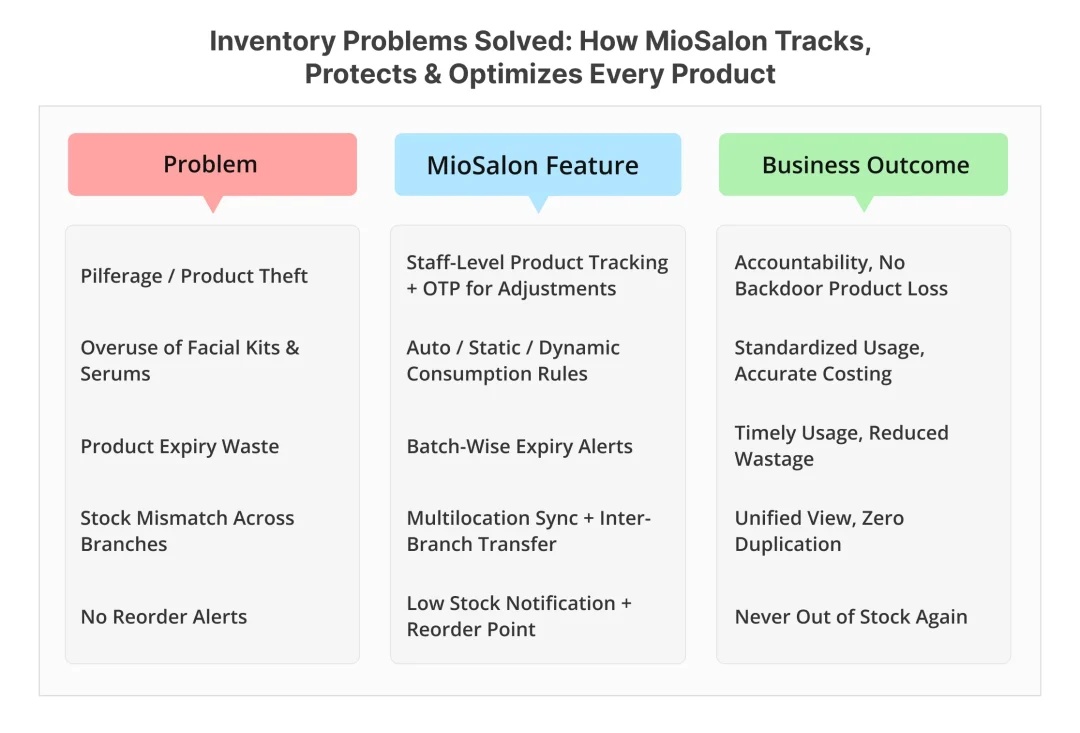
MioSalon offers a suite of internal product consumption tools designed to track and control the use of consumables (e.g., shampoos, oils) used during services.
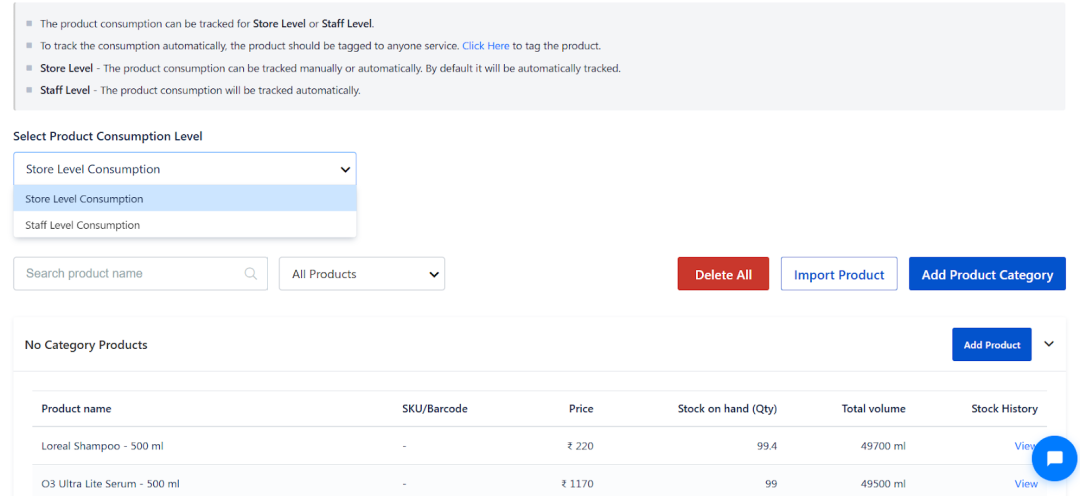
- Flexible tracking modes: You have the choice between manual and automated tracking. If you know exactly how much of a product is used for particular services, MioSalon supports static consumption models.
But if usage varies (for instance, depending on hair length or hair density), you can configure dynamic consumption models.
- Auto consumption during checkout: With auto consumption enabled, MioSalon automatically subtracts predetermined quantities from your inventory every time a service is completed. This reduces human error, ensures consistency, and prevents overuse.
- Manual adjustment: Even after checkout, your team can correct or update consumption data to reflect real-world usage. This allows adjustments based on actual service dynamics.
- Low-stock alerts for internal inventory: MioSalon lets you define threshold levels for internal-use products. When stock dips below those levels, the system notifies you so you can reorder or balance stock.
- Staff-level and store-level monitoring: You can track consumption at the micro-level: which staff member is using what, and where (which outlet or location), giving detailed insights into usage patterns.
Retail Product Inventory Management
For the stock you sell to clients, whether haircare, skincare, or cosmetic products, MioSalon provides powerful retail inventory control.
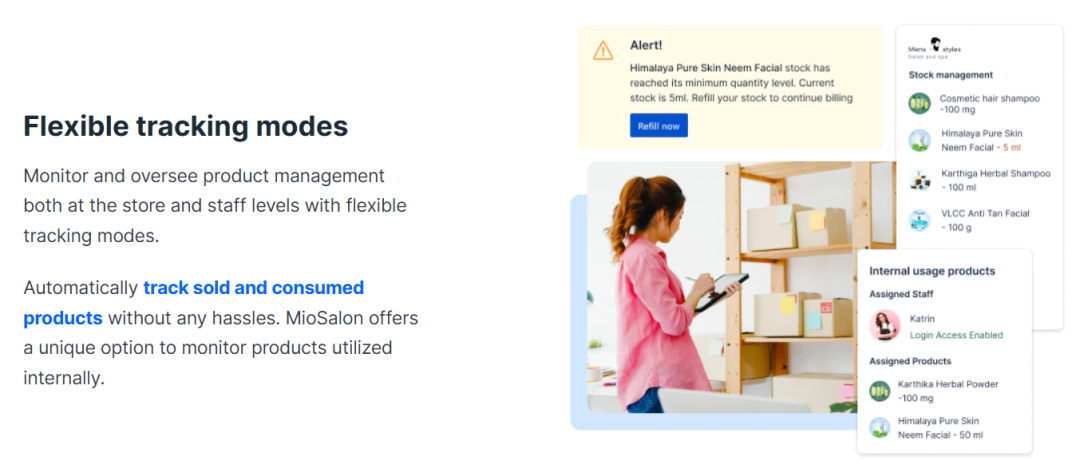
- Low-stock reminders: Automatically triggered when a product’s inventory level falls below your configured threshold, helping you restock before a critical shortage.
- Inventory across branches: If you operate multiple locations, MioSalon allows for inter-branch transfers. This ensures that if one outlet is running low on a high-demand SKU, you can move stock from another branch instead of placing an emergency order.
- Store-level pooling: You can maintain a common pool of products (central inventory) or track per-store inventory, depending on what works best for your business model.
- Sales tracking & analytics: By tracking which products are selling, and where, MioSalon helps you identify top-performing SKUs, seasonal trends, and slow movers, enabling smarter purchasing decisions.
- Preventing wastage and pilferage: Through close monitoring and usage tracking, MioSalon reduces product loss due to misuse or theft.
Multi-Location Synchronisation & Stock Transfer
If your salon business spans multiple branches, MioSalon’s multi-location logic is a game-changer.
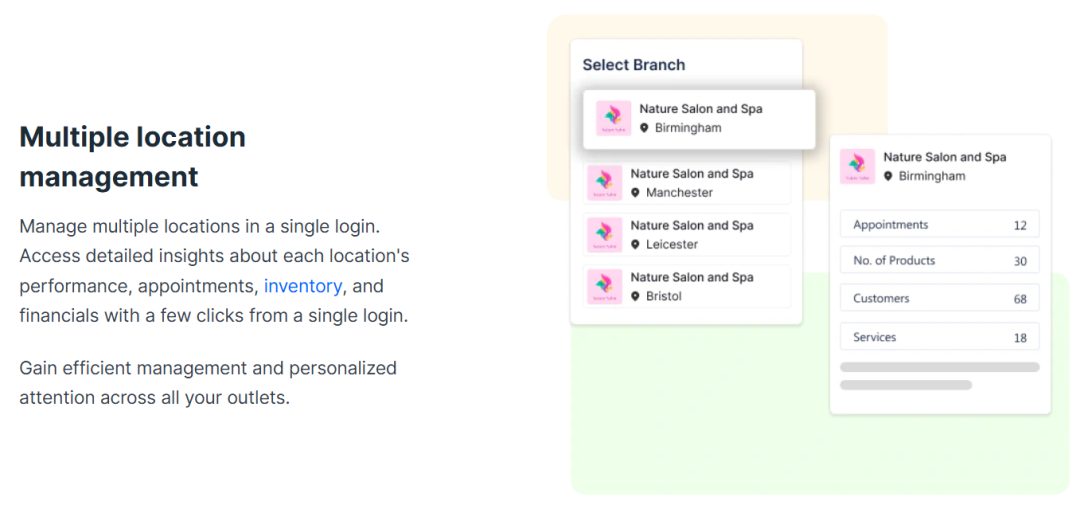
- You can oversee all your branches via a central dashboard, aligning inventory strategy across locations.
- Inventory visibility is consolidated: you can see real-time inventory levels across all outlets and decide how to allocate stock based on demand, without guesswork.
Staff Commission & Incentives Linked to Inventory
Inventory control isn’t just a back-office function in MioSalon; it’s integrated into your performance and incentive strategy.
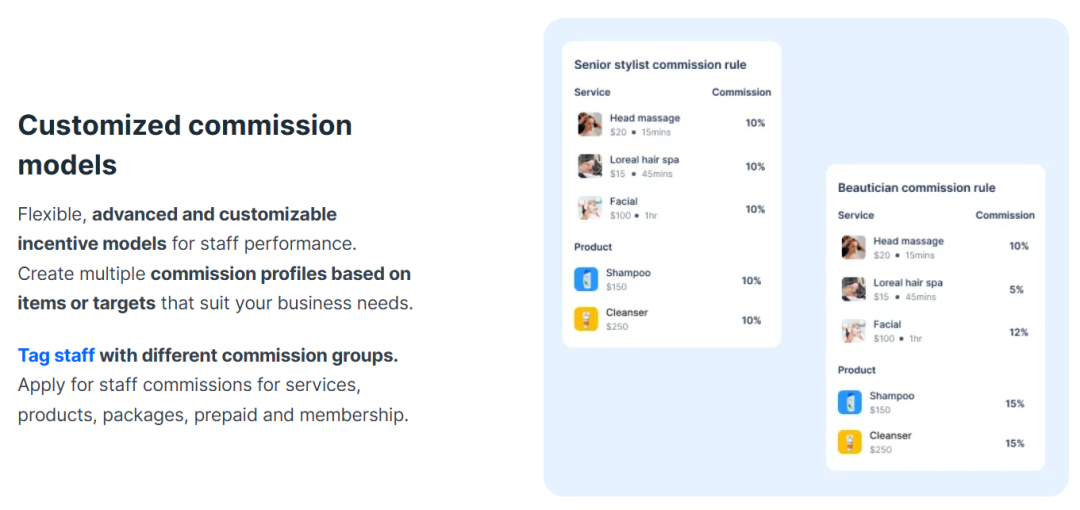
- Commission tracking by product sales: MioSalon tracks which staff members are selling which retail products, making commission calculations transparent and accurate.
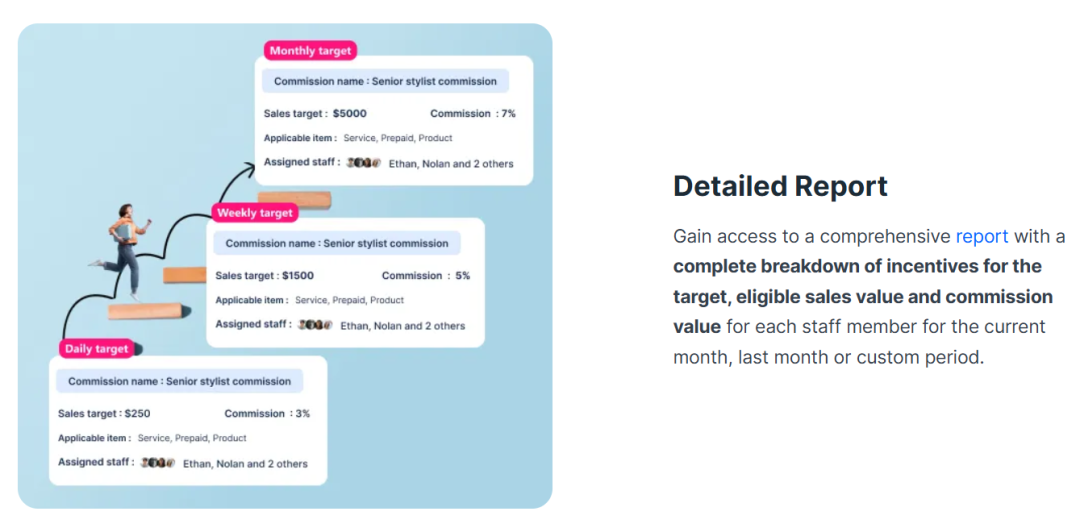
- Set targets & profiles for incentives: You can define commission targets (weekly or monthly), associate them with specific products, and let MioSalon automate commission calculations.
- Automated staff reporting: Stylists or staff can have login access to view their own performance reports (sales, commissions, inventory usage), helping them stay motivated, accountable, and engaged.
- Inventory efficiency as a performance metric: By tying consumption and sales data into staff evaluations, you encourage responsible use and proactive selling of retail inventory.
Dashboards, Reports & Analytics
Understanding your inventory data is just as important as collecting it. That’s where MioSalon’s reporting and analytics suite shines.
- Dashboards let you track key metrics like inventory levels, stock-outs, consumption trends, sales performance, and more, all in one place.
- Customizable reports offer flexibility to view data by timeframe (daily, weekly, monthly) and by dimension.
- Trend analysis: By reviewing which products are consistently in demand or consistently underperforming, you can refine your procurement strategy, negotiate better with suppliers, or phase out low-margin, slow-moving items.
- Staff-level insights: Identify product usage patterns by individuals to spot inefficiencies or best practices and optimise consumption norms.
Final Thoughts
Inventory is often the silent Achilles’ heel of salon businesses: expensive, difficult to control, and easy to overlook. But with MioSalon, you can turn inventory into a predictable, profitable, and fully optimised part of your business.
From internal consumption tracking to retail stock control, from multi-branch transfers to automated low-stock alerts, MioSalon gives you total command over every product that enters, moves through, or leaves your salon.
If you’re serious about improving profit margins, preventing wastage, empowering your staff, and giving clients a consistent, delightful experience, then now is the time to upgrade your systems. Book a Free Demo and grow your salon with confidence.
How to Get Started?
1. Book a Free Demo – See MioSalon in action. Our team will walk you through the features that match your salon’s needs.
2. Personalised Onboarding – Once you’re ready, we’ll set up your account, import your data, and tailor the software to your services, team, and preferences.
3. Staff Training & Support – We’ll train your team to use the system smoothly, including appointments, payments, client records, and more.
4. Go Live – Start taking bookings, sending reminders, and managing your salon efficiently. You’re all set to shine.
Start your Free Demo and see it in action! To learn more about the pricing plan, visit MioSalon’s Pricing Page.
FAQ
1. Why is inventory management important for salons?
Because products are one of the biggest cost drivers. Proper control reduces wastage, prevents pilferage, and ensures smooth, consistent service delivery.
2. Does MioSalon track both retail and internal product usage?
Yes. It separately tracks products sold to clients and consumables used during services, giving you complete clarity.
3. Can MioSalon manage multiple salon branches?
Absolutely. You can monitor all branches, transfer stock between outlets, and maintain centralised or branch-wise inventory.
4. How does auto-consumption work?
When a service is billed, MioSalon automatically deducts the predefined product quantity from your inventory, ensuring accuracy and reducing manual errors.
5. Will staff be able to see their own sales and commissions?
Yes. MioSalon sends staff performance reports through WhatsApp, SMS, or email, helping them stay motivated and accountable.