

WhatsApp Business for Salons: Increase Bookings & Reduce No-Shows (2026 Guide)
Introduction
The salon and spa industry operates on three pillars: trust, timing, and personal connection. Unlike retail or e‑commerce, salon services are experiential. A client does not merely purchase a haircut or facial; they commit time, money, and personal comfort to a brand.
In 2026, this decision-making process increasingly begins before the client steps into the salon, and most often, it begins on WhatsApp. Modern customers expect immediacy. They want quick answers, clear service details, flexible booking, and reminders that fit naturally into their daily lives.
Traditional channels such as phone calls and emails are no longer aligned with this expectation.
This guide provides an exhaustive, point-by-point explanation of how WhatsApp Business can be leveraged for salon growth, operational efficiency, customer retention, and revenue optimization.
Table of Contents
- How can salons use WhatsApp Business to increase bookings?
- Why WhatsApp Business for Salons Drives More Bookings & Customer Retention
- Comparative Analysis: WhatsApp Business vs Traditional Communication Channels
- WhatsApp Marketing Trends in the Salon Industry (2026)
- Step-by-Step Implementation of WhatsApp Business for Salons
- Detailed WhatsApp Use Cases in Salon Operations
- WhatsApp’s Role in SEO, AEO, and AI Search Visibility
- Common Strategic Mistakes in WhatsApp Salon Marketing
- How MioSalon Powers WhatsApp Marketing for Salons and Spas
- Conclusion
How can salons use WhatsApp Business to increase bookings?
Salons can use WhatsApp Business to send appointment reminders, run targeted promotions, respond instantly to inquiries, and automate follow-ups. This improves conversion rates, reduces no-shows, and increases client retention.
What Exactly is WhatsApp Business?
WhatsApp Business is a purpose-built version of WhatsApp designed for commercial use. While it retains the familiar interface of personal WhatsApp, it introduces structured business features that allow organizations to communicate professionally, consistently, and at scale.
Studies show WhatsApp messages achieve open rates of up to 98%, making it one of the most effective communication channels for service businesses.
Personal WhatsApp accounts are informal, unstructured, and unsuitable for handling multiple clients, staff interactions, and marketing activities. WhatsApp Business introduces tools such as business profiles, catalogs, automated responses, labels, and bulk messaging and analytics.
In practical terms, WhatsApp Business transforms casual messaging into a controlled, measurable, and brand-aligned communication system.
Why WhatsApp Business for Salons Drives More Bookings & Customer Retention
1. Clients Already Use WhatsApp as a Daily Habit
Most salon clients open WhatsApp multiple times a day for personal communication. This habitual usage removes the psychological resistance typically associated with marketing messages.
When a salon communicates on WhatsApp, the message appears in the same environment as trusted personal conversations. WhatsApp feels personal, so clients trust and respond faster.
For salons, this matters because service decisions are often impulse-driven or reminder-driven. A client who postponed booking may act immediately upon seeing a WhatsApp message simply because it arrives at the right moment in a familiar space.
2. Consistently High Open and Read Rates
WhatsApp messages demonstrate open rates between 90% and 98%, a figure unmatched by email or SMS. This occurs because WhatsApp notifications are treated as interpersonal communication.
From a business perspective, high open rates translate directly into operational reliability. Appointment reminders are read, promotional campaigns are noticed, and follow-up messages are acknowledged. This reduces uncertainty in communication outcomes.
For salons, where missed appointments directly impact revenue, this reliability is not a marketing advantage but an operational necessity.
3. Low-Friction Communication
Salon clients frequently require quick clarifications: service duration, pricing differences, stylist availability, or rescheduling options. Delayed responses often result in lost bookings.
WhatsApp enables asynchronous real-time communication. Clients can send a message without committing to a phone call, and salons can respond promptly without disrupting ongoing services.
4. Personalisation Builds Emotional Loyalty
Salon loyalty is emotional rather than transactional. Clients return to salons where they feel recognized, remembered, and understood.
WhatsApp enables personalisation through the use of names, service history, visit frequency, and preferences. Referencing a past service or suggesting a follow-up treatment demonstrates attentiveness.
TL;DR:
WhatsApp works for salons because it has extremely high open rates, low communication friction, and enables personalised, real-time conversations that directly influence booking decisions.
Comparative Analysis: WhatsApp Business vs Traditional Communication Channels
WhatsApp vs Traditional Channels
| Channel | Open Rate | Speed | Interaction |
| 90–98% | Instant | Two-way | |
| SMS | Medium | Fast | One-way |
| Low | Slow | One-way |
- WhatsApp Business vs Phone Calls
Phone calls demand immediate attention and often interrupt clients during work or personal time. Many customers actively avoid calling businesses unless absolutely necessary.
WhatsApp allows asynchronous interaction. Clients can enquire, pause, and respond at their convenience. This increases engagement while reducing friction. For salons, it also minimizes front-desk overload during peak hours.
- WhatsApp Business vs SMS
SMS is limited to plain text and lacks interactivity. It does not support visual context, catalogs, or structured replies.
WhatsApp enables rich media, buttons, and two-way conversations. This is particularly valuable for salons, where visual representation of services significantly influences purchasing decisions.
- WhatsApp Business vs Email
Email communication suffers from delayed engagement and spam filtering. Time-sensitive messages often lose relevance before being opened.
WhatsApp messages are typically read within minutes, making them ideal for reminders, last-minute offers, and urgent updates.
TL;DR:
Compared to calls, SMS, and email, WhatsApp is faster, more interactive, and more likely to be seen, making it the most effective communication channel for salons.
WhatsApp Marketing Trends in the Salon Industry (2026)
Modern WhatsApp marketing relies on client data rather than mass broadcasting. Salons segment clients based on visit history, service categories, spending patterns, and inactivity periods.
This approach ensures relevance. A facial client receives skincare offers, while a haircut client receives grooming reminders. Relevance reduces opt-outs and increases conversion probability.
Conversational Marketing and Action-Based Messaging
- WhatsApp marketing has shifted from one-way announcements to conversational flows.
- Messages are designed to invite interaction through quick replies and action buttons.
- This design aligns with natural human communication patterns, increasing engagement and reducing cognitive effort for the client.
Automation as an Operational Necessity
- As salons scale, manual messaging becomes unsustainable. Automation ensures consistency, timeliness, and accuracy.
- Automated reminders, follow-ups, and campaigns allow salons to maintain high communication standards without increasing staffing costs.
Step-by-Step Implementation of WhatsApp Business for Salons
Step 1: Establishing a Professional Business Profile
A complete WhatsApp Business profile functions as a digital storefront. It communicates legitimacy, transparency, and professionalism.
Clients rely on visible information such as operating hours, address, and service details to make quick decisions. An incomplete profile introduces uncertainty and reduces trust.
Step 2: Consent-Based Contact Collection
WhatsApp marketing operates on explicit consent. This is both a regulatory requirement and a trust-building mechanism.
Clients who opt in are more receptive, leading to higher engagement and lower complaint rates. Consent should be collected during booking, billing, or through digital touchpoints.
Step 3: Automation and Message Structuring
Automated greetings, away messages, and confirmations create predictable communication flows. This reduces response delays and sets clear expectations for clients.
Step 4: Chat Organization Through Labels
Labels allow salons to categorize conversations based on client type or status. This improves internal workflow and ensures timely follow-ups.
What Are Labels?
Labels are short tags you attach to a conversation to classify it.
For example:
- New Inquiry
- First-Time Client
- Regular Client
- VIP
- Bridal Lead
- Pending Payment
- Follow-Up Required
- Complaint
- No-Show
Instead of guessing what each chat is about, your team instantly sees the context.
Detailed WhatsApp Use Cases in Salon Operations
Appointment Booking and Confirmation
WhatsApp simplifies booking by reducing steps. Clients can confirm or reschedule with minimal effort. Automated reminders significantly reduce no-shows, directly protecting revenue.
Promotional Campaign Execution
Effective WhatsApp promotions are targeted and contextual. Broad discounting erodes brand value, while personalised offers increase perceived exclusivity.
Service Catalog Distribution
Catalogs reduce information asymmetry. Clients understand services, pricing, and value before booking, leading to higher satisfaction and fewer disputes.
Feedback Collection and Reputation Management
Post-service feedback via WhatsApp achieves higher response rates due to familiarity and convenience. Structured feedback supports service improvement and online reputation growth.
TL;DR:
From bookings and reminders to promotions and feedback, WhatsApp supports the entire salon customer journey in one platform.
WhatsApp’s Role in SEO, AEO, and AI Search Visibility
Alignment With Conversational Search Queries
Search behavior has shifted toward conversational questions. WhatsApp-related FAQs align naturally with this trend, increasing eligibility for AI-generated summaries and featured snippets.
Indirect Local SEO Benefits
Higher engagement, improved reviews, and consistent communication enhance local search signals, supporting long-term discoverability.
Common Strategic Mistakes in WhatsApp Salon Marketing
- Over-Messaging Without Value
Excessive messaging erodes trust and increases opt-outs. Frequency must be balanced with relevance.
- Generic Communication
Non-personalized messaging signals indifference. In service industries, perceived indifference leads directly to churn.
- Failure to Analyze Performance
Without measurement, improvement is impossible. Analytics are essential for sustainable growth.
How MioSalon Powers WhatsApp Marketing for Salons and Spas
While WhatsApp Business on its own offers basic tools, it was never designed to handle the operational complexity of a salon or spa.
MioSalon bridges this gap by integrating WhatsApp marketing directly with salon operations, customer data, booking workflows, and revenue tracking.
This section explains how MioSalon’s WhatsApp feature works, why it matters, and what business outcomes it creates.
Why Regular WhatsApp Business Is Not Enough for Growing Salons
If your team is constantly replying to WhatsApp manually, you’re already losing time and revenue.
Most salons begin WhatsApp marketing using the free WhatsApp Business app. While this works at a very small scale, it quickly breaks down as the business grows.
In practical terms, this means salon owners must manually:
- Remember who booked what service
- Decide who should receive which message
- Track whether a message actually resulted in a booking
- Follow up with customers who did not respond
This manual approach is not only time-consuming but also error-prone. As customer volume increases, consistency drops, follow-ups are missed, and WhatsApp becomes just another inbox instead of a revenue-driving channel.
MioSalon solves this by connecting WhatsApp directly to the salon’s operational brain.
Automated Appointment Reminders via WhatsApp
Missed appointments are one of the biggest revenue leaks in salons. MioSalon’s WhatsApp integration automates appointment reminders based on booking data stored in the system.
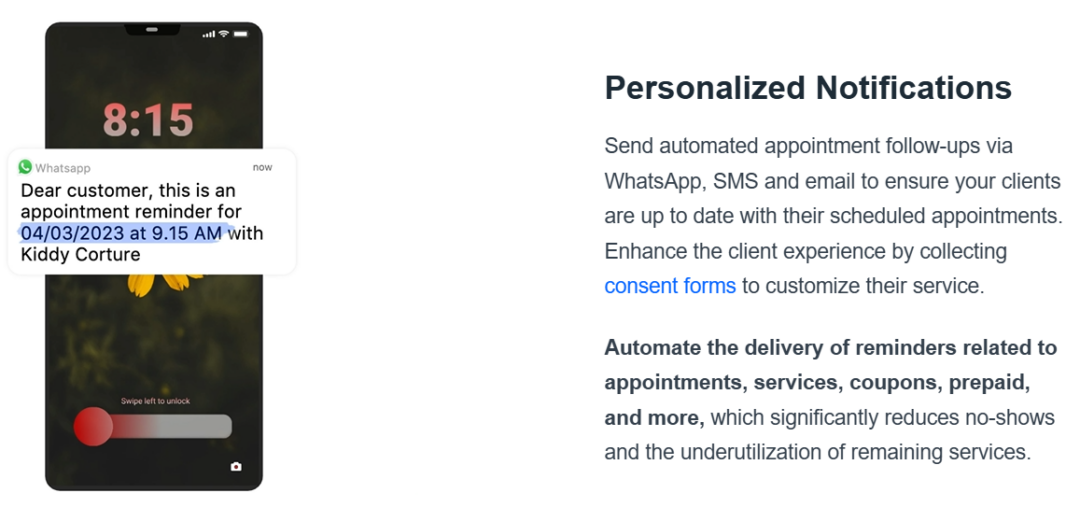
Instead of manually sending reminders, MioSalon:
- Automatically triggers reminder messages at predefined times (e.g., 24 hours before the appointment)
- Includes appointment-specific details such as service name, stylist, date, and time
- Reduces no-shows by ensuring customers acknowledge their booking
Because these reminders are sent through WhatsApp, a channel customers actively use they are far more likely to be seen and acted upon compared to SMS or email reminders.
WhatsApp-Based Promotions Linked to Real Customer Segments
Generic promotional broadcasts often fail because they are irrelevant to the recipient. MioSalon enables salons to run WhatsApp campaigns based on actual customer behavior, not assumptions.
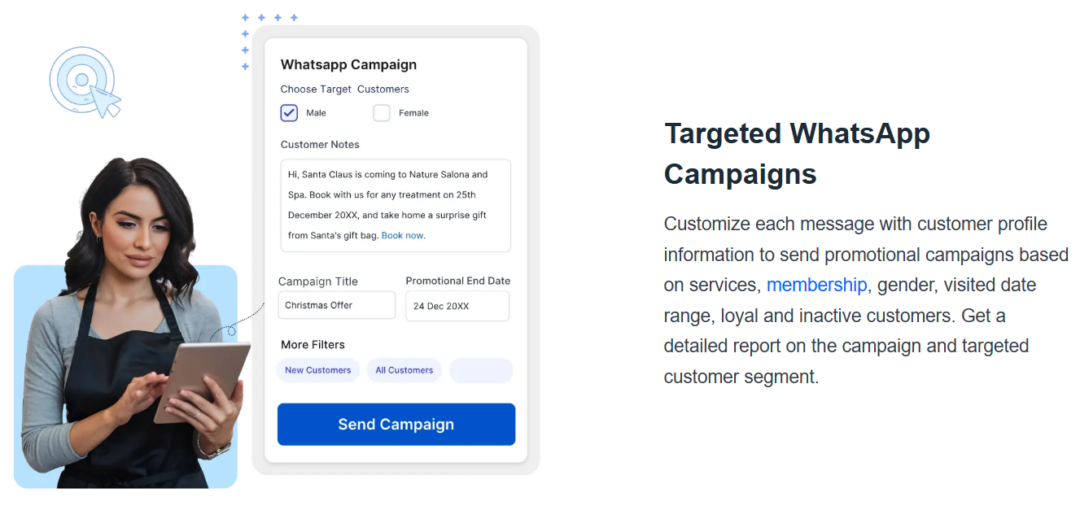
For example, salons can target:
- Customers who have not visited in the last 60 days
- Clients who regularly take premium services
- First-time visitors who have not returned
Each campaign is sent via WhatsApp and tied back to measurable outcomes such as bookings generated and revenue earned.
This allows salon owners to understand which messages work and which do not, turning WhatsApp from a messaging tool into a measurable marketing channel.
Two-Way WhatsApp Communication Without Operational Chaos
One of the biggest challenges with WhatsApp marketing is handling replies. When messages increase, staff often struggle to respond consistently, leading to delayed replies or missed inquiries.
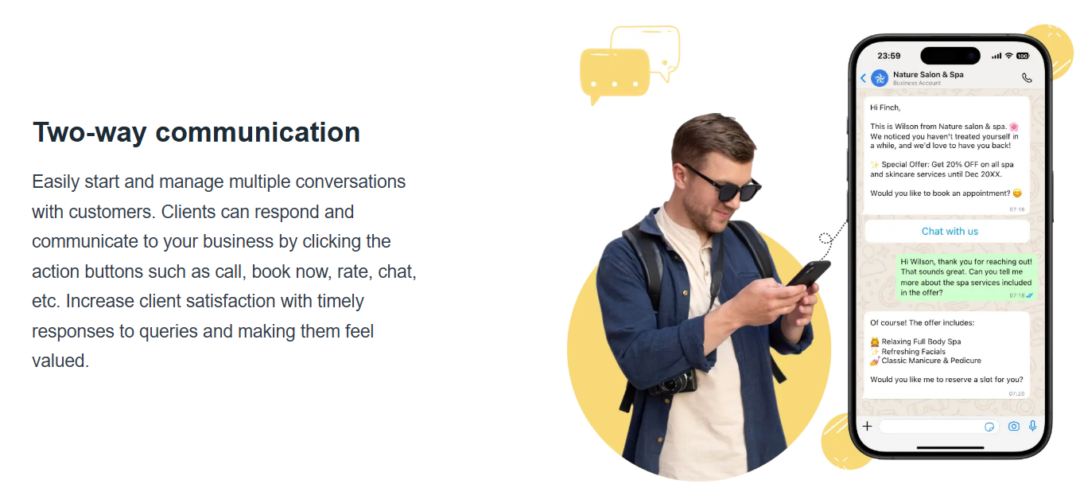
MioSalon centralizes WhatsApp conversations so that:
- All incoming messages are visible in one system
- Staff can respond without using personal phones
- Conversation history is preserved for future reference
This creates a professional communication structure while maintaining the informal, friendly tone customers expect on WhatsApp.
WhatsApp Campaign Performance Tracking and ROI Visibility
Unlike standalone WhatsApp usage, MioSalon provides visibility into performance metrics. Salon owners can see:
- How many messages were delivered?
- How many customers responded?
- How many bookings were generated from each campaign?
This level of tracking is essential for decision-making. Instead of guessing whether WhatsApp marketing is “working,” salons can rely on data to refine timing, messaging, and targeting.
Compliance, Opt-In, and Trust Management
WhatsApp marketing must be permission-based to maintain customer trust and platform compliance. MioSalon supports responsible messaging practices by:
- Managing customer consent
- Preventing message overuse
- Ensuring communication remains relevant and non-intrusive
This protects the salon’s brand reputation while maintaining long-term customer relationships.
| Use Case | MioSalon Feature | Outcome |
| Reminders | Auto WhatsApp triggers | Reduce no-shows |
| Promotions | Segmented campaigns | Higher conversions |
| Replies | Central inbox | Faster response |
| Tracking | Campaign analytics | ROI visibility |
Why MioSalon Makes WhatsApp a Scalable Growth Channel
The key difference between using WhatsApp manually and using WhatsApp through MioSalon is scalability. MioSalon allows salons to:
- Communicate with hundreds of customers consistently
- Maintain personalisation without manual effort
- Convert conversations into bookings systematically
In essence, MioSalon transforms WhatsApp from a reactive messaging app into a structured growth engine tailored specifically for salons and spas.
TL;DR:
MioSalon turns WhatsApp into an automated growth system by connecting customer data, bookings, and campaigns in one place.
Conclusion
WhatsApp Business is a strategic asset. For salons and spas, it integrates communication, marketing, and customer experience into a single, high-impact channel.
When implemented correctly particularly through management software platforms like MioSalon WhatsApp becomes a scalable system for engagement, retention, and revenue growth.
Salons that master this channel will gain a durable competitive advantage in an increasingly crowded market. Ready to upgrade your salon WhatsApp business? Book a Free Demo with MioSalon.
How to Get Started?
1. Book a Free Demo – See MioSalon in action. Our team will walk you through the features that match your salon’s needs.
2. Personalised Onboarding – Once you’re ready, we’ll set up your account, import your data, and tailor the software to your services, team, and preferences.
3. Staff Training & Support – We’ll train your team to use the system smoothly, including appointments, payments, client records, and more.
4. Go Live – Start taking bookings, sending reminders, and managing your salon efficiently. You’re all set to shine.
Start your Free Demo and see how MioSalon helps you streamline appointments, staff schedules, and client communication, all while improving salon etiquette and experience.
Want pricing info? Check out our Plans & Pricing page.
FAQs:-
1. What is WhatsApp Business and how does it help salons?
WhatsApp Business is a professional messaging platform that allows salons to automate bookings, send reminders, run targeted promotions, and communicate directly with clients in a trusted environment.
2. Can WhatsApp Business reduce salon no-shows?
Yes. Automated WhatsApp appointment reminders significantly reduce no-shows because messages are read quickly and clients can instantly confirm or reschedule.
3. Is WhatsApp better than SMS for salon marketing?
WhatsApp is more effective than SMS because it supports images, catalogs, quick replies, automation, and two-way conversations, increasing engagement and conversions.
4. How can salons automate WhatsApp messages?
Salons can automate WhatsApp messages using salon management software like MioSalon, which connects booking data with scheduled reminders, promotions, and follow-ups.
5. How does WhatsApp improve customer retention for spas?
WhatsApp improves retention by enabling personalised communication, timely reminders, service follow-ups, and targeted offers based on client history and preferences.