

How to Manage Salon Staff Efficiently: 7 Proven Systems to Boost Productivity & Profit

Introduction:
Managing a salon team efficiently is one of the most underestimated challenges in the beauty industry. Most owners focus heavily on attracting clients, upgrading interiors, or introducing new services, but the real determinant of consistent growth is how well the staff operates within a structured system.
Salon staff management is about clarity and alignment, not control. When roles, expectations, incentives, performance tracking, and operational systems align, efficiency stops being forced and starts becoming natural.
The best way to manage salon staff efficiently is to build a structure that removes ambiguity, reduces emotional decision-making, and creates measurable accountability across every role in the salon.
Table of Contents :
- How can you manage salon staff efficiently?
- 1. How to Manage Salon Staff Efficiently with Clear Role Definitions
- 2. Salon Staff Performance Tracking: Manage Salon Staff Efficiently with Data
- 3. Improve Salon Staff Productivity with a Strong Performance Culture
- 4. How to Manage Underperforming Salon Staff Effectively
- 5. Use Salon Employee Management Systems to Improve Efficiency
- How MioSalon Helps You Manage Salon Staff Efficiently
- Conclusion
How can you manage salon staff efficiently?
Salon staff can be managed efficiently by defining clear roles, tracking measurable KPIs like revenue and rebooking rates, implementing transparent incentives, and using salon management software to automate scheduling, commissions, and performance tracking.
Let’s break that down clearly and practically.
1. How to Manage Salon Staff Efficiently with Clear Role Definitions
Many salons operate with informal role distribution.
- A senior stylist may unofficially mentor juniors.
- A receptionist may sometimes handle complaints.
- Retail management may fall to whoever is available.
Over time, this informal structure creates confusion and uneven accountability. Efficient staff management begins with defining responsibilities clearly for each position.
For example, a senior stylist’s role should extend beyond delivering quality services. It should include measurable expectations such as maintaining a defined rebooking percentage, contributing to retail sales targets, mentoring junior stylists, and sustaining an average bill value above salon baseline.
Similarly, front desk staff are not just appointment coordinators. They are responsible for optimizing scheduling, reducing no-shows, confirming online bookings in advance, and ensuring client flow runs without overlap or idle gaps.
When responsibilities are defined in measurable terms rather than vague expectations, performance discussions become objective and productive.
TL;DR: Clearly defined roles eliminate confusion and improve accountability. When responsibilities are measurable, staff performance becomes easier to track and improve.
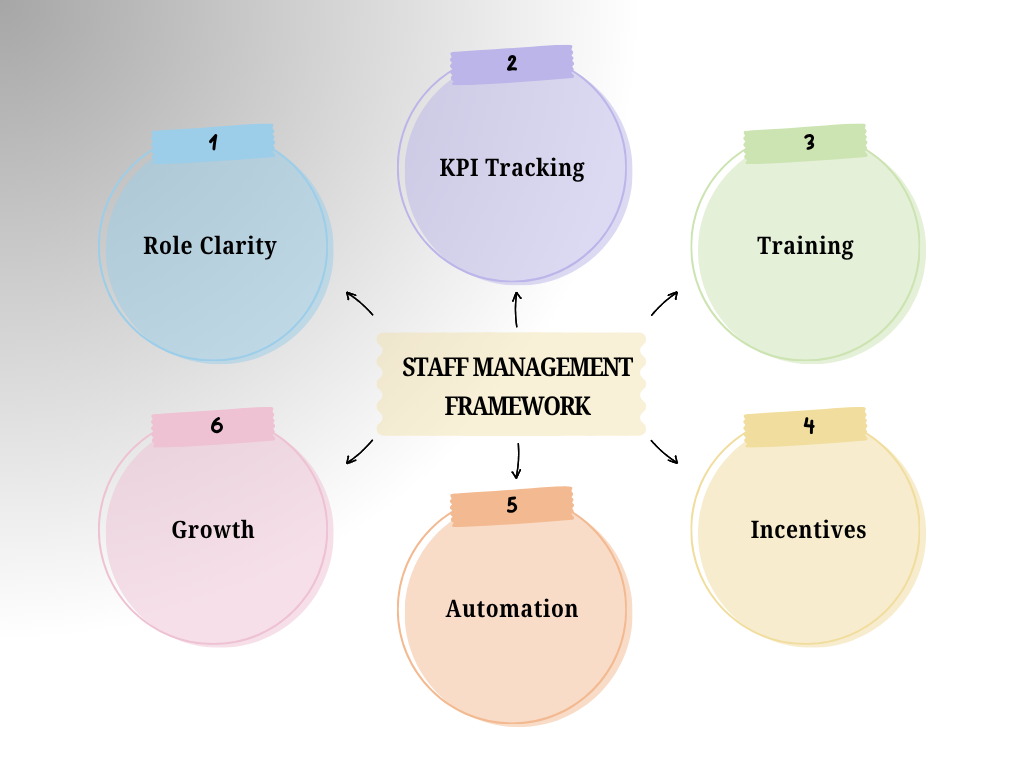
2. Salon Staff Performance Tracking: Manage Salon Staff Efficiently with Data
One of the biggest mistakes salon owners make is managing based on perception. A stylist who appears busy may not necessarily be profitable. A staff member who is popular may not be retaining clients long term.
Studies show that businesses using data-driven performance tracking see up to 20 – 25% improvement in productivity and staff retention.
Efficient management requires measurable visibility. The most critical performance indicators in a salon environment include:
- Revenue generated per staff member
- Average bill value
- Retail-to-service ratio
- Rebooking percentage
- Client retention rate
- Service time adherence
When these metrics are tracked consistently, patterns become visible.
Data shifts management conversations from assumption to clarity. Instead of saying “You need to improve,” you can say “Your rebooking rate is 38%, and our target is 60%. Let’s identify what’s affecting it.”
That level of precision builds professionalism and etiquette within the team.
TL;DR: Managing data helps identify real performance gaps. Metrics like rebooking rate and revenue per staff create clear, actionable insights.
If you’re still tracking staff performance in spreadsheets, you’re already falling behind.
3. Improve Salon Staff Productivity with a Strong Performance Culture
A performance culture balances expectations with enablement. Staff must understand not only what they are expected to achieve, but also how to achieve it.
This requires three structured elements:
- Defined Targets
Not general goals like “increase sales,” but measurable improvements such as raising average bill value by 15% or increasing retail attachment to 25% of serviced clients. - Skill-Based Training
Retail selling techniques, consultation frameworks, time management strategies, and objection handling must be trained deliberately, not assumed. - Transparent Incentives
Commission logic should be clear and consistent. When incentives feel unpredictable, motivation declines.
When staff see a direct connection between skill improvement, measurable targets, and financial growth, efficiency improves organically.
TL;DR: A performance culture connects clear targets, training, and incentives, helping staff improve consistently and stay motivated.
4. How to Manage Underperforming Salon Staff Effectively
Every salon will face performance gaps. The difference between stable salons and unstable ones lies in how those gaps are handled. Underperformance should be diagnosed before it is addressed.
- First, review measurable data. Has retail conversion dropped? Has attendance become inconsistent? Has rebooking declined?
- Second, identify whether the issue is skill-based or behavioral. A stylist struggling with retail may need structured selling training, not reprimand. A therapist exceeding service time limits may need workflow guidance, not criticism.
- Third, define an improvement timeline with measurable checkpoints. Instead of vague warnings, establish specific improvement metrics over a defined period.
This structured approach protects morale while maintaining accountability.
TL;DR: Identify whether issues are skill-based or behavioral, then fix them with structured plans instead of emotional reactions.
5. Use Salon Employee Management Systems to Improve Efficiency
Even strong teams perform poorly in chaotic systems.
Manual commission calculations create distrust. Paper attendance tracking creates inconsistency. Spreadsheet-based performance monitoring consumes time and introduces errors. Inventory mismanagement affects both service quality and retail sales.
Operational inefficiency often disguises itself as staff inefficiency. When processes are automated and centralized, team performance stabilizes. This is where structured salon management software becomes essential.
TL;DR: Simplifying operations through automation reduces errors, saves time, and allows staff to focus on delivering better service.
How MioSalon Helps You Manage Salon Staff Efficiently
As your salon grows, success depends more on systems than effort.
You can have skilled staff. You can have loyal clients. You can even have strong monthly revenue. But if your systems are fragmented, scheduling in one place, commissions in another, attendance tracked manually, and client history scattered inefficiency slowly erodes salon profitability.
| Challenge | MioSalon Feature | Outcome |
| Scheduling chaos | Smart calendar | Better utilization |
| No performance clarity | KPI dashboard | Accountability |
| Manual commissions | Auto calculation | Trust |
| Attendance issues | Leave tracking | Stability |
| Poor client context | CRM profiles | Better service |
This is where MioSalon changes the equation. It does not simply “organize” your salon. It centralizes operational intelligence. Even if you run a small 3 – 5 chair salon, these systems can be implemented step-by-step.
Let’s examine this deeply, feature by feature.
1. Intelligent Scheduling: Turning Your Calendar into a Revenue Engine
In most salons, the appointment book is treated as a passive tool. It records what is booked. In a structured salon, the appointment system actively shapes performance.
MioSalon transforms scheduling from a booking diary into a productivity control system.
- Skill-Based Allocation
Instead of assigning appointments randomly, you can map specific services to staff expertise levels. High-value treatments can be restricted to senior professionals. Junior staff can be gradually exposed to advanced services under structured planning.
This prevents two common problems:
- Senior staff being overbooked while juniors remain underutilized.
- High-revenue services being mishandled due to improper allocation.
It also allows you to design growth pathways. As staff upgrade their skills, service permissions can be updated within the system.
- Real-Time Availability and Visibility
Every staff member’s working hours, shift timings, and leave approvals are reflected directly in the calendar. This eliminates confusion at the front desk.
Instead of asking, “Is she available at 4 PM?” the system shows live availability. Instead of accidental double bookings, conflicts are prevented automatically.
This reduces friction between front desk and service staff, a common internal stress point in salons.
- Service Duration Intelligence
One of the most overlooked inefficiencies in salons is inaccurate service timing.
If a haircut is blocked for 30 minutes but consistently takes 45, the entire day gets delayed. If a facial is given a long buffer unnecessarily, revenue capacity is wasted.
MioSalon tracks actual service completion patterns. Over time, you can analyze:
- Which services overrun consistently
- Which staff complete services efficiently
- Where buffers need adjustment
2. Performance Dashboards: Replacing Assumption with Accountability
Most salon owners have a general idea of who performs well. But general ideas do not scale businesses. MioSalon creates structured performance visibility across the team.
- Individual Revenue Tracking
Every service billed is mapped to the staff member who performed it. This automatically builds a revenue profile for each individual.
You can analyze:
- Monthly revenue trends
- Growth or decline patterns
- Revenue comparison across team members
- Contribution percentage to total salon turnover
This clarity removes guesswork from recognition and promotion decisions.
- Retail Sales Monitoring
Retail is often the most underutilized profit stream in salons. Stylists may recommend products inconsistently because performance tracking is weak. With MioSalon, retail sales are linked to individual staff accounts. You can identify:
- Who consistently converts consultations into product sales
- Who avoids product discussions
- Which services generate the most retail attachment
Instead of broadly telling the team to “push retail,” you can coach specific individuals with specific data.
- Rebooking Rate Analysis
Client retention is the backbone of predictable revenue.
MioSalon tracks rebooking patterns, allowing you to see which staff consistently convert first-time visits into returning clients.
This metric alone can transform growth planning. High rebooking rates indicate strong consultation and relationship-building skills, which can be modeled across the team.
3. Commission Architecture: Building Trust Through Automation
Commission conversations can either strengthen loyalty or damage morale. Manual calculation creates room for doubt. Even small discrepancies can feel significant to staff.
MioSalon eliminates ambiguity by allowing you to define commission structures systematically.
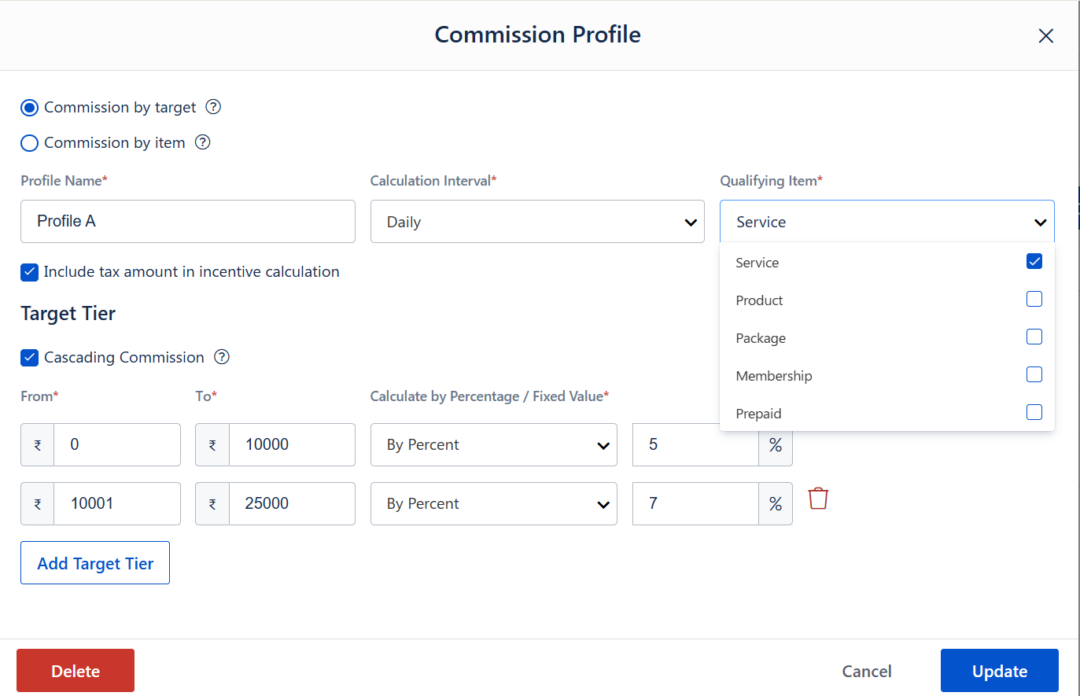
- Multi-Layer Commission Configuration
You can configure commissions based on:
- Service category percentages
- Revenue slabs (e.g., higher commission after crossing thresholds)
- Retail performance bonuses
- Target achievement rewards
These rules are embedded into the system. Once defined, calculations happen automatically based on actual billing data.
- Transparent Earnings Reports
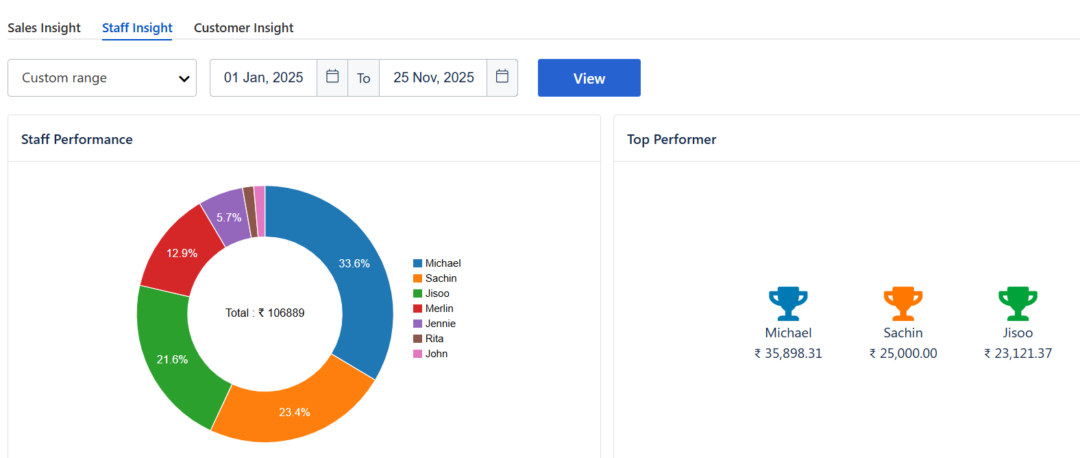
At the end of each cycle, earnings reports are generated clearly. Because the data is system-generated and traceable, discussions become factual.
4. Attendance and Leave Management: Protecting Operational Stability
In growing salons, attendance inconsistency can silently disrupt productivity. When shifts are managed verbally and leave approvals are informal, overlapping absences create stress for the remaining team.
MioSalon integrates attendance tracking directly into the operational system.
- Digital Leave Requests
Staff can submit leave requests within the system. Approvals are documented. The calendar updates accordingly.
This ensures:
- No accidental overlap of critical staff.
- Proper workforce planning during peak seasons.
- Accountability through record-keeping.
5. Client Intelligence: Empowering Staff with Context
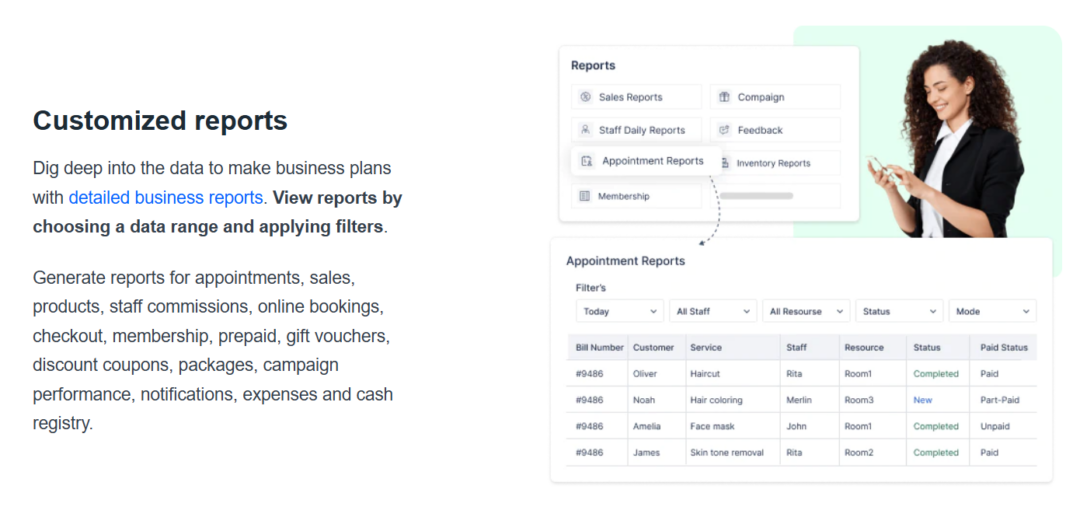
Staff efficiency improves dramatically when consultations are informed. MioSalon centralizes client profiles, including service history, product purchases, preferences, and notes for client management.
Before starting a service, a stylist can review:
- What treatments were previously done
- Which products were recommended
- Allergies or sensitivities
- frequency trends
This transforms consultations from generic to personalized. Because these outcomes are measurable within the system, you can directly connect structured client data to revenue growth.
6. Target Tracking: Turning Goals into Daily Momentum
Setting monthly targets is common. Tracking them consistently is rare. MioSalon allows you to define performance benchmarks and monitor progress in real time.
Instead of waiting until month-end to review performance, you can see:
- Percentage of target achieved
- Revenue gap remaining
- Retail milestone proximity
- Individual vs team comparisons
This visibility shifts motivation from reactive to proactive. Staff begin adjusting behavior mid-month rather than waiting for feedback. The system subtly drives urgency without constant reminders.
Before vs After Using a Salon Management System
| Without System | With MioSalon |
| Guesswork | Data-driven decisions |
| Manual tracking | Automated KPIs |
| Confusion in roles | Defined responsibilities |
| Commission disputes | Transparent payouts |
| Overbooking | Smart scheduling |
Conclusion
When roles are clearly defined, performance is measurable, incentives are transparent, and operations are centralised, salon management shifts from reactive to predictive.
Revenue becomes more stable because rebooking improves. Retail sales increase because recommendations are structured. Staff morale strengthens because compensation is transparent.
Most importantly, the owner transitions from daily firefighting to strategic leadership.
The best way to manage salon staff efficiently is not by increasing supervision, but by building systems that create clarity, accountability, and growth alignment.
Ready to move from reactive management to strategic control?
Book a Free Demo and explore how MioSalon can centralise your operations.
How to Get Started
1. Book a Free Demo – See MioSalon in action. Our team will walk you through the features that match your salon’s needs.
2. Personalised Onboarding – Once you’re ready, we’ll set up your account, import your data, and tailor the software to your services, team, and preferences.
3. Staff Training & Support – We’ll train your team to use the system smoothly, including appointments, payments, client records, and more.
4. Go Live – Start taking bookings, sending reminders, and managing your salon efficiently. You’re all set to shine.
Start your Free Demo and see how MioSalon helps you streamline appointments, staff schedules, and client communication, all while improving salon etiquette and experience. See how staff performance tracking improves salon revenue.
Want pricing info? Check out our Plans & Pricing
FAQs
1. What is the best way to manage salon staff efficiently?
The best way to manage salon staff efficiently is to define clear roles, track measurable performance metrics, implement transparent incentives, and centralize operations using salon management software.
2. How do you track salon staff performance?
Salon staff performance can be tracked using metrics like revenue per employee, rebooking rate, retail-to-service ratio, client retention rate, and service time adherence.
3. How can salon owners reduce staff conflicts?
Salon owners can reduce staff conflicts by setting clear responsibilities, automating commission calculations, maintaining transparent reporting, and ensuring structured scheduling systems.
4. Why is rebooking rate important in salon management?
Rebooking rate is important because it directly impacts revenue predictability, client retention, and long-term salon growth by ensuring repeat business.