

The Real Strategy Behind Achieving Monthly Salon and Spa Goals

Introduction:
Most salon and spa owners don’t fail because they lack passion. They fail because they confuse activity with strategy.
They set revenue targets. They announce promotions. They push staff to “sell more.” And at the end of the month, they either feel relieved they survived or frustrated they missed the numbers again.
Monthly goals in a salon business are not motivational slogans. They are economic commitments. They determine whether your rent, payroll, inventory costs, and marketing spend translate into real profit or just cash flow stress.
The truth is simple: A salon that consistently hits monthly goals operates on systems with a help of a salon management software, not emotion. This guide will walk you through what that actually means.
How do salons achieve monthly revenue goals consistently?
Salons achieve monthly goals by tracking key business drivers like active clients, visit frequency, average bill value, service profitability, and retail sales, then improving each metric using CRM, automation, staff performance tracking, and marketing ROI measurement.
Table of Contents :
- 1. How to Set Monthly Salon and Spa Revenue Goals Correctly
- 2. Client Retention Strategy for Monthly Salon Goals
- 3. How to Increase Average Bill Value in a Salon
- 4. Salon Operational Efficiency and Profitability
- 5. Staff Performance Tracking for Monthly Salon Goals
- 1. Smart Appointment & Scheduling Management
- 2. CRM That Drives Retention Instead of Random Visits
- 3. WhatsApp & Marketing Automation: From Promotion to Measurable ROI
- 4. Inventory & Consumption Control: Protecting Your Margins
- 5. Staff Performance & Commission Tracking
- 6. Advanced Reporting & Business Intelligence
- 1. Smart Appointment & Scheduling Management
- Final Thought:
1. How to Set Monthly Salon and Spa Revenue Goals Correctly
If your monthly goal is “₹10 lakhs this month” (or any number), that figure must be broken into controllable drivers. Otherwise, it’s just pressure. Revenue problems are usually retention problems.
Every salon’s revenue is powered by five core levers:
- Number of active clients
- Visit frequency
- Average bill value
- Service mix profitability
- Retail attachment rate
If you do not track and optimize each lever independently, you are managing blind. For example, imagine your revenue dropped this month. Without clarity, you might assume demand is down. But what if:
- Your new client count increased,
- Yet rebooking rates fell?
- Or footfall stayed constant,
- But the average bill value dropped because add-ons weren’t recommended?
Monthly goals must be reverse engineered. Instead of asking: “How do we hit ₹10 lakhs?”
Ask: “How many clients must walk in?”, “What must the average bill be?”, “How many of them must rebook?”, “What percentage should you buy retail?”.
When you quantify this, your target becomes operational not emotional.
TL;DR: Monthly revenue goals should be broken into measurable drivers like client count, visit frequency, average bill value, and retail sales instead of setting a single revenue target.
Revenue Formula:
| Revenue = Active Clients × Visit Frequency × Average Bill Value |
2. Client Retention Strategy for Monthly Salon Goals
Retaining existing clients is significantly more profitable than acquiring new clients. If your salon constantly depends on new walk-ins to survive, your business is fragile. The real monthly goal is not just revenue. It is the retention percentage.
A returning client:
- Costs less to acquire
- Spends more over time
- Refers more people
- Is less price sensitive
Yet most salons do not actively measure retention.
You should know:
- What percentage of first-time clients return within 45 days
- Which services have the highest drop-off
- Which stylists retain clients best
- How many clients are overdue for revisit
Retention is not built through random loyalty cards. It is built through systems:
- Automatic rebooking prompts
- Personalised service notes
- Follow-up messages after services
- Targeted reminders based on service cycles
- Taking feedback as a constructive criticism.
If you don’t proactively track and nurture these cycles, clients silently disappear. And no marketing campaign can fix a retention leak.
TL;DR: Retention is the most important driver of monthly revenue because repeat clients spend more, visit more often, and refer new clients.
3. How to Increase Average Bill Value in a Salon
Many owners believe upselling feels pushy. In reality, upselling is professional guidance when done correctly.
If a client comes for a haircut and you don’t recommend:
- A hair spa
- A strengthening treatment
- Or a take-home maintenance product
You are not protecting them from sales, you are limiting their results.
Average bill value grows when:
- Stylists understand client history
- Services are bundled intelligently
- Add-ons are suggested based on real need
- Retail recommendations feel educational, not transactional
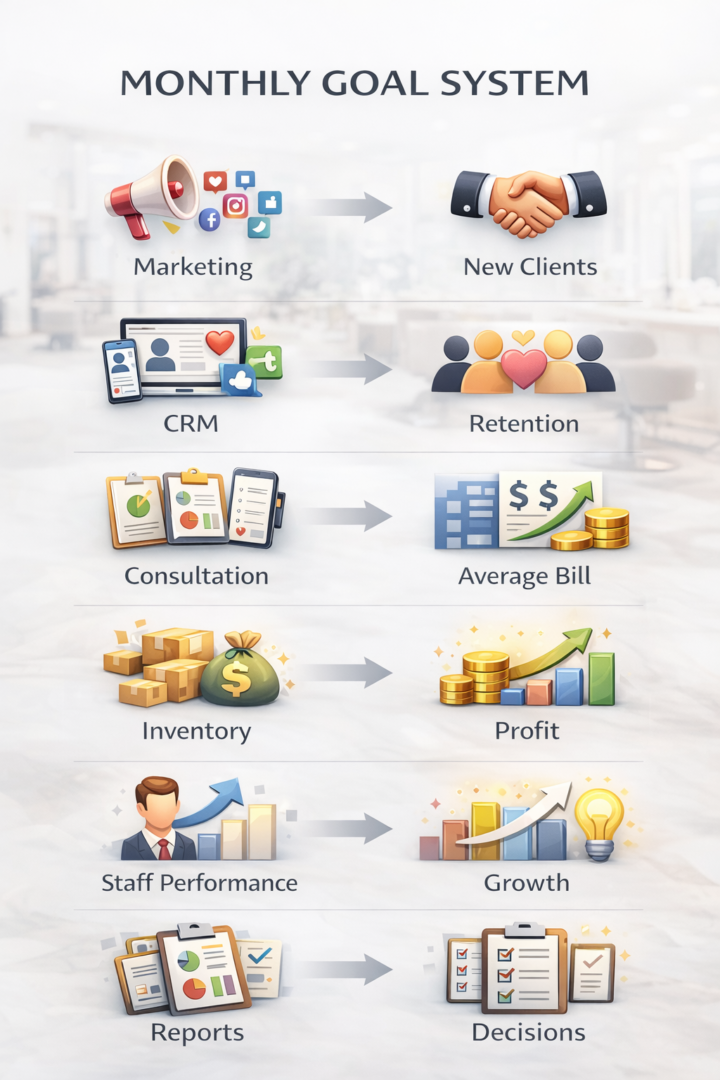
But here’s the truth: If your team cannot see client history instantly, upselling becomes guesswork. And guesswork rarely converts. Monthly growth depends on structured consultation systems not random suggestions.
TL;DR: Increasing average bill value through consultations, add-ons, and retail recommendations helps grow revenue without increasing footfall.
4. Salon Operational Efficiency and Profitability
You can increase revenue and still reduce profit. If your scheduling is inefficient, you lose billable hours. If your inventory is mismanaged, you lose margin. If your staff idle time is high, payroll drains profit.
Look at these operational questions:
- What is your daily chair utilization rate?
- How many gaps exist between appointments?
- How much product is consumed per service?
- How much stock expires monthly?
- Are staff incentives aligned with business goals?
Operational inefficiency is silent profit leakage. And most salons don’t see it because they don’t measure it.
TL;DR: Scheduling efficiency, inventory control, and staff utilization directly affect profitability and monthly goal achievement.
5. How to Track Marketing ROI for Salon Growth
Many salons invest in Instagram ads, influencers, WhatsApp promotions but cannot answer a simple question:
Which campaign generated revenue?
You should know:
- Cost per lead
- Conversion rate
- Revenue per campaign
- Client lifetime value from each channel
If you cannot track marketing ROI, you are guessing. And guessing is expensive. Marketing goals must connect to booking data. Otherwise, visibility does not equal profitability. Businesses that track KPIs regularly achieve goals more consistently.
TL;DR: Marketing should be measured based on bookings, revenue, and client lifetime value, not likes or engagement.
5. Staff Performance Tracking for Monthly Salon Goals
Your team must see the connection between their performance and business outcomes. If goals live only in the owner’s mind, they fail.
Monthly goals should translate into:
- Individual revenue targets
- Retail targets
- Rebooking percentages
- Client satisfaction scores
And these must be tracked transparently. When staff see numbers daily, they improve consciously. When numbers are hidden, performance becomes inconsistent.
TL;DR: When staff performance and incentives are linked to revenue, rebooking, and retail sales, monthly goals become achievable.
| Revenue Driver | What to Track | How to Improve |
| Active Clients | Monthly client count | Marketing & referrals |
| Visit Frequency | Rebooking rate | Reminders & memberships |
| Average Bill | Service + retail value | Upselling & bundles |
| Service Mix | High margin services | Consultation |
| Retail Sales | Product attachment rate | Recommendations |
How MioSalon Transforms Monthly Goals Into Measurable Results
Setting monthly goals is easy. Achieving them consistently is where most salons struggle. The gap is rarely about talent or effort. It is about systems.
When goals live in notebooks, spreadsheets, or verbal team meetings, they remain intentions.
This is exactly where MioSalon shifts the equation. It does not just record transactions. It converts operational activity into strategic clarity. Let’s break down how each core system directly impacts your monthly revenue, retention, margins, and performance.
| Business Goal | MioSalon Feature | Business Impact |
| Increase bookings | Online booking + reminders | Higher visit frequency |
| Improve retention | CRM + follow-ups | Repeat clients |
| Increase average bill | Client history | Better consultations |
| Protect margins | Inventory tracking | Lower product cost |
| Improve staff performance | Performance reports | Higher revenue |
| Track marketing ROI | Campaign reports | Better marketing decisions |
| Monitor growth | Business reports | Goal tracking |
1. Smart Appointment & Scheduling Management
Every salon’s primary asset is time. More specifically, sellable chair time.
If your salon operates 10 hours a day with 6 chairs, you technically have 60 billable chair-hours daily. But how many of those hours are actually monetized? Most owners don’t know precisely. They feel busy, but busy does not always equal optimize.
MioSalon’s scheduling system restructures this completely.
Eliminating Revenue Leakage
With MioSalon’s intelligent calendar interface, you see:
- Real-time stylist availability
- Accurate service durations pre-mapped in the system
- Live booking adjustments
- Clear visual representation of occupied vs. vacant slots
This visual clarity changes decision-making instantly. If you notice 3 – 5 PM consistently underperforming, you can push targeted promotions for that time window. If Saturday evenings are overloaded, you can redistribute staff strategically.
From Occupancy to Optimisation
Beyond basic booking, MioSalon allows you to:
- Track stylist utilization rates
- Identify peak and non-peak demand patterns
- Adjust staffing based on historical booking trends
This means scheduling stops being reactive and becomes predictive.
2. CRM That Drives Retention Instead of Random Visits
New client acquisition is expensive. Retention is profitable.
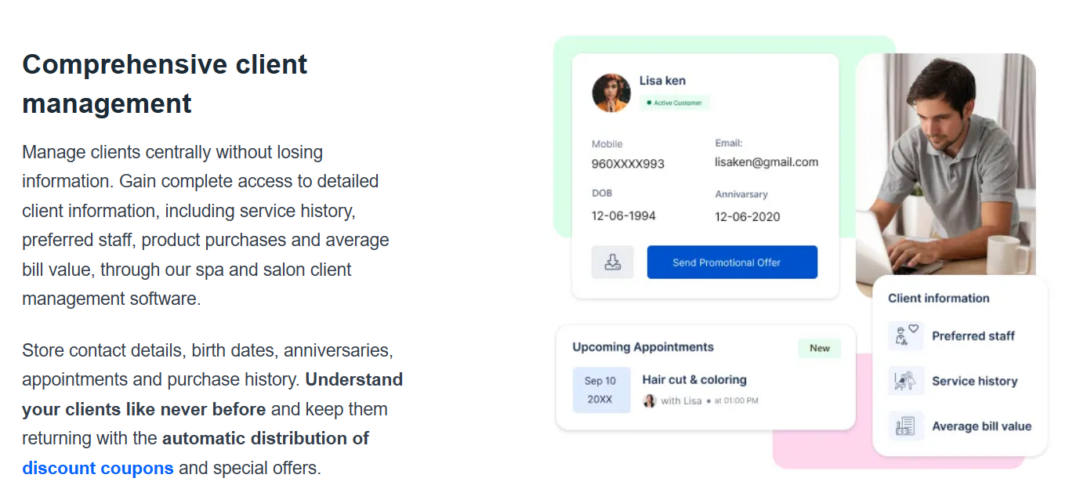
But retention does not happen because your team “remembers” clients. It happens because your system remembers everything. MioSalon’s CRM is not just a contact database. It builds behavioral intelligence around every client.
Complete Client Visibility
Each profile stores:
- Full service history
- Product purchase records
- Visit frequency patterns
- Preferred stylist
- Personal notes and preferences
- Spending behavior
When a client walks in, your team is not guessing. They know what was done last time, what product was recommended, and when the next revisit is ideally due.
This transforms consultation quality. Instead of generic questions like, “What do you want today?”, your team can say: “Last time you did a keratin treatment three months ago. Shall we schedule a maintenance session?”
That level of personalization increases trust and upselling success.
3. WhatsApp & Marketing Automation: From Promotion to Measurable ROI
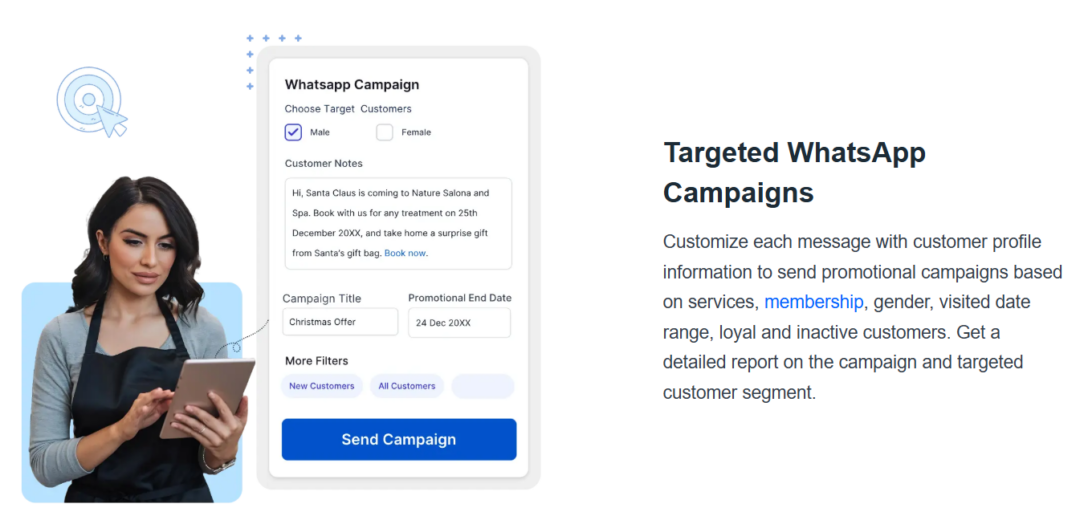
Most salons promote blindly. They send offers and hope for bookings. MioSalon integrates WhatsApp marketing directly into the operational ecosystem.
Precision Targeting
Instead of blasting generic offers, you can segment audiences based on:
- Service history
- Gender
- Spending capacity
- Visit gaps
- Loyalty tier
This means your facial promotion goes only to clients who previously booked skincare services. Your hair color campaign reaches those who color regularly. Marketing becomes relevant, not noisy.
Direct Booking Conversion
Each campaign can include:
- Direct booking links
- Automated reminders
- Follow-up nudges
The friction between seeing an offer and booking an appointment is reduced to a single click.
Real-Time Campaign Tracking
Here is where it becomes powerful.
You can track:
- Open rates
- Click rates
- Bookings generated
- Revenue attributed to each campaign
Now you know which campaigns drive revenue and which ones only generate engagement.
4. Inventory & Consumption Control: Protecting Your Margins
Revenue growth means nothing if margins are weak. Inventory mismanagement is one of the most silent profit killers in salons.
Without structured tracking, you face:
- Overstocking that locks working capital
- Emergency purchases at higher rates
- Unrecorded product usage
- Product expiry losses
- Internal pilferage
MioSalon addresses this at both macro and micro levels.
- Real-Time Stock Visibility
The system tracks:
- Live stock levels
- Product consumption per service
- Expiry alerts
- Reorder thresholds
- Vendor purchase history
When a hair spa service is performed, the mapped product quantity is automatically deducted from inventory. This connects service revenue directly with product consumption.
- Controlling Hidden Losses
You can identify:
- Services with higher-than-expected product usage
- Products that are underperforming in sales
- Fast-moving vs. dead stock
- Shrinkage patterns
This level of insight allows you to:
- Negotiate better vendor contracts
- Reduce over-ordering
- Standardize product usage across staff
- Protect gross margins
Inventory stops being an expense guess. And protected margins directly improve net profitability at month-end.
5. Staff Performance & Commission Tracking
Your team drives your revenue. But without transparent tracking, performance management becomes emotional rather than factual. MioSalon converts performance into visible metrics.
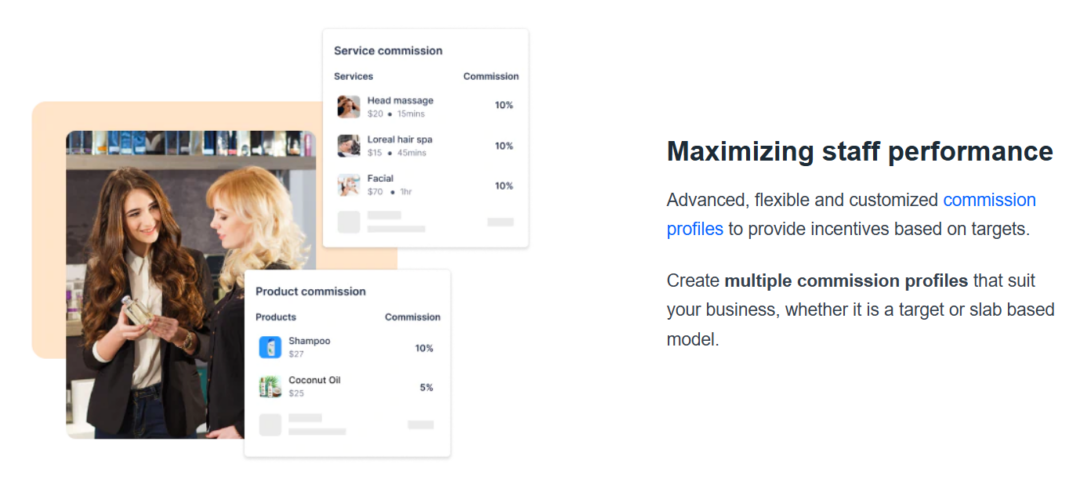
Individual Performance Dashboards:
The system automatically calculates:
- Revenue generated per stylist
- Service category contribution
- Product sales numbers
- Commission earnings
- Target achievement percentage
- Attendance records
This removes payroll confusion and manual calculation errors.
Performance Transparency
When stylists see:
- Their revenue contribution
- Their ranking within the team
- Their commission structure
- Their progress toward monthly targets
Motivation shifts internally. Instead of pushing staff verbally, you show them data. Healthy competition increases upselling. Upselling increases ticket size. Higher ticket size increases monthly revenue without increasing footfall.
Accountability becomes embedded into daily workflow and fair commission automation ensures staff trust the system.
6. Advanced Reporting & Business Intelligence
Many salon owners operate based on feeling.
- “It seems like we had a good month.”
- “Footfall looks decent.”
- “Product sales feel lower.”
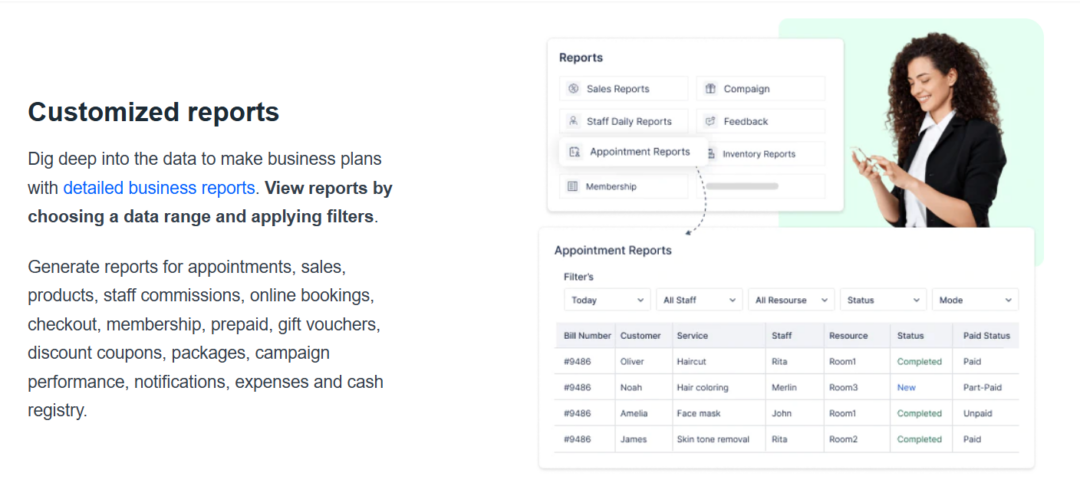
But feelings do not scale businesses, metrics do. MioSalon offers 13+ structured reports that convert raw data into decision-ready insight.
- Revenue & Trend Analysis
You can analyze:
- Daily, weekly, and monthly revenue trends
- Service category performance
- Peak revenue hours
- High-performing service bundles
This allows proactive adjustments mid-month instead of end-of-month panic.
- Client Analytics
You gain visibility into:
- Retention rates
- Repeat visit ratios
- Average ticket size
- Client lifetime value
- Dormant client lists
Instead of guessing why revenue dipped, you can see whether the issue is retention, pricing, staffing, or marketing response.
Final Thought:
Monthly goals are not just numbers, they are proof of leadership. If you are serious about building a salon or spa that grows consistently not occasionally it’s time to move beyond manual management.
MioSalon doesn’t just help you track your business. It helps you command it. And that’s the difference between surviving each month and scaling every month.
Are you ready to start leading it with clarity and control? If you’re serious about consistent growth, higher revenue, and smarter decisions, don’t leave it to chance.
Book a Free Demo with MioSalon today and see how you can turn every monthly goal into guaranteed progress.
How to Get Started?
1. Book a Free Demo – See MioSalon in action. Our team will walk you through the features that match your salon’s needs.
2. Personalised Onboarding – Once you’re ready, we’ll set up your account, import your data, and tailor the software to your services, team, and preferences.
3. Staff Training & Support – We’ll train your team to use the system smoothly, including appointments, payments, client records, and more.
4. Go Live – Start taking bookings, sending reminders, and managing your salon efficiently. You’re all set to shine.
Start your Free Demo and see how MioSalon helps you streamline appointments, staff schedules, and client communication, all while improving salon etiquette and experience.
Want pricing info? Check out our Plans & Pricing
FAQs:-
1. How can salons consistently achieve monthly revenue goals?
Salons achieve monthly revenue goals by breaking targets into measurable drivers like client count, average bill value, retention rate, and retail sales, then tracking them using structured systems instead of manual methods.
2. Why is client retention more important than new client acquisition?
Client retention is more profitable because returning clients spend more over time, cost less to market to, and increase referral potential, creating predictable monthly revenue.
3. How do you increase the average bill value in a salon?
Average bill value increases through structured consultations, intelligent service bundling, personalized add-on recommendations, and access to complete client history.
4. How can salons track marketing ROI effectively?
Salons can track marketing ROI by measuring campaign cost, booking conversions, revenue generated, and client lifetime value through integrated marketing and booking data.
5. What is the best way to manage monthly salon goals?
The best way to manage monthly salon goals is by using a salon management system that tracks appointments, retention, inventory, staff performance, and financial reports in real time.